Disclaimer
This article is not intended to be a detailed examination of the complex Islamic rules of inheritance – such a task is beyond the scope of any one article. The components of inheritance in Islam, its conditions, its causes, impediments, categories, types and allocated shares, require many years of deep study and examination under a qualified and competent teacher and within the parameters of one of the legal schools1 (at least in the first instance).
Rather, the purpose of this article is to explore the reasons why it is important to both study the rules of Islamic inheritance as well as seek professional advice (from a qualified scholar or fatwa council, as well as legal professionals) in order to draft a Will that can meet the requirements of Islamic law and be officially recognised by the law of England & Wales.
I intend to combine over two decades of studies in fiqh (Islamic Jurisprudence) with my knowledge of the law of England and Wales to provide both a brief overview of selected categories of heirs of Islamic inheritance – primarily from the perspective of the Hanbali Madhab (school of Islamic Jurisprudence), and to outline practical steps Muslims can take to plan how their wealth and assets can be administered upon death in accordance to Islamic jurisprudence while complying with UK domestic family law.
__________
Introduction
Most Muslims in the UK appear to be living in slightly less favourable economic circumstances when compared to the overall population. For example, a census report in 2021 conducted by the Office for National Statistics found that: Muslims were nearly four times more likely to live in overcrowded homes than the overall population of England and Wales; 45.6% of Muslims lived owner-occupied (compared with 62.8% of the overall population); 26.6% lived in social rented accommodation housing (compared to 16.6% of the overall population); and Muslims had the lowest percentage of people aged 16 to 64 years in employment (51.4% compared with 70.9% of the overall population)2.
However, despite this bleak picture, many Muslims in the UK are far from being poor. A groundbreaking report, ‘The Economic Contribution of British Muslims to the UK’s Growth and Prosperity, and the Risk of Exodus’3, published in 2024, found the following:
- British Muslims generate at least £70 billion annually for the UK economy.
- The British Muslim workforce contributes £42 billion, Muslim-owned businesses add between £16.3 billion and £24.7 billion, and charitable donations and volunteer time contribute an additional £2.4 billion.
- British Muslims are vital in public sectors such as the NHS, where they hold over 46,000 roles, making critical contributions to healthcare, transport, and education.
- The UK has emerged as the Islamic finance capital of the West, with UK-based Islamic banks controlling 85% of the total European Islamic financial assets, valued at £7.5 billion.
- However, the report also reveals that British Muslims are 50% more likely to consider emigration than the average Briton and affluent British Muslims, earning over £62,000 pa, are 75% more likely to contemplate leaving the UK.
This report highlights the immense economic contributions made by British Muslims and the potential economic risks posed by immigration due to rising religious discrimination and dissatisfaction. The report also, when compared to the Census report of 2021, sheds light on the fact that there are huge economic disparities within the Muslim community in the UK.
Therefore, regarding Muslims who have been blessed with wealth, it is important to ensure that this wealth is not lost and is adequately utilised to strengthen the Ummah first by ensuring that religious obligations regarding wealth are discharged. This includes fulfilling individual obligations like Zakat, which should be paid on time and to institutions that can distribute it properly; communal obligations like building masjids and madrasahs and ensuring that these are consistently provided for; and that recommended charity is paid as and when needs arise. And finally, that the rules of Islamic inheritance are strictly adhered to if one has any wealth to bequeath in his or her final act of justice in this life before returning safely back to Allah  , the Creator.
In this article, I want to explore the following topics before concluding with recommendations:
- Bequests and Wills;
- Categories of Heirs in Islamic rules of inheritance;
- Sharia vs UK law regarding inheritance; and
- Other matters that may hinder the application of the Islamic rules of Inheritance in the UK.
__________
SECTION I: BEQUESTS & WILLS
Waṣiyah is a verbal noun used to refer both to the act of bequeathing and to the bequeathed property itself4. It describes the declaration a person makes while they are still alive regarding their property. It also deals with the arrangements according to Islamic law to be carried out after their death. This is akin to a “will” in English law. Laws around inheritance in Islam are derived from instructions in the Qur’an and through the Sunnah of the Prophet Muhammad  .
.
Allah commands us in the Noble Qur’an to take care of our inheritance: 
“It is prescribed that when death approaches any of you—if they leave something of value—a will should be made in favour of parents and immediate family with fairness5. ˹This is˺ an obligation on those who are mindful ˹of Allah˺.” [Surah Al-Baqarah: 2;180]
Furthermore, Ibn Umar  reported Allah’s Messenger as saying:
“It is the duty of a Muslim who has anything to bequeath, not to let two nights pass without writing a will about it.” [Muslim]
Moreover, we learn from the Quran and Sunnah that when a person dies, they will be called to account for every major and minor action they did in this world, whether it was good or bad. They will be rewarded for their good deeds and punished for their bad actions.
The first stage of that reckoning is in the grave. In the grave, the first thing we will be asked is: Who was your Lord? What is your religion? Who is this man who was sent amongst you?6
Then on the Day of Resurrection, we will be brought to account for every major and minor deed. The first thing for which we will be brought to account for then, will be our prayer7.
On the Day of Resurrection, we will also be asked about other matters, including our wealth – how we earned it and how we disposed of it8.
So, the wise person should be keen to save themselves and prepare acceptable answers to these questions.
Rulings of Bequests
Scholars of all four of the schools of Islamic jurisprudence have opined that it is wajib (mandatory) for someone with wealth (i.e. property, savings, investments, pensions, etc.) and liabilities (e.g. debts) to write a will detailing them. In addition to the rights of people, some scholars state that the rights of Allah that have not been fulfilled should also be added, such as unpaid zakat, vows and expiations, as well as Hajj if the deceased did not perform the mandatory Hajj9.
However, they have argued that bequests are not recommended for those who have little or no money (and no liabilities). Despite this, those who have little wealth and have heirs who are poor, should not bequeath any portion of their estate because the heirs have a superior claim to it10.
The scholars also state that if someone has a significant estate and no liabilities, bequeathing is mustaḥabb (recommended)11.
Some scholars, on the other hand, including az-Zuhri, held that it is wajib on all people. They cited the Prophet’s saying:
“It is not permissible for any Muslim who has something to will to stay for two nights without having his last will and testament written and kept ready with him.” [Bukhari]
They also said that at first, it was agreed that the waṣiyah was obligatory, based on Allah’s saying:
“It is prescribed that when death approaches any of you—if they leave something of value—a will should be made in favour of parents and immediate family with fairness. ˹This is˺ an obligation on those who are mindful ˹of Allah˺.” [Surah AlBaqarah: 2;180]
They argued that the obligation that was abrogated only concerned bequeathing to heirs who were later given fixed shares by Allah , not to those relatives who do not inherit12.
The majority of scholars argued that some of the Companions did not have a will, and the others did not blame them for this13.
What Is The Best Amount to Bequeath?
Sa’d reported: The Prophet , visited me while I was ill in Mecca. I said, “I have some wealth. May I donate all of it?” The Prophet said, “No.” I said, “Half of it?” The Prophet said, “No.” I said, “A third of it?” The Prophet said, “Yes, a third, but this is still too much. That you leave your inheritors wealthy is better than leaving them dependent, begging for what people have. Whatever you spend on them is charity for you, even the morsel you feed to your wife.” [Bukhari]
This Hadith reported by Sa‘d indicates that the amount of a bequest is limited to 1/3 (one-third) of the entire estate. Scholars have all agreed on this as the maximum limit; however, they disagreed over the best amount: 1/3, 1/4, and 1/5 were all mentioned. The chosen position in the Hanbali school is 1/5 – this was reported in Sunan al-Bayhaqi to be the position of Abu Bakr and Ali , albeit with a controversial transmission. Ibn Qudâmah (rh) added in al-Mughni14 that this was the position of most of the Salaf (the earliest generations of the righteous followers of Islam)15.
A person should also appoint any sane, trustworthy Muslim man or woman as an executor (of the bequest) to perform acts that are within the scope of the legal capacity of the testator (the person who has made a will or given a bequest), such as: paying his debts, distributing his bequest, and looking after his children’s interests16.
__________
SECTION II: ISLAMIC RULES OF INHERITANCE
The subject matter of this knowledge, ‘ilm al-farâ’iḍ or ‘ilm al-mawâreeth (the science of inheritance), relates to the estate of the deceased. It is a division of fiqh (Islamic jurisprudence) that also requires an understanding of mathematics. For this reason, it is usually mentioned as a separate discipline by itself, and mastery of it is rare, even among scholars. Learning this science in order to accurately distribute the estate of the deceased justly among the heirs as prescribed by Allah is a farḍ kifayah (communal obligation)17.
It goes without saying that learning this extremely important science must be done under the guidance and supervision of competent and qualified scholars. Understanding the Islamic laws of inheritance must be combined with a study of the philosophical foundation of family in Islam and the distribution of rights and obligations, because exploring this topic in isolation will lead to a distorted understanding. For example, giving daughters half the share of the sons may sound unfair; however, when one considers the obligation upon men to be responsible for providing for women in the Muslim family, one will appreciate the overall fairness and justice when things are examined holistically18.
Do Islamic Inheritance Laws Favour Men Over Women?
This myth is due to a misconception derived from a misunderstanding of a part of a verse from the Qur’an where Allah says:
“Allah commands you regarding your children: the share of the male will be twice that of the female…” [Surah An-Nisa: 4;11]
However, this verse does not mean that men always receive more than women. Islamic inheritance laws are based on a wider, complex framework of Islamic finance grounded in financial responsibility. In this system, sometimes women receive less than men; however, there are also multiple cases where women inherit equal to19 or even more than20 men. All instances where there is a discrepancy between male or female heirs are when there is a difference in proximity between the heir and the deceased, or there is more of a responsibility of one party to provide for the other (e.g. men are obligated to financially support family members).
The objective behind the distribution of inheritance was to equalise all the recipients amongst the deceased’s family and treat women with justice and dignity21. So the idea that men always inherit more is an oversimplification; the reality is more nuanced, especially since there are several cases where women receive equal or greater shares of inheritance than men.
Islam was actually the first religion to assign women inheritance rights based on her responsibilities, and not her gender, as Allah said: 
“For men there is a share in what their parents and close relatives leave, and for women there is a share in what their parents and close relatives leave—whether it is little or much. ˹These are˺ obligatory shares.” [Surah An-Nisa: 4;7]
It is for these reasons that Professor Almaric Rumsey (1825-1899) of King’s College, London, who was the author of many works on the subject of the Muslim law of inheritance, said: “The Moohummudan law of inheritance comprises beyond question the most refined and elaborate system of rules for the devolution of property that is known to the civilized world, and its beauty and symmetry are such that it is worthy to be studied, not only by lawyers with a view to its practical application, but for its own sake, and by those who have no other object in view than their intellectual culture and gratification.22”
The heirs will inherit both the liabilities and assets of the deceased, but they are not required to pay off liabilities if they are more than the assets can cover, although it is recommended because the Prophet said23:
“A believer’s soul remains suspended (from joining his befitting station) by his debt until it is settled or paid off on his behalf.” [At-Tirmidhi]
Thus, accurate distribution of wealth through the Islamic rules of inheritance is from amongst the most important matters in Islam. This is why the Prophet encouraged Muslims to learn the rules of inheritance and teach them to others. He ) said:
“Learn about the inheritance and teach it, for it is half of knowledge, but it will be forgotten. This is the first thing that will be taken away from my nation.24”
Here, the Prophet refers to the rules of inheritance as “half of knowledge” because they contain most of the rulings that pertain to a human being in the state of death whilst the other rulings of fiqh pertain to how people should live life.
In another narration, he said:
“I am a mortal and knowledge will be taken away and trials will appear until (there would be) two persons who would differ about a case of inheritance and cannot find anyone to give a judgement.25”
Without doubt, what the Prophet said has now occurred as this branch of knowledge has been ignored and forgotten and is rarely taught to the average Muslim unless one undertakes formal training in the Islamic sciences in a well-known Islamic seminary or institute of higher education. It is crucial that as Muslims we revive this branch of knowledge in order to educate ourselves and preserve it in our communities, as it involves the rights of others, which is something that we will be questioned about on the Day of Judgement.
The Prophet also said:
“(Sacred) knowledge has three categories, anything else is extra; a precise verse, an established Sunnah, or a firm rule of inheritance.26”
Umar ibn al-Khattab said:
“Learn the rules of inheritance, for they are part of your religion.27”
Islamic rules of inheritance refer to shares allocated to legal heirs by the noble Qur’an – these are prescribed shares of the estate which are to be given to those who deserve them.
These laws ensure the correct distribution of the wealth of a deceased person. It is a right of those left behind among the deceased’s inheritors. Studying these rules entails learning how to divide an estate, its fiqh rulings, calculations and shares.
After death, the following order takes place with regard to the deceased’s wealth:
a) Firstly, we use it to spend on his funeral expenses;
b) Secondly, we use it to pay off any debts that the person may have towards people or Allah ;
i) those debts related to mortgages take preference over general debts;
ii) Debts to Allah include things like Zakah, Hajj, etc.
c) Thirdly, we execute the person’s will up to one-third of their wealth;
d) Finally, we distribute the remaining wealth to their inheritors according to fixed laws in the Qur’an and Sunnah28.
If any property remains after that, it is to be divided amongst their agnate29 relatives.
It is not permissible for anyone to try to change these laws of inheritance, which are decreed by Allah as He says: 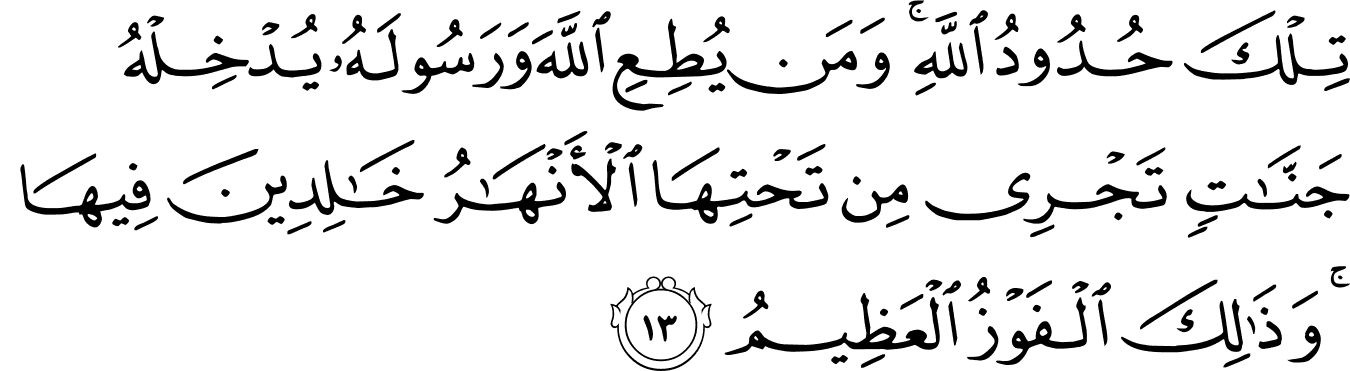
“These ˹entitlements˺ are the limits set by Allah. Whoever obeys Allah and His Messenger will be admitted into Gardens under which rivers flow, to stay there forever. That is the ultimate triumph! But whoever disobeys Allah and His Messenger and exceeds their limits will be cast into Hell, to stay there forever. And they will suffer a humiliating punishment.” [Surah An-Nisa: 4;13-14]
Regarding the tafsir of this verse, Imam ash-Shawkani states:
“The word ‘these’, in the aforementioned verse, refers to the laws of inheritance which are discussed in the two verses preceding these two verses mentioned above. Allah (swt) refers to these laws as ‘limits’ because it is impermissible to exceed the limits of these rules or violate them. The phrase ‘…and whoever obeys Allah and His Messenger…’ means: whoever obeys Allah and His Messenger in applying the laws of estate division or any other Islamic rulings, as implied by the general meaning of the phrase ‘…will be admitted by Him to gardens [in paradise] under which rivers flow…” 30
Imam ash-Shawkani then adds:
It is related by Ibn Majah on the authority of Anas that the Messenger of Allah said:
“If anyone disinherits his heir, Allah will deprive him of his share in Paradise on the Day of Resurrection.”31
Therefore, whoever changes any of the laws of inheritance and prevents them by either allowing an illegal heir to inherit, or disinheriting a legal heir or depriving a legal heir of his or her share, may themselves be forfeiting their place in Paradise as a result.
The Most Important Evidences Regarding the Islamic Rules of Inheritance
There are three verses from the Noble Qur’an and one Hadith of the Prophet that address the bulk of the issues of inheritance by designating the heirs, their shares and the approach to dividing the estate:
The three verses are from Surah An-Nisa:
The First Verse: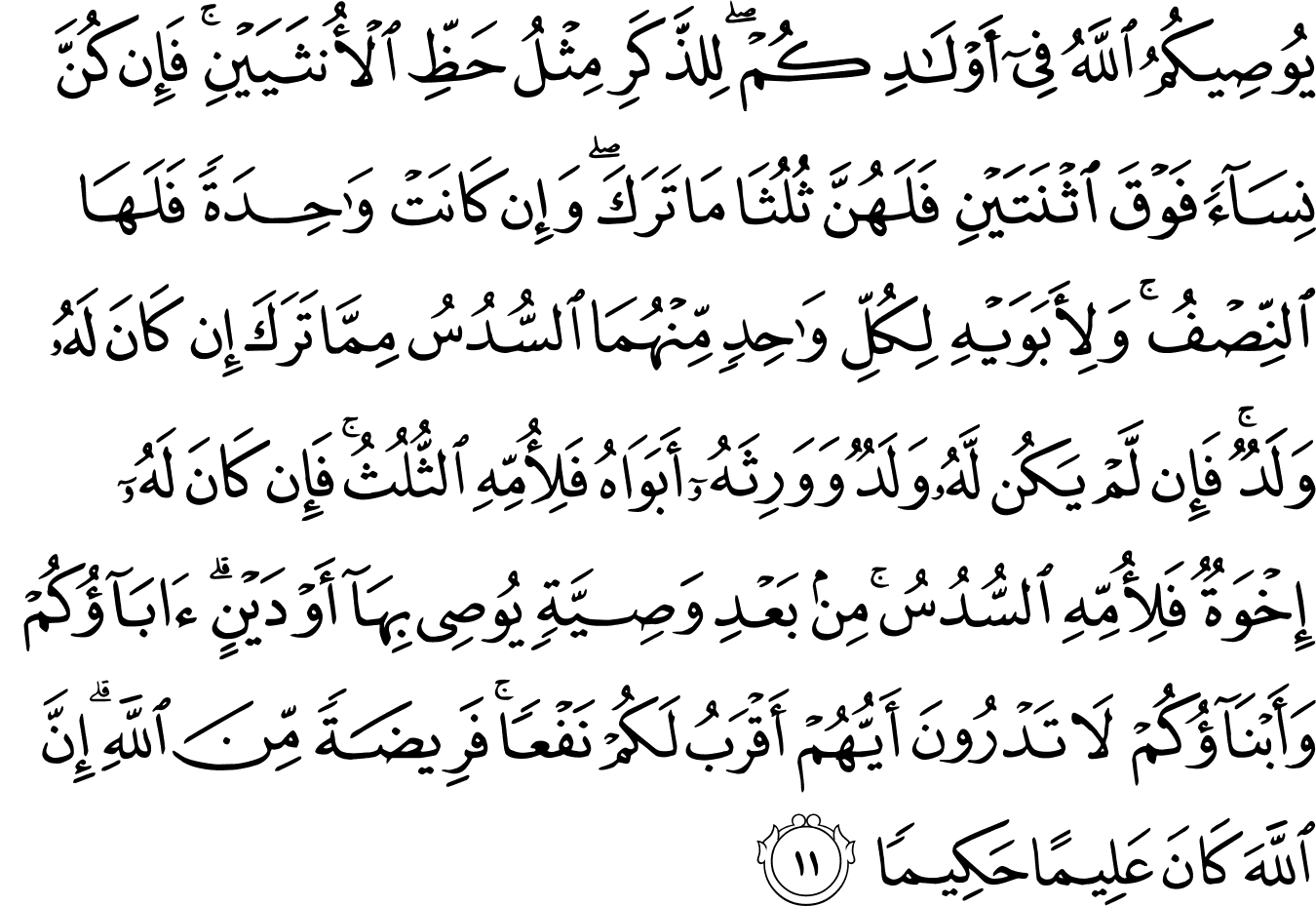
“Allah commands you regarding your children: the share of the male will be twice that of the female. If you leave only two ˹or more˺ females, their share is two-thirds of the estate. But if there is only one female, her share will be one-half. Each parent is entitled to one-sixth if you leave offspring. But if you are childless and your parents are the only heirs, then your mother will receive one-third. But if you leave siblings, then your mother will receive one-sixth—after the fulfilment of bequests and debts. ˹Be fair to˺ your parents and children, as you do not ˹fully˺ know who is more beneficial to you. ˹This is˺ an obligation from Allah. Surely Allah is All-Knowing, All-Wise.” [Surah An-Nisa: 4;11]
The Second Verse: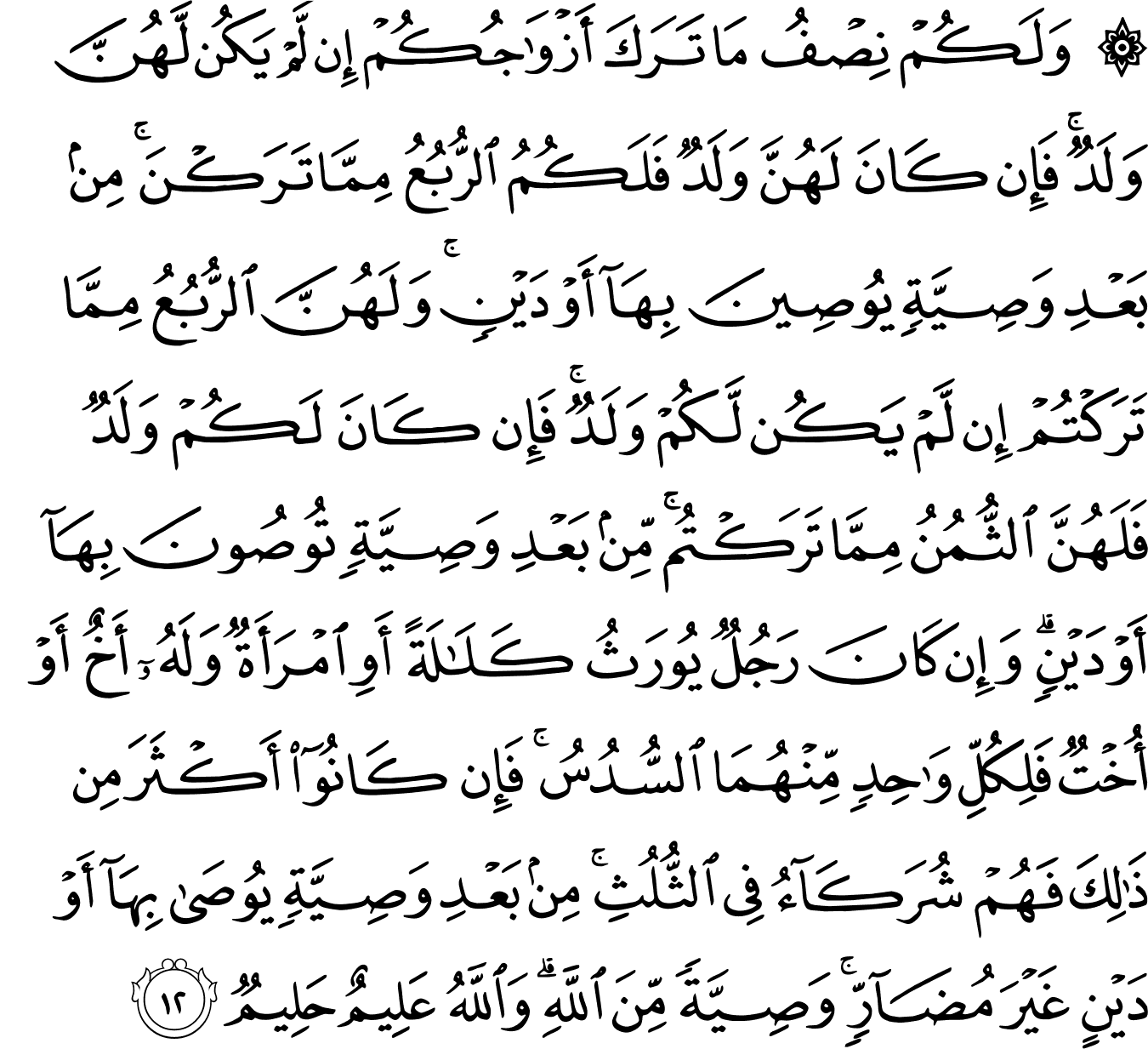
“You will inherit half of what your wives leave if they are childless. But if they have children, then ˹your share is˺ one-fourth of the estate—after the fulfilment of bequests and debts. And your wives will inherit one-fourth of what you leave if you are childless. But if you have children, then your wives will receive one-eighth of your estate—after the fulfilment of bequests and debts. And if a man or a woman leaves neither parents nor children but only a brother or a sister ˹from their mother’s side˺, they will each inherit one-sixth, but if they are more than one, they ˹all˺ will share one-third of the estate—after the fulfilment of bequests and debts without harm ˹to the heirs˺. ˹This is˺ a commandment from Allah. And Allah is All-Knowing, Most Forbearing.” [Quran: An-Nisa: 4;12]
The Third Verse: 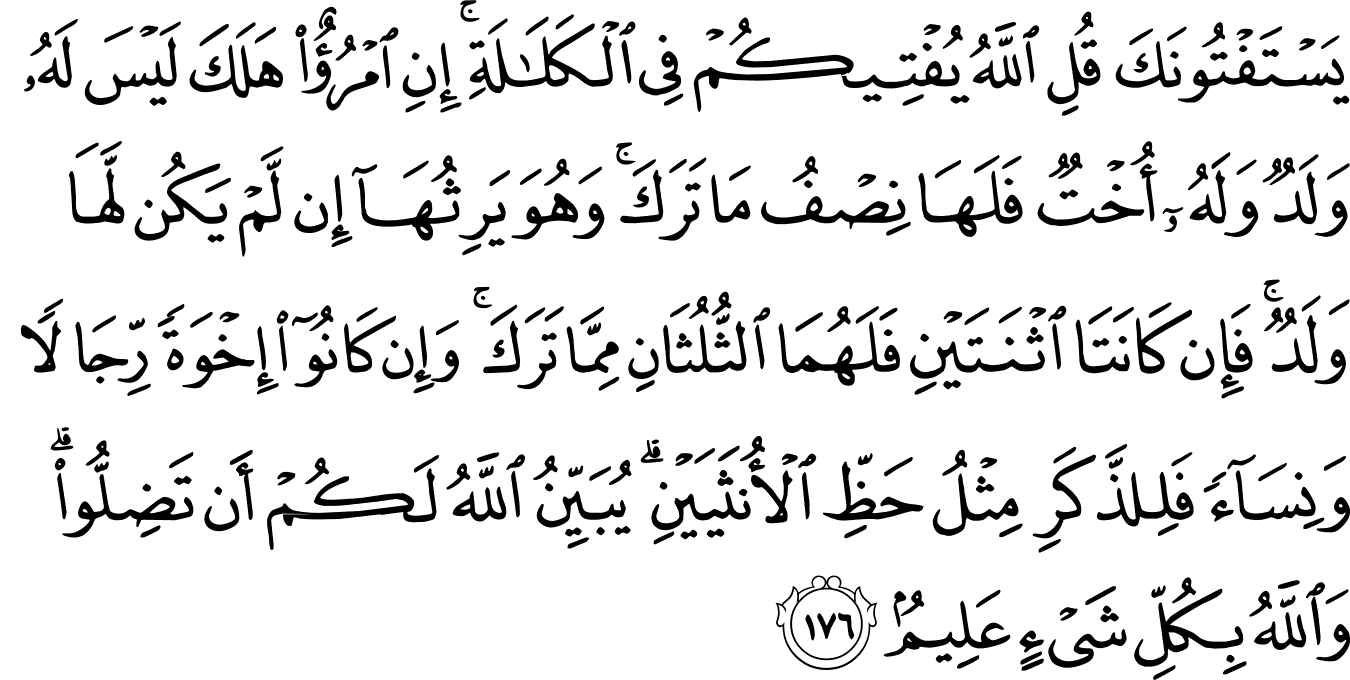
“They ask you ˹for a ruling, O Prophet˺. Say, “Allah gives you a ruling regarding those who die without children or parents.” If a man dies childless and leaves behind a sister, she will inherit one-half of his estate, whereas her brother will inherit all of her estate if she dies childless. If this person leaves behind two sisters, they together will inherit two-thirds of the estate. But if the deceased leaves male and female siblings, a male’s share will be equal to that of two females. Allah makes ˹this˺ clear to you so you do not go astray. And Allah has ˹perfect˺ knowledge of all things.32” [Surah An-Nisa: 4;176]
There is also an additional verse from the Qur’an that concerns blood relatives, though it is not explicit, where Allah says: 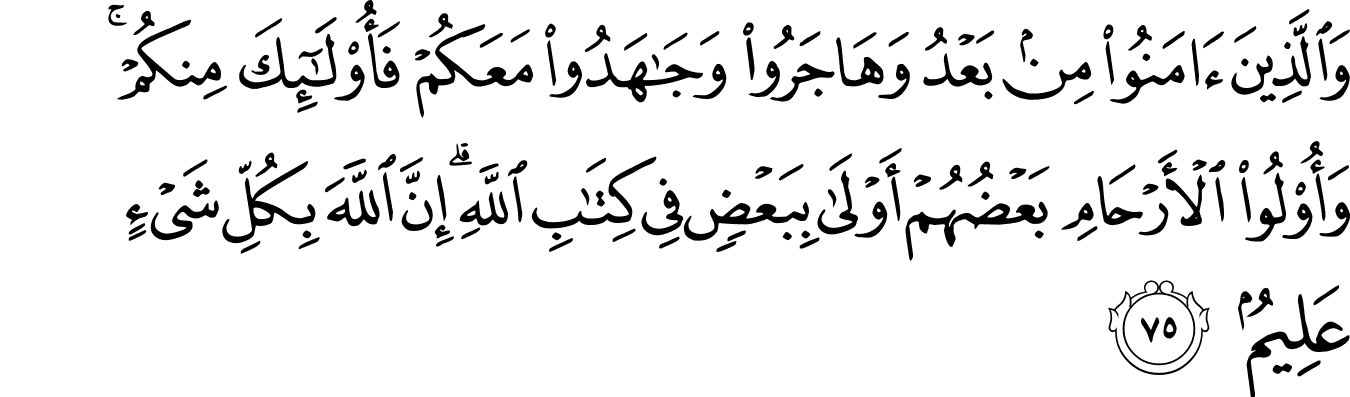
“And those who later believed, migrated, and struggled alongside you, they are also with you. But only blood relatives are now entitled to inherit from one another, as ordained by Allah. Surely Allah has ˹full˺ knowledge of everything.33” [Surah Al-Anfal: 8;75]
The Hadith of the Prophet :
As for the Hadith of the Prophet , Ibn ‘Abbās narrated that Allah’s Messenger said:
“Give the stipulated shares to their owners; what is left over goes to the nearest male heir.” [Muslim]
Summary of the Main Categories of Heirs
Below is a brief summary of some of the main categories of heirs in the Islamic rules of inheritance taken from Umdat al-Fiqh – a primary text of the Hanbali Madhab (school of law), written by Imam Ibn Qudamah al-Maqdisi34.
In the preface of his book Umdat al-Fiqh, Imam Ibn Qudamah said, “I included in it authentic narrations for their blessings and authority.” This was done to remind the student of knowledge that the spirit and foundation of this knowledge is the divine revelation (the Qur’an and Sunnah). The mere memorization of the rulings of different madhabs (schools of law) does not make one a Faqih (scholar of Islamic jurisprudence) until he or she knows their sources (proofs) and how they were deduced, and acts upon them with sincerity and devotion35.
CATEGORIES OF HIERS
The heirs belong to one of three categories:
- Dhoo Farḍ (heirs with designated shares)
- ‘Aṣabah (residuary heirs)
- Dhoo raḥim (other kin)
– First Category: Dhoo Fard – Primary Heirs with Designated Shares
Heirs with designated shares are 10:
[1&2] The spouses;
[3&4] The parents;
[5] The (paternal) grandfather;
[6] The grandmother;
[7] The daughters;
[8] The daughters of the sons;
[9] The sisters; and
[10] The maternal half-siblings.
– Second Category: ‘Asabah – Secondary Residual Heirs
Residual heirs are due to blood relationships – they inherit in the instance that there are first category primary heirs with designated shares. These include aunts and uncles, nieces and nephews and other distant relatives36.
– Third Category: Dhawi Arha’m (Other Kin)
These are the rest of the relatives or extended family who are neither: (i) first category primary heirs (with designated shares) nor (ii) second category secondary residual heirs (who are not entitled to a designated share). They may receive a share of the inheritance, only in the instance that there are no primary or secondary category heirs.
Hindrances to Inheritance
These include:
1) Difference in religious affiliation, meaning that the people of one religion shall not inherit from the people of another, because the Messenger of Allah said,
“The Muslim shall not inherit from the non-Muslim, nor shall the non-Muslim inherit from the Muslim,” [Muslim] and, “People of two different religious affiliations may not inherit from one another.” [Ibn Majah]
2) Killing (accidentally or intentionally); the killer shall not inherit from one whom he or she killed unjustifiably.
It was narrated from Abu Hurairah that the Messenger of Allah said:
“The killer does not inherit.” [Ibn Majah]
__________
SECTION III: ISLAMIC SHARIA VS UK LAW REGARDING INHERITANCE
Since there are strict and uniform interpretations and guidelines around inheritance, seeking professional help and advice when compiling an Islamic will is of utmost importance in order to fulfil the obligations of Islamic inheritance and make the will legally binding and enforceable in the UK.
As we have seen, in Islam, the Shariah outlines how inheritance is to be distributed after a Muslim’s death. These distribution laws are not something that can be amended according to individual preference. However, under the UK civil law, one’s estate and assets can be distributed according to an individual’s preferences as outlined in their will – this is the primary difference between an Islamic will and a conventional will.
An Islamic will is only acceptable as long as it is compliant with the Shariah, and binding as long as it is compliant with UK civil law. If an Islamic will is found to be invalid, a Muslim’s inheritance will be distributed in accordance solely with the rules of intestacy (i.e., the laws that apply in that particular land) – this, of course, differs from country to country.
Common Mistakes People Make Regarding Inheritance
- Leaving everything to one spouse or heir;
- Preferring one child over the other;
- Having assets and liabilities, but no will;
- Not taking adequate care to protect assets and their distribution upon death;
- Not maintaining the correct documentation in order to identify assets;
- Making a Will based on domestic law only; and
- Bequeathing more than a third of one’s entire estate to charity.
Consequences of Dying Without a Valid Will
- Without a Sharia-compliant Will, or any Will, one’s estate may be more complex and difficult to administer, as well as being costly;
- It will mean that assets will be distributed in accordance with the rules of intestacy in England and Wales, which do not include provisions for Sharia compliance
__________
SECTION IV: OTHER MATTERS THAT MAY HINDER THE APPLICATION OF THE ISLAMIC RULES OF INHERITANCE IN THE UK
-
The impact of marriage
In the UK, a legal/registered marriage entails that all assets will be equally divided37 on divorce or automatically transferred to the surviving spouse upon the death of one of them (in the absence of a valid Will). This can have a huge impact on how someone’s estate is administered on divorce or death. Therefore, expert advice from Sharia scholars as well as lawyers needs to be sought in order to determine how to protect one’s assets (so heirs are not adversely impacted) and that a person’s Will is always divided according to the Sharia whether in a divorce or death. Wills, Trusts, and Prenuptial agreements can be the best way to protect one’s assets against unintended divisions.
Nevertheless, this is a matter for Sharia Councils, Fiqh Academies and Lawyers specialising in Sharia-compliant Wills and Trusts.
-
The Cohabitation Rights Bill 202638
This Bill which is currently making its way through Parliament, is designed to shape the future of family law in the UK in order to better reflect modern society. When it becomes law, it will offer cohabiting couples a distinct and different set of rights from legally married couples, including enhanced legal rights, automatic inheritance rights and domestic abuse protection39. The bill is also considering making pre-nuptial agreements and post-nuptial agreements automatically legally binding.
This is a welcome move as it means that Muslims who are married according to Islamic law, with a valid Nikah ceremony (who have not had a civil marriage), will have greater rights and protections. This will strengthen the position of the Sharia council in determining matters related to marriage and may also lead to people taking the Islamic nikah more seriously, which may (hopefully) even lead to a reduction of divorces for petty reasons. This obviously excludes abuse or violence, which are legitimate grounds for divorce.
Despite the positives, the Cohabiting Rights Bill (when it becomes law), just like a legal civil marriage, will impact how someone’s wealth and estate are administered on death or divorce. Again, just as in the case of a civil marriage, wills, trusts and pre/post-nuptial agreements may be the best way to protect one’s assets against unintended divisions.
-
Workplace Pensions
Another matter for Fiqh Councils/Academies is the question of private pensions, which can be inherited by a surviving spouse. Private pensions can consist of: a lump sum; death in service payment; and a monthly pension (paid like a salary). Which (if any) aspect of these amounts must be given to heirs, and which part can a surviving spouse keep for themselves, is a question that needs to be determined by Sharia scholars and Fiqh Councils.
-
Life Insurance
Without getting into the Islamic ruling regarding commercial insurance that a person opts to pay for, some companies also offer their employees free life insurance as an ancillary company benefit (along with private health care, gym membership, etc.). The question to ask is, how do we treat life insurance payments (when paid out at the event of death)? Are they subject to the rules of inheritance, or is it to be treated like a ‘gift’ from a company to the surviving spouse?
__________
SECTION V: CONCLUSION & RECOMMENDATIONS
It can be seen that inheritance planning is extremely important for Muslims who have wealth that will remain after their passing. A properly drafted will can also help to avoid disputes and maintain peace after the death of a family member. If not dealt with correctly, inheritance can cause problems and quarrels among families.
Family members may feel they have been treated unjustly and not given their rights, and may harbour resentment towards those they feel have ‘taken their share’.
Inheritance planning ensures that one’s wealth and assets are fairly given to those who have rights to them.
It also means that the wishes of the deceased person are fulfilled, for example, if they wish for a certain portion of their wealth to be given as Sadaqah (charity).
By correctly preparing for one’s death, one is ensuring the well-being of one’s family and of the Muslim community at large.
Recommendations
For Individuals:
(i) Learn or, at the very least, familiarise yourself with the Islamic rules of inheritance;
(ii) Know who to ask (local Imam, Scholar, Fiqh/Sharia Council) and where to look (reputable organisations) for information regarding inheritance; and
(iii) Consult a solicitor/law firm who is experienced in writing Sharia-compliant and legally binding wills.
Mosques & Islamic Institutions:
(i) Educate your congregation regarding the importance of this topic and getting things right when it comes to inheritance planning;
(ii) Run courses at your local mosques to teach people about inheritance;
(iii) Da’wah organisations should make learning the rules of inheritance part of their teaching curricula together with other important subjects like aqeedah (theology), fiqh of worship and transaction, tafsir, Hadeeth, Arabic language, etc.
(ii) Since the science regarding the Islamic rules of Inheritance is very complex and detailed, it would be wonderful to see respected Islamic institutions and Fiqh/Fatwa councils create a tool (like Zakat calculators) or software where an individuals can input their details (heirs, financial assets and liabilities etc) and the software is programmed to divide the assets into their designated shares for the heirs. This could then be developed and refined to divide assets according to the rules and opinions of each of the established schools of law (Madhabs).
One such tool exists here: www.almwareeth.com
Allah knows best, and may His peace and blessings be upon our Prophet Muhammed , his Companions and all his family.
*****
BIBLIOGRAPHY
Books & Articles
- Al-Buhuti, Shaykh Mansur, ‘Shar Muntaha al-Iraadaat’ li al-Buhuti,’ (www.shamela.ws)
- Al-Fawzan, Dr. Saalih, ‘The Summary of Islamic Jurisprudence’ (al-Maiman Publishing House, 2011), Volume 2.
- Al-Fawzan, Dr. Saalih, ‘Shar mukhtasa ala matn zaad al-mustaqni’ (Dar al-Aasima, 2004), Volume 3.
- Al-Sa’di, Sheik Abdurahman bin Nasir, ‘Nur al-Basai’r wa al-Baab fi Ahkaam al-Ibadaat wa al-Mu’amalaat wa al-Huquq wa al-Adab’ (Dar Ibn al-Jawzy, 1420h).
- Al-Sa’di, Sheik Abdurahman bin Nasir, ‘Shar al-Qawa’id wa al-Usool al-Jaamia’ (www.moswarat.com).
- Al-Sa’di, Sheik Abdurahman bin Nasir, The Path of the Wayfarer (Manhaj al-Salikin), (The Islamic Literary Foundation, 2014 – translated from Arabic by S. ‘Abd al-Hamid).
- As-Shithry, Dr. Sa’d ibn Nasir, Shar Nur al-Basai’r wa al-Baab fi Ahkaam al-Ibadaat wa al-Mu’amalaat wa al-Huquq wa al-Adab (Dar Kunuz Ishbayliya, Riyadh 2014).
- Al-Haj, Dr. Hatem, ‘Umdat al-Fiqh Explained: A Commentary on Ibn Qudamah’s The Reliable Manual of Fiqh,’ Volume 2: Fiqh of Worship and Commerce (International Islamic Publishing House, 2019).
- al-Uthaymeen, Shaykh Saalih, ‘Shar Mumti ala zaad al-Mustaqni’ (Dar Ibn Jawzi, 2005), vol. 8
- Hollingsworth, Munazza (partner at RHJ Devonshire solicitors), ‘The Islamic Succession,’ (www.rhjdevonshire.co.uk).
- Khattab, Dr. Mustafa ‘The Clear Quran’ (theclearquran.org)
- Rumsey, Almaric, ‘Moohummudan Law of Inheritance and Rights and Relations Affecting It,’ (3rd ed. London: W.H. Allene, 1880. iii. Print.)
- Ash-Sawkaani, ‘Fathul Qadir’ (https://shamela.ws/book/23623)
- Siyech, Mohammed Sinan & Shah, Sofiah Laila, ‘The Economic Contribution of British Muslims to the UK’s Growth and Prosperity, and the Risk of Exodus’ (EQUI, 2024)
- Umar, Dr. Sajid, ‘Preserving a Legacy: Exploring Islamic Wills and their Profound Impact – Part I & II,’ (www.sajidumar.com, 2023)
Websites
- https://www.ons.gov.uk/peoplepopulationandcommunity/culturalidentity/religion/articles/religionbyhousinghealthemploymentandeducationenglandandwales/census2021
- www.qur’an.com
- www.islamicfinanceguru.com
- https://shamela.ws
- www.almwareeth.com
- www.islamicrelief.com
- www.islamqa.com
- www.islamicaid.com
- www.yaqeeninstitute.org
Lectures:
- Dr Hatem al-Haj, Fiqh of Inheritance, lectures 1 – 14 (Muslim Central, June 2020)
Related:
– To Buy Or Not To Buy, That Is The Question: An Analysis Of Possible Home Purchasing Options For Muslims In The UK
– So You Want To Become A Lawyer? [Part I] – On Faith, Duty, And The Legal Profession
1 The madhabs of Imam Abu Hanifa, Imam ash-Shafi’I, Imam Malik or Imam Ahmed (may Allah have mercy on them all)2 Religion by housing, health, employment, and education, England and Wales: Census 2021 (Office for National Statistics)3 Siyech, Mohammed Sinan & Shah, Sofiah Laila, ‘The Economic Contribution of British Muslims to the UK’s Growth and Prosperity, and the Risk of Exodus’ (EQUI, 2024)4 Al-Haj, Dr. Hatem, ‘Umdat al-Fiqh Explained,’ vol 2, p.155 . This ruling should be understood in light of the inheritance laws in 4:11-12, which give specific shares to parents and close relatives. Relatives who do not have a share may get a bequest of up to one-third of the estate.6 Abu Dawud in his Sunan (4753) and classed as authentic by Al-Albani in Sahih Abu Dawud, 2979.7 It was narrated from Abu Hurayrah (may Allah be pleased with him) that the Prophet (peace and blessings of Allah be upon him) said: “The first thing among their deeds for which the people will be brought to account on the Day of Resurrection will be prayer. Our Lord will say to His angels, although He knows best, `Look at My slave’s prayer, is it complete or lacking?’ If it is complete, it will be recorded as complete, but if it is lacking, He will say, `Look and see whether my slave did any optional prayers.’ If he had done voluntary prayers, He will say, `Complete the obligatory prayers of My slave from his voluntary prayers.’ Then the rest of his deeds will be examined in a similar manner.” ((Narrated by Abu Dawud, 864; classed as authentic by Al-Albani in Sahih Abu Dawud, 770)8 It was narrated from Ibn Mas`ud (may Allah be pleased with him) that the Prophet (peace and blessings of Allah be upon him) said: “The son of Adam will not be dismissed from before his Lord on the Day of Resurrection until he has been questioned about five things: his life and how he spent it, his youth and how he used it, his wealth and how he earned it and how he disposed of it, and how he acted upon what he acquired of knowledge.” (Narrated by At-Tirmidhi, 2422; classed as sound by Al-Albani in Sahih At-Tirmidhi, 1969)9 Al-Haj, Dr. Hatem, ‘Umdat al-Fiqh Explained,’ vol 2, p.1610 Ibid11 Ibid12 Ibid13 Ibid14 Ibn Qudâmah’s ‘Al-Mughni fee Fiqh al-Imam Ahmed ibn Hanbal ash-Shaybani’ is considered by many to be the greatest compendium of fiqh written in Islam; he mentioned the positions both within and outside the Hanbali school, citing the various textual and rational proofs. 15 Al-Haj, Dr Hatem, ‘Umdat al-Fiqh Explained,’ vol 2, p.1716 Ibid, p. 2917 Ibid, p. 3518 Ibid19 . See calculations according to ‘Umdat al-Fiqh’ when the deceased leaves Maternal siblings (brothers and sisters from the same mother)20 . See calculations according to ‘Umdat al-Fiqh’ when the deceased leaves a daughter and a father or if the deceased leaves two daughters and a father.21 . Do Islamic inheritance laws favour men over men?’ (www.yaqeeninstitute.org)22 Ibid23 Ibid, p. 3524 Sunan Ibn Majah (2719) [3/315] 25 At-Tirmidhi (2096) [4/413] and Ibn Majah (54) [1/41]26 Abu Dawud (2885) [3/207], and Ibn Majah (54) [1/41]27 Ad-Darimi (2744) [2/779] and Ibn Abu Shaybah (31025) [6/241]28 As-Shithry, Dr Sa’d ibn Nasir, ‘Shar Nur al-Basai’r wa al-Baab fi Ahkaam al-Ibadaat wa al-Mu’amalaat wa al-Huquq wa al-Adab.’ p. 357 – 35829 Agnate relatives are those related on or descended from the father’s or male side. 30 Fathul Qadir (https://shamela.ws/book/23623)31 Ibn Majah (2703) [3/304] and Abu Shaybah (31032) [6/242]32 This verse is placed at the end of the sûrah and not with similar verses at the beginning to connect the end of this sûrah with the next one or, according to Al-Fakhr Ar-Râzi, either to tie the end of the sûrah with its beginning for emphasis, as found in 20:2 and 124 as well as 23:1 and 117, or to emphasize Allah’s knowledge, just like the first verse emphasizes His power.33 This verse ended a previous ruling that allowed inheritance between Muslims from Mecca (Al-Muhâjirûn, the Emigrants) and Muslims from Medina (Al-Anṣâr, the Helpers). Now, only relatives can inherit from one another, whereas non-heirs can receive a share through bequest, up to one-third of the estate.34 . Abu Muhammed, Abdullah ibn Ahmed ibn Qudamah al-Maqdisi (d. 620 AH / 1223 CE) was the most distinguished author of Hanbali fiqh and the most verified scholar of the madhab. 35 Al-Haj, Dr. Hatem, ‘Umdat al-Fiqh Explained,’ vol 2, p.1536 Umar, Dr. Sajid, ‘Preserving a Legacy: Exploring Islamic Wills and their Profound Impact – Part II.’ 37 50/50 is the starting point; however, the Courts will consider many other factors before ruling on a final settlement.38 https://www.gov.uk39 https://ericrobinson.co.uk
The post Rules Of Islamic Inheritance: Dispensing One’s Final Act Of Justice In This Life appeared first on MuslimMatters.org.

 Michael Sanders (Armie Hammer) walks into a hospital room to “talk sense” into a rape victim
  BNP canvassers in Burnley, 2012