Darius awakens to discover the guards have been betting on him; Weili makes a plea; and Longwei reveals a frightening secret.
Read Part 1 | Part 2 | Part 3 | Part 4 | Part 5 | Part 6 | Part 7 | Part 8 | Part 9 | Part 10 | Part 11 | Part 12 | Part 13 | Part 14 | Part 15 | Part 16 | Part 17 | Part 18 | Part 19 | Part 20 | Part 21 | Part 22 | Part 23 | Part 24 | Part 25
* * *
Questions
My fellow guards helped me onto Belly. I was grateful for it. My back was burning again, my calf throbbed where the poisoned arrow had gone through it, and the man who had tried to strangle me had apparently bruised every part of me that the Afghans and Captain Karim had neglected.
We rode back toward the wagons, and before we had even reached them, men began coming out from beneath the awnings. Someone must have carried word ahead of us, because by the time I dismounted, with two guards helping me down, half the caravan seemed to know that something had happened.
Memdooh was among the first to reach me. “Darius! We heard you killed two men!”
“Are you alright?” Meilin demanded. She took one look at my face and answered her own question. “No. Obviously not.”
I studied her for a moment. Her arm was still in a sling, but aside from that she was her usual sturdy, slightly chubby, oddly athletic self. In any other context, with a different set of clothing, she could have passed for a farm wife. So this woman had offered to take half my lashes…
I must have been smiling, because Meilin said, “Why are you grinning like an idiot?”
“Who were the men?” Memdooh asked. “Why did they attack you?”
“They didn’t. I attacked them.”
Memdooh blinked. “Of course you did.”
Before I could explain, Corporal Bao pushed his way through the gathering crowd. A number of the other guards came with him, all non-Muslims. They surrounded me closely, pushing my Muslim friends to the rear. There was something strange about the expectant way they looked at me. I couldn’t put my finger on it. They seemed unusually interested.
“Let him speak,” Bao said.
The men fell silent.
I looked around at them. They looked back at me.
My entire body hurt. I was hot, exhausted, hungry, and missing the pistachios I could have had, and I had just learned that I was somehow in Persia and had apparently saved the son of the Shahanshah from two assassins.
I looked around at the men and raised my hands questioningly. “What?”
Bao smiled encouragingly. “Nothing. You must have questions.”
Questions… Yes. I did. “How is Gulnur?”
Three or four men immediately shouted in triumph. “Yes!” – “I told you!” – “Hand it over.” Several others groaned.
I stared at them. “What?” I said again, feeling indeed like the idiot that Meilin called me.
“Nothing,” Bao said quickly. “Gulnur is much better. Hakim Yusuf says she will live.”
“Alhamdulillah. That’s great.” Then I remembered what Captain Karim had told me. “I can’t believe we’re in Persia. How long was I asleep?”
This produced a much larger reaction. Men shouted, groaned and slapped one another on the back. One man cursed. Another raised both hands victoriously. Some men handed coins to others.
“Three days!” Bao said.
I forgot the strange behavior immediately. “Three days? SubhanAllah.” I ran my hand over my close-cropped hair. It was a weird sensation, but not unpleasant. Three days? I remembered drinking the medicine Hakim Yusuf had given me, then lying back and thinking that I wasn’t sleepy. After that there was nothing. That opium was powerful stuff. I resolved at that moment that I would avoid taking that drug again except in the most extreme circumstances.
I looked at Belly. He stood beside me with his head down, looking as tired as I felt. “Who took care of Belly?”
This caused an uproar. “That counts!” – “No, it doesn’t!” – “He asked about the horse!” – “He asked who took care of the horse. That’s not the same thing.” – “Of course it’s the same thing!” – “No! Asking if Belly is well is asking about Belly.”
Belly had raised his head at the sound of his name. I stroked his neck, feeling the pain in my back as I did so. He’d saved my life, not for the first time. If I ever went home, this horse was going with me. I would never part from him.
Corporal Bao raised both hands. “Quiet! Quiet!”
I frowned. “What are you all arguing about?” The sun and the exhaustion were starting to get to me. I noticed that my hands were trembling.
“Longwei, Meilin and Memdooh took turns caring for him,” Bao said. “He gave them trouble.”
“He gives everyone trouble,” someone said.
Thirty To One
Another non-Muslim guard pushed forward. “Darius, is there anything else you want to ask?”
A second man immediately shouted, “Don’t prompt him!”
“I’m not prompting him!”
“Let him speak!” Bao shouted again, and they all fell silent, staring at me like ravens watching a dying fox. I was beginning to think the opium had damaged my mind.
A guard near the back called, “What about Weili?”
Men shouted in protest, and Bao again yelled for them to shut up. They quieted, although several continued glaring at the man who had mentioned Weili.
I shook my head. “I don’t care about that.”
A tremendous groan rose from half the men, while the other half erupted in cheers. They turned to each other in huddles, passing something back and forth.
“What is wrong with all of you?” I demanded.
“Wait!” Memdooh cried.
He forced his way through the crowd and seized my arm, then apparently remembered that I was wounded and let go. “Captain Karim!” he shouted. “Captain! Come here!”
Karim had been speaking with Ahmed a short distance away, ignoring this whole hubbub. He turned.
“What?”
“Darius wants to talk to you.”
I frowned. “I do?”
Karim looked annoyed, but he came over as the guards parted to let him through.
I hadn’t intended to speak to him just then, but there was in fact something I had been wondering about.
“I heard you only gave me seven lashes.”
The crowd became utterly silent.
Karim studied me. “That’s right.”
“You sentenced me to ten.”
“I am aware.”
“I want the other three.”
For one heartbeat there was no reaction at all.
Then Memdooh went insane. “YEEEEESSSSSS!” He jumped into the air, both fists raised. “THIRTY TO ONE! I WON! THIRTY TO ONE!”
The crowd exploded. – “No!” – “You’ve got to be kidding me!” – “Who would ask for three more lashes?” – “I told you he was crazy!”
Memdooh was dancing now, his recently wounded leg seemingly forgotten. “Thirty to one! Pay me! All of you, pay me!”
I stared at him as men began reaching reluctantly into their purses. I was becoming genuinely angry now. I felt that everyone was playing some kind of ugly trick on me, and I was not in the mood at all.
“What are you talking about?” I demanded. “Memdooh?”
The young poet held out both hands as coins began dropping into them. “I won!”
“Won what?”
“The betting pool.”
Who Bet On Me Dying?
I looked at Corporal Bao, but he only shrugged.
I gave Memdooh a look that, if looks were iron, would kill. “You were betting on me?”
“On what you would say when you woke up,” Memdooh explained happily. Men continued to drop coins into his hands. “How long were you asleep, that was one. Gulnur was another. Belly. Weili. How’s Meilin’s arm? How is Memdooh’s leg? Did we recover anything from the Silk Store? One man bet you would ask for food.”
“I didn’t say half of those things.”
“Yeah, those people lost.” He began counting his coins.
“And you…” I swallowed hard. I could feel the anger growing in my chest, as hot as the sun above our heads. “You bet that I would ask Captain Karim for the other three lashes?”
Memdooh beamed. “Nobody else thought of it.”
I looked at Corporal Bao. “You organized this?”
For the first time he seemed to become aware of my rage. He held up a hand. “It was an innocent game.”
I stepped forward and seized Bao’s tunic with both hands. My fingers tightened and I brought my face close to his. I heard people saying, “Hey, whoa, no!”
“So you think my pain…” My breath was coming hard now, my nostrils wide. Corporal Bao was of Mongolian stock, and while short, his body was compact and powerful. Yet when he tried to pull away from me, he could not. As for me, all my pain had vanished. I felt all the muscles of my body working together, connected like links in a chain. My father used to say that we bring power up from the ground and transmit it through the legs, then the core, then the torso, and when we do this we become as immovable as a tree, or as irresistible as a charging elephant.
“Let me go!” Bao shouted, a note of panic in his voice.
I tightened my grip. “You think my pain, and injuries, and KILLING TWO MEN are amusing?” I brought my mouth to his ear and whispered. “Who bet on me dying? And who bet on me beating you to a pulp?”
Ahmed stepped close, as if the three of us were confidantes sharing a secret. Yet when he spoke he said, “Memdooh?”
I shot him a confused glance.
“Yes?” Memdooh replied.
“Gambling is haram, is it not? Darius, do you remember the ayah?”
I looked at Ahmed again puzzled. My grip on Bao loosened. “Al-Maidah,” I answered. “You taught me that when people were gambling on the archery contest. ‘O believers! Intoxicants, gambling, idols, and drawing lots for decisions are all evil of Satan’s handiwork. So shun them so you may be successful.’”
“No no no,” Memdooh protested. “This is not gambling.”
Ahmed, still looking at me, raised an eyebrow. “Indeed it is. Right, Darius?”
“I guess.”
“It’s a game,” Memdooh insisted.
“Did you wager money on an outcome you could not know or control?”
Memdooh looked down at the coins in his hands. His shoulders slumped.
Ahmed spread his hands. “That is haram money.”
“What’s the matter with all of you?” Hakim Yusuf came storming through the crowd, as men hastily moved out of his way. “Can’t you see this boy is wounded and exhausted? Go on with your work!”
The crowd scattered. Yusuf took one look at me and paused. “Darius,” he said softly. “You know who I am, right?”
I gave him a faint smile. “Yes.”
“We’re friends, right?”
“Right.”
“Let go of Corporal Bao.”
“Oh.” I opened my hands. “Of course.” I met Bao’s shaken gaze, then patted his chest. “Sorry.”
Suddenly my entire body sagged, and Hakim Yusuf caught me as my legs turned to jelly. Captain Karim rushed forward and helped him lead me to the medical wagon. Behind us, I heard Memdooh complain to Ahmed.
“What am I supposed to do with the money?”
“That,” Ahmed replied, “is an excellent question.”
No Opium
Hakim Yusuf washed the blood from my face and neck first, including some that had somehow gotten into my ear. Most of it belonged to the assassin Belly had bitten, though some was mine. Then he unwound the bandages from my back and made a sound through his teeth.
“What?”
“You’re supposed to let your wounds heal, Darius, not open them up again. Maybe you thought I needed more practice.”
“Sorry.”
“Don’t apologize, I’m just teasing. I know you did what you had to do.”
Several of the lash wounds had torn open during the fight. Yusuf washed them carefully with warm water, then disinfected them with one of his medicines. That hurt badly enough that I gripped the sides of the cot and clenched my teeth. When he finished cleaning them, he prepared his needle and thread.
“No opium,” I said. “I don’t want to sleep another three days. That stuff is crazy.”
He smiled. “No worries. I can numb the skin locally.”
The anesthetic did its job and I lay still while he stitched me up. The wagon was hot despite the open flaps, and outside I could hear the ordinary sounds of the caravan: men calling to one another, horses snorting, someone hammering on wood.
When Yusuf finished, he spread ointment over the wounds and wrapped my torso in fresh bandages. Then he brought me a bowl of rice and lamb cooked until both were soft, along with bread and water. I ate everything.
A Heron In a Rice Paddy
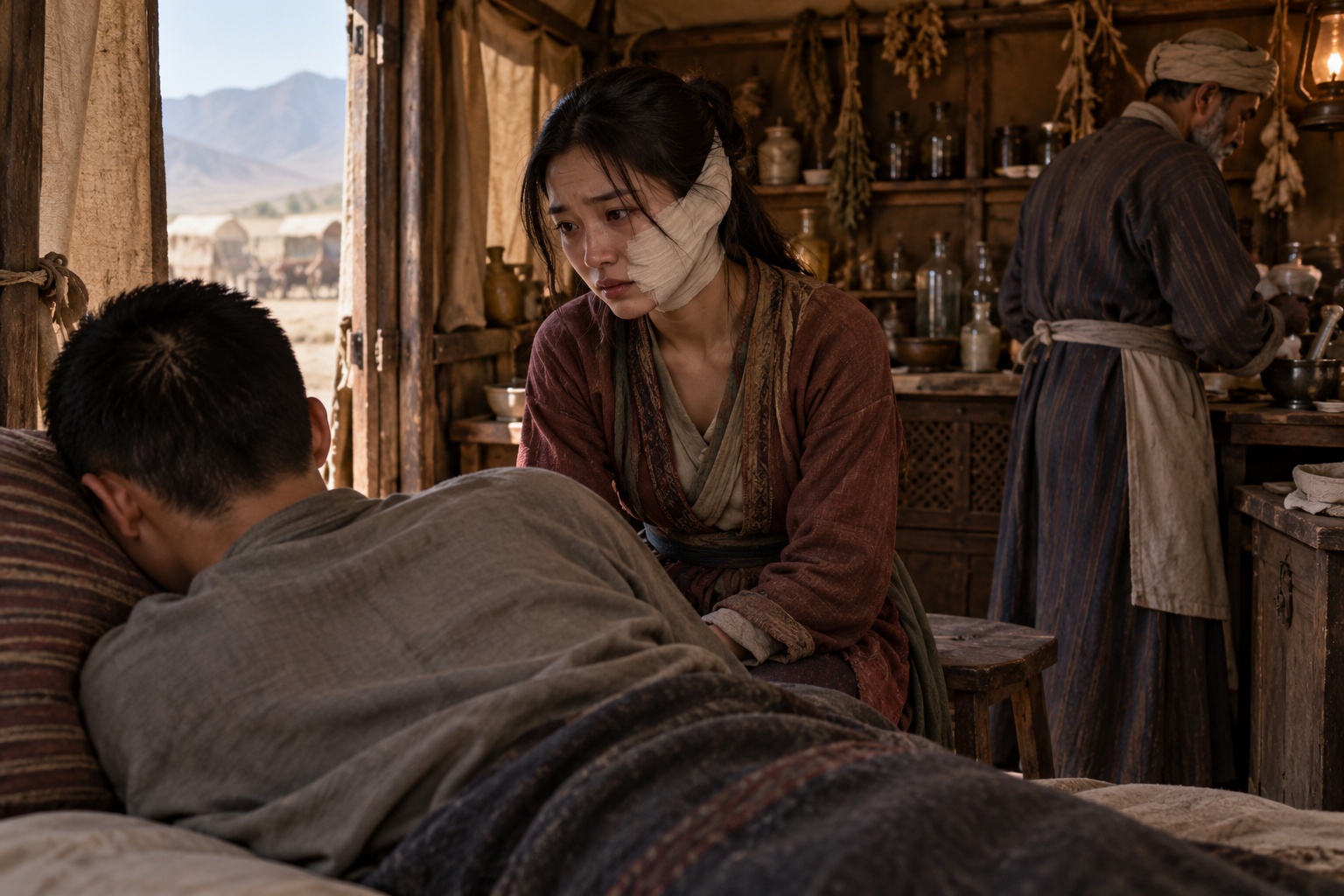
I lay down and closed my eyes, and when I opened them again it was later afternoon, and Deng Weili was sitting on a stool beside my cot. For a moment I thought I was dreaming. Weili looked terrible. Her skin was pale and damp, there were dark circles beneath her eyes, and her hair was tied back carelessly. She seemed thinner than I remembered. Her entire left cheek was bandaged. She was watching me.
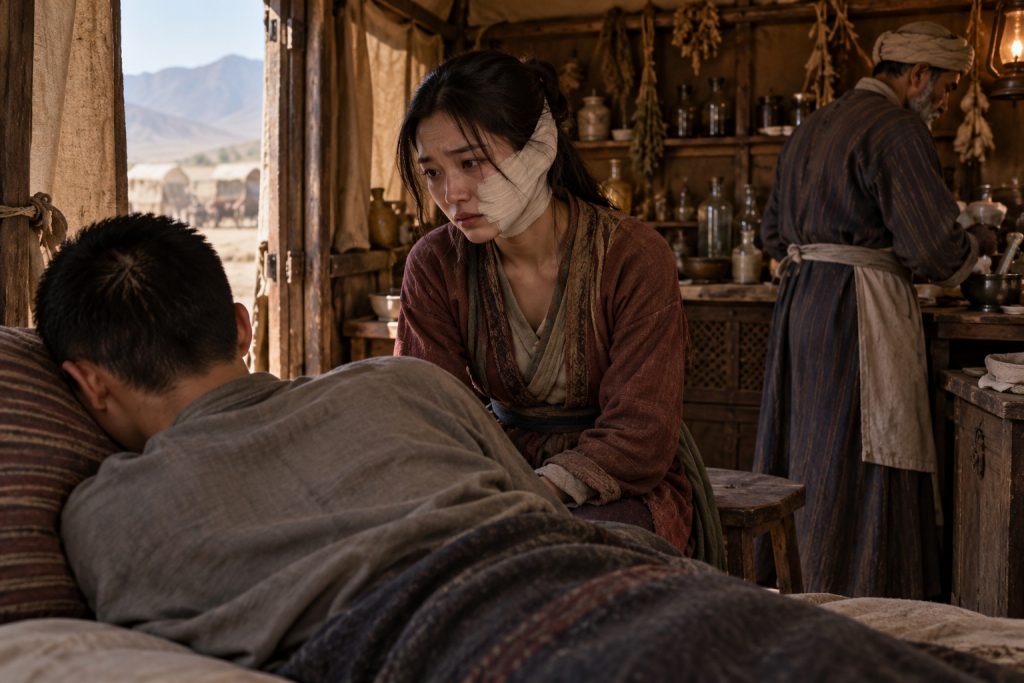
“Darius.”
I turned my head away and looked at Hakim Yusuf’s back. He was puttering about at his mixing table, pretending to ignore us.
“I heard what happened. I heard you killed two men, and that they almost killed you.”
I said nothing.
“I’m sorry.” Her voice trembled. “For everything. Most of all for letting you take my lashes. Karim hurt you so bad.” With this last comment, she began to weep.
I looked at her then, but I did not speak.
“I’ve been sick,” Weili went on, drying her eyes with her sleeve. “Meilin has been taking care of me.”
I looked away again.
“Do you remember,” Weili said softly, leaning in close to me, “what Arslan said before he left?
Just the mention of Arsan’s name made me grimace. I was so tired of all this.
“He said,” Weili continued, “that he wasn’t the one I really loved. He said…” She hesitated. “He said I loved you. I told him he was wrong, but I’ve been thinking about it, and I -”
I raised my hand to stop her.
“Darius, please. I just want to -”
I raised my hand again and turned my face toward the wall.
“It’s because I’m ugly now,” she said bitterly. “My face is scarred. You’re just another shallow man. You only pursued me when I was beautiful.”
I turned back to her and took a deep breath. I had resolved never to speak to her again, but I realized now that certain things had to be said.
“You are not ugly and never could be,” I said. “Once, outside of Deep Harbor, I saw a tall heron standing in a rice paddy. It was so graceful, so pure. To me, you are more beautiful than that. I wouldn’t care if your whole cheek was melted off. To me, you will always be a tiger prowling through the forest, or a bright star in the sky. I remember the first time I saw you, at the archery competition in Deep Harbor, the way you stood so tall and confidently, and fired your arrows fast and true like a hero from a legend. I knew you were special even then.” I paused and licked my lips. “I’m sorry you lost your parents. I’m sorry that life has not been kind to you. I know you need someone you can count on. I thought I could be that person for you. But you used me, and when Arslan appeared you threw me away. Do you remember all the ugly names you called me? A creep, a jealous child, a rat. I don’t know what you think love is, Deng Weili, but that is not it. If I were to take you back, and love you once more, I could never trust you again. No. I don’t want to have anything to do with you. I don’t want to speak to you again, except what the job requires. You go your way, and I’ll go mine.”
Weili looked stricken. She opened her mouth, but nothing came out. Slowly her face shaped itself into a controlled, hopeful smile.
“You look very cute with your hair short like that, did you know that?”
I said nothing. She took a breath, tried again:
“I don’t know why I ever thought you were too young for me. There isn’t a man here who has half your courage, except for the Captain of course.”
I said nothing.
Her composure broke. Her lower lip trembled. “Give me another chance,” she pleaded. “I can be everything you ever dreamed of. It won’t be like before, it will be so much more.”
“No.”
She slapped me, then pulled her hand back and gasped, shocked at what she had done.
Yusuf shot to his feet. “Weili! Get out.”
She stood, took a few steps toward the entrance, then turned. “Darius, I’m sorry.” A moment later she was gone.
The Way of Things
I woke to twilight and the smell of something cooking outside.
Hakim Yusuf was nowhere to be seen. I sat up carefully and found a small bowl of dates on his table. I ate four of them, took two for Belly, drank some water, then dressed and gathered my things. I had spent enough time in the medical wagon.
Outside, the last traces of red had faded from the western sky. Most of the men were gathering for supper around the campfires, but I went to the water wagon. I made wudu, found a clean patch of ground and prayed Maghreb alone. When I was done, I found Belly tied with the other horses. He greeted me with a low nicker and pushed his nose against my chest.
“Yes, I know. Everyone is an idiot except you.”
He seemed to agree. I fed him the dates and he chewed them happily. Then I found his brush and spent some time working the dust from his coat. Belly stood quietly, occasionally turning his head to watch me. I brushed his neck, his shoulders and his broad back, then combed the tangles from his mane. It was something simple to do, and I liked the steady movement of my hand and the warmth of him beneath it.
When I finished, I took my pack and bedroll to the rear of the caravan, away from the campfires. I spread the bedroll on the ground and sat with my legs stretched out in front of me. Night had settled over the plain. Away from the fires the sky was crowded with stars, thousands upon thousands of them, more than I could ever see in Deep Harbor. My eyes wandered among them, picking out the constellations I knew.
I heard footsteps behind me, and glanced back. Captain Karim stood a few paces away.
“Why aren’t you eating supper with the men?”
“I don’t know.”
He studied me for a moment, then came over and sat beside me.
“A courier came from Herat. We are to dine at the palace tomorrow evening. I have to say, I’m happy about this. Prince Farhad could turn out to be a powerful benefactor. The bosses back home will be pleased. And we owe it to you.”
“I killed two men.”
“But it doesn’t bother you as much as it used to, does it? You feel like you should be bothered, but you’re not.”
I chewed on my lip. “Yeah. You’re right.”
“That’s the way of things.”
Then Karim said, “You put your hands on Corporal Bao today. You violated Five Star regulations and the proper conduct between a guard and his superior officer. Under any other circumstances, you would be disciplined.”
I gave a bitter laugh. “You want to give me those other three lashes now?”
“No.”
I looked at him. Was there anything in the world more solid than Captain Karim? A mountain could not be more dependable. He wasn’t friendly or kind, nor was he cruel. But you always knew where you stood with him. If my father was at one end of my life’s rope, and Zihan Ma at the other, then Karim was the firm earth on which I stood.
“What I want and expect,” he said, “is for you to apologize to Bao. Publicly.”
“Okay.”
“I mean right now. He’s sitting by the large campfire with the others.”
I looked toward the distant campfire. I could see the silhouettes of men gathered around it, eating and talking. “I just got comfortable.”
Karim grinned. “You’re a caravan guard. If you wanted comfort, you picked the wrong career.”
“So I’m learning.”
He stood. “Come on.”
Crispy Rice
Most of the guards were around the campfire, sitting on blankets, crates and even saddles, eating supper from bowls and plates. Conversation quieted as we approached. Weili was there, on the opposite side of the fire from where I stood. I ignored her.
Corporal Bao was sitting on an overturned bucket. He looked up at me, then at Karim.
I stopped in front of him, aware of everyone’s eyes upon me. I spoke loudly enough for everyone to hear. “Corporal Bao, I’m very sorry. I had no right to grab you or threaten you. You are my superior officer. I apologize.” I wasn’t just going through the motions. I knew what I had done was unacceptable.
Bao stood. “And I apologize to you. I organized the betting pool. I thought it would be fun, but I didn’t stop to think about how it would feel to you.”
I nodded. “Alright.” We shook hands, and that was the end of it. I turned to walk away.
“Where are you going?” Bao called. “Sit down. Meilin saved a plate for you.”
Meilin was sitting on a folded blanket beside Longwei. She held up a wooden plate piled with rice, roasted lamb, flatbread and vegetables, along with a small bowl of yogurt. My stomach immediately reminded me that a few dates were not supper. I was ravenously hungry.
“Scoot over,” Meilin told Longwei.
Longwei muttered something under his breath, but moved.
I sat between them and accepted the plate. There was plenty of lamb, the rice had been spooned from the part of the pot where it had browned and crisped on the bottom, and there were no cooked carrots.
I looked at Meilin. “How did you know what I like?”
“Because we know you, Darius Lee.” She smiled. “You’re one of us. Even if you look like an adolescent kid now.”
Before I could stop her, she ran a hand playfully over my short hair.
“Hey!”
Everyone laughed.
I looked across the fire at Bao. “You didn’t bet on whether I’d stay for dinner, did you?”
That brought another round of laughter.
Bao raised both hands. “No more betting.”
“Let me tell you all,” Longwei said, “about the time I found myself rappelling down a cliff in Tibet to escape twenty angry Buddhist warrior-monks.”
I began to eat, and after that I made no more conversation, for the hot food going into my stomach was like a gift and a homecoming. From time to time I looked up, and every time I saw Weili watching me. I did not meet her eyes.
Folly and Death
Around the time I was taking the last few bites, someone said, “I can’t believe we’re in Persia. We made it.”
“You know we’ll get major bonuses when we get home,” someone else said.
“Don’t count your gold before you’ve struck it.” This was Meilin.
“I’m going to open a theater,” Memdooh said. “This caravan thing is too intense.”
“A bakery in Deep Harbor for me,” Weili said, and her voice was quiet, devoid of her usual confidence.
“Enough!” Longwei’s voice carried, even when he did not raise it. Everyone fell silent. “Enough of this moronic prattling. Don’t you all understand that there will be nothing to go home to? Take what you have earned so far and stay here, or go anywhere else.”
“What do you mean?” Meilin demanded. “What are you saying?”
“The war,” Longwei said. “The war, the war. Don’t you understand? The invaders who now ravage our country cannot be stopped. They had turned east when we left. They will gut the great cities of the southeast, then return to the heartland. Everywhere they go they slaughter the people and burn everything to the ground. They are giants, some of them twice our size. Their armor and weapons are better than ours. Everything we have attempted against them has failed. Some of you know this.”
“It’s true,” Weili said softly. “They burned my village and killed my parents.”
“Mine too,” someone else said. “They threw the bodies on a pyre.”
“We are a great nation,” Bao protested. “We have never been conquered.”
“Have you fought them?” Longwei asked.
Bao shook his head. “Five Star guards get exemptions.”
“I have. I served two years. I was one of the few who survived my tour of duty. I have seen battle trenches so full of dead men you could march right across. I have come face to face with the invaders. One of them did this to me.” He stood and pulled up his tunic, and the men gasped at the livid scar that ran from just beneath his neck to the bottom of his generous belly. “I pushed my own intestines back into my body. They have a champion.” His voice fell, and men learned forward to hear. “He is the size of a giant. He fights with a sword in one hand and an axe in the other, and no armor. Before every engagement he steps forward. The invaders’ commander issues a challenge. Beat the giant, and the invaders will abandon our country and return home. No one has been able to so much as wound him. He has killed three hundred men in duels. His name is White Wolf.”
The men repeated this name in fearful whispers.
“Darius could beat him,” Weili said.
Longwei threw his head back and laughed, and the sound was like a slap to the face. “Darius is a puppy with sharp teeth. He has been lucky so far. White Wolf would tear him to pieces as a lion tears the flesh from -”
Karim stepped out in front of Longwei. I had not seen him arrive. “Stop,” he said. “Your words are foul, and your call to abandon the caravan is tantamount to betrayal.”
I saw that Meilin had moved away from Longwei and was staring at him in horror.
“To resist the invaders is folly and death,” Longwei went on. His face was twisted into a bitter mask, and his words came quickly now. “Our emperor should surrender and submit our land to their rule. But he loves his power and wealth, and because of this, our nation will fall, and from sea to sea we will become bones beneath their feet. To return to our land is folly and ruin. Our future is one of red suns and redder soil, stained with the blood of -”
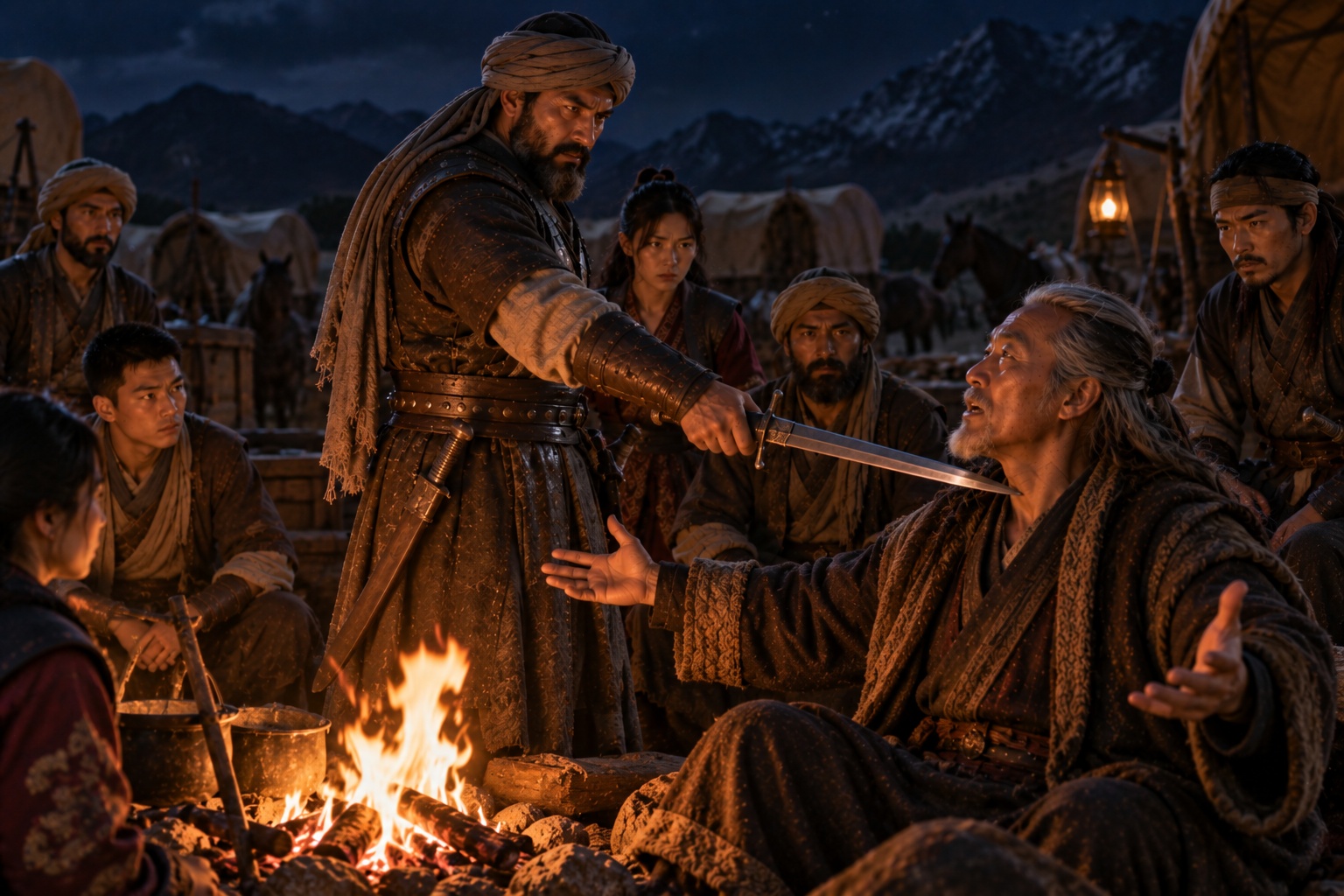
Karim drew his sword and put it to Longwei’s neck. “One more word,” he said, “and I swear, I will end your life right now.” He looked around. “Everyone go to your wagons and bedrolls, and forget the words of Shaytan you heard spoken here, for his job is to cast despair into the hearts of men. Do not believe him, for Shaytan is a liar, and has always been so, from the moment he tricked Adam and Hawa into eating from the tree.”
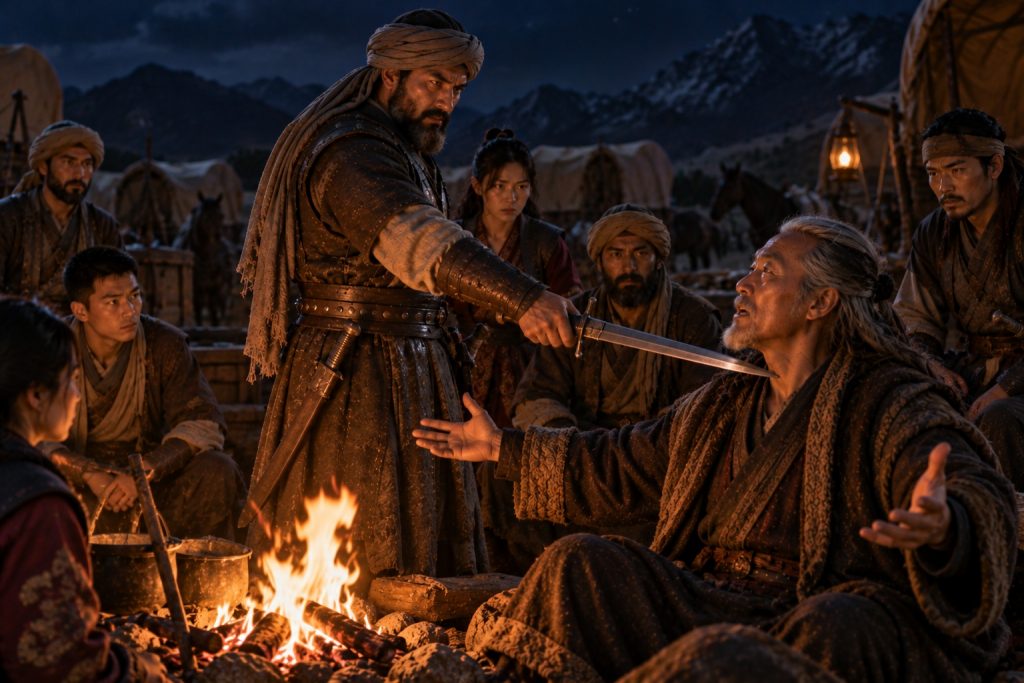
The men dispersed, as did I. Two conflicting thoughts battled in my head. One, called up by Longwei’s words, was the image of my father, his body rotting in a trench. The other was Karim’s final statement: Shaytan is a liar, and has always been so.
The two thoughts chased each other in circles in my mind, until Karim’s words won. Longwei’s tirade faded away. Lying on my bedroll without a sleeping bag – it was not needed in this warm climate – I watched the stars wheeling above me. I thought of Zihan Ma, Lee Ayi, Haaris, Far Away and Bao Bao. They would not be slaughtered, and the farm would not be burned. Allah would not let that happen, and – by the will of Allah – neither would I.
Herat
The next morning, not long after we had eaten, a troop of Persian cavalry appeared on the road. There were twenty of them, all in matching uniforms, carrying long spears and curved swords. Their officer spoke with Captain Karim and Ahmed, and we learned that Prince Farhad had sent them to escort us into Herat whenever we were ready.
The banquet was not until evening, but Karim saw no reason to wait. For the first time since the raid in Afghanistan, I put on my Five Star uniform. It felt strange after so many days in loose clothing and bandages, and the sword belt pressed uncomfortably against my back. Still, when I looked down at myself I felt more like a caravan guard again and less like one of Hakim Yusuf’s patients.
We were on the road before noon.
I rode Belly near the front with Karim, Ahmed and the other guards, while the Persian cavalry surrounded the caravan. I noticed that Meilin no longer rode with Longwei, and other guards seemed to keep their distance from him as well.
As we approached Herat, the traffic grew heavier. Farmers drove carts piled with melons, grapes and vegetables. Merchants passed us with laden donkeys and camels. There were Persians, Afghans, Uzbeks and people I could not identify, speaking languages I had never heard. Some men wore enormous turbans, others tall caps or fur hats, and the women seemed to favor bright colors and flowing garments.
Then we passed through the city gate, and I forgot about the people.
Herat was green.
After the barren mountains and dry plains we had crossed, I could hardly believe it. Water ran through channels beside the streets. Trees rose above garden walls, and vines spilled over them. Here and there I caught glimpses through open gates of courtyards filled with flowers and fruit trees. Beyond the rooftops rose slender minarets and great domes covered in colored tile.
A little farther on we passed a masjid grander than any building I had seen since Samarkand. Four impossibly tall minarets rose above the surrounding rooftops, and the entrance was framed by an enormous pointed arch covered in blue and turquoise tiles, patterned with flowers, stars and flowing Arabic calligraphy. Seeing it, my mouth fell open in astonishment. Beyond it I could glimpse a broad courtyard surrounded by arched galleries, with a row of fountains at its center for wudu.
It was astounding to me that men and women could build such things. I remembered the ayah in Surat Al-Baqarah where Allah tells the angels that He will create a khalifah for the earth:
˹Remember˺ when your Lord said to the angels, “I am going to place a khalifah on earth.” They asked ˹Allah˺, “Will You place in it someone who will spread corruption there and shed blood while we glorify Your praises and proclaim Your holiness?” Allah responded, “I know what you do not know.”
I could almost imagine that one of things Allah knew, and that the angels did not know, was this: “You cannot imagine what they will build.”
Neither could I, until I had embarked on this journey. I found myself staring back at the masjid until the wagons carried me out of sight.
The streets were so crowded that the caravan slowed to a crawl. People stopped to stare at us. I supposed forty-eight enormous Chinese wagons guarded by Chinese soldiers were not something the people of Herat saw every day.
There were camels everywhere. I had seen a few since leaving China, but here they seemed almost as ordinary as horses. Some traveled in long strings, laden with bales and baskets, moving through the crowds with their long necks held disdainfully above everyone else. Every time we passed them, I stared like a foreigner in a strange land, which of course I was.
Something struck me: this city did not stink. Deep Harbor had stunk of garbage, sewage, body odor, mud and salt. Yet this crowded city, which was hot and therefore should have smelled even worse, actually carried scents of jasmine and spice. And yes, camels too. That was unavoidable.
We followed the Persian cavalry deeper into the city until the streets widened and the crowds thinned. Ahead of us rose a massive fortified complex of high walls and towers.
I looked at Ahmed. “Is that the palace?”
He nodded. “The citadel.”
That reminded me of something.
“Who’s going to guard the wagons while we’re eating?”
“I don’t know. We’ll figure something out.”
I frowned. Five Star had already lost one wagon to the Afghans and most of the Silk Store to the fire. What remained belonged to the company, and I couldn’t imagine Captain Karim leaving it sitting outside the palace while every guard went inside to eat roasted lamb with a prince.
A Little Naivete
The citadel gates opened.
Our Persian escort rode through as a gate guard waved us in.
The first Five Star wagon followed them, and the guard kept on waving.
I stared. “We’re all going in?”
Apparently we were.
One by one, all forty-eight wagons passed beneath the gates. The horses, the drivers, the servants, the guards, everyone. Persian soldiers directed us into an enormous outer courtyard where there was room for the entire caravan. More soldiers stood along the walls and at the gates.
I laughed. So that was who was going to guard the wagons.
The palace itself rose beyond another set of walls. It was unlike anything I had seen in China. Arched entrances were covered in intricate blue and turquoise tile, and beyond them I could glimpse shaded courtyards, gardens and fountains. Everything seemed designed on a scale meant to remind a visitor that whoever lived here possessed more wealth and power than he did.
Memdooh rode up beside me, staring.
“I’m definitely going to write a poem about this.”
“That’s great,” I said, “but it still won’t be as good as:
I ride from a northern land,
curved sword in my hand.
I’m young but I’m hard,
for I’m a caravan guard!”
Memdooh turned slowly toward me, then he gave me an appreciative smile. “That was a good one, huh? It seems a bit… naive now.”
I shrugged. “Maybe a little naivete is a good thing.”
Happy Wagon
Once the caravan was settled in the courtyard, the drivers unharnessed the teams and led the horses away to be watered and fed. Persian servants showed us where we could draw water, and Captain Karim immediately tasked men to inspect and repair the wagons.
Hakim Yusuf found me while I was helping unsaddle Belly.
“Come to the medical wagon when you’re finished. I want to look at your back and change the bandages.”
“I will. There’s something I want to do first.”
I made my way through the rows of wagons until I found the Happy Wagon. I recognized it immediately by the flowers painted along its sides. I knocked on the wooden frame.
Kuangren pulled back the curtain. His face brightened when he saw me.
“Darius! Come in.”
I removed my boots and climbed carefully inside.
I had never been inside the Happy Wagon before, and I was surprised by what they had made of it. A colorful carpet covered the floorboards, and cushions were arranged along the walls for sitting. Their belongings were neatly stored in baskets and wooden boxes, and little touches here and there made the wagon seem less like something used to haul goods across the world and more like a tiny home.
Gulnur sat propped against several cushions. I remember the first time I’d seen this daughter of a Kyrgyz chieftain. Her entire tribe had ridden hard out of their city, in pursuit of Kuangren the scoundrel, who had apparently dishonored her. She’d carried a bow on her back and a knife at her hip, and she had seemed like a falcon, fierce and uncontrollable.
Since she’d been wounded at the raid, however, she had lost a great deal of weight. Her face was thin and her hands looked almost delicate, but when she saw me she smiled.
“Darius.”
I sat across from her. “How are you?”
“Better every day. Hakim Yusuf says I will recover completely. I only need time.”
“Alhamdulillah for that. I’m so glad.”
Kuangren sat beside her, cross-legged, and took her hand in his. He hardly resembled the drunken, carousing rebel who had caused Captain Karim so many problems in the early days of the journey. He was quiet now. In his other hand he held a sabha, moving the beads slowly through his fingers.
“Do you remember,” I said to Kuangren, “when Karim threatened to nail your boots to a wagon with your feet inside them?”
He laughed, but before he could say anything, Gulnur patted him on the head, the way one would do to a child. “No need for that anymore.”
Kuangren put on a mask of pretend anger. “You’d better stop that, woman, or you’ll see just how wild I can still be.”
“By all means,” she replied. “Show me.”
I cleared my throat uncomfortably. “I wanted to tell you both something,” I said. “Both of you fought extraordinarily well in the raid. You held your position even when the Afghans swarmed us. You did exactly what needed to be done. I am sorry how it turned out.”
Kuangren looked at me for a long moment.
“We were only following your commands, Darius,” he said. “And we would do the same today, tomorrow or next year. There is nothing to apologize for.”
My eyes suddenly filled with tears. I rubbed them quickly with the heels of my hands and stood.
“I have to go. Hakim Yusuf wants to change my bandages.”
Gulnur smiled. “Go. Before he comes looking for you.”
I paused at the doorway. “We call this the Happy Wagon, did you know that?”
Kuangren smiled. “It is well named.”
I studied him, remembering how he’d been forced under threat of death to convert to Islam and marry Gulnur.
“No regrets?”
Before he could speak, Gulnur reached out and covered her husband’s mouth with one hand.
“Goodbye, Darius.”
* * *
Come back next week for Part 27 – The Prince’s Ring
Reader comments and constructive criticism are important to me, so please comment!
See the Story Index for Wael Abdelgawad’s other stories on this website.

Wael Abdelgawad’s novels – including Pieces of a Dream, The Repeaters and Zaid Karim Private Investigator – are available in ebook and print form on his author page at Amazon.com.
Related:
The Deal : Part #1 The Run
Gravedigger: A Short Story
The post Far Away [Part 26] – Shaytan Is A Liar appeared first on MuslimMatters.org.


 Written by a Muslim author