At his grandmother’s opulent riverside estate, Darius finds himself judged not for who he is, but for whose son he is.
Read Part 1 | Part 2 | Part 3 | Part 4 | Part 5 | Part 6 | Part 7 | Part 8 | Part 9 | Part 10 | Part 11
* * *
Self-Controlled
The colorfully dressed doorman opened the gates before we even reached them.
The Chen residence did not resemble any home I had ever seen. Calling it a house seemed absurd. It was a walled compound of white stone and dark wood, with curved roofs layered one behind another like overlapping wings. Red lanterns hung beneath the eaves despite the daylight, and narrow streams of water crossed the inner courtyards beneath little carved bridges. Bamboo rustled softly in the winter breeze.
I slowed, taking it all in. It was like something I might have conjured in a dream.
Haaris, walking beside me, whispered proudly, “Big, right?”
Indeed. “What does Master Chen do for a living?”I whispered.
“He owns a foundry that makes weapons.” replied softly.
Servants moved everywhere, silent and efficient. One swept fallen leaves from the stone paths with a long reed broom. Another carried folded linens across the courtyard. Two men unloaded crates from a wagon near a side gate while a woman directed them sharply.
Something unsettled me immediately. After a few moments, I realized that no one here was comfortable. No one laughed or joked as Haaris and I did when we worked. Everyone was carefully self-controlled, as if they thought they were being watched at every moment.

I felt the absence of my dao acutely. Not that I thought I would need it here. But ever since I’d left it wrapped in cloth beneath the wagon seat in the stable yard, I’d been worried about it. What if someone stole it? It was a gift from my father – the only thing I had from him.
Before we entered the inner residence, an elderly servant approached and bowed stiffly, saying, “I will take your coats and travel packs, honored guests.”
We all handed over our bundles, including my travel pack containing the gifts I had bought in the marketplace. The old servant stacked everything carefully into a lacquered cart beside the entrance, then wheeled the cart away through a side doorway.
A servant girl in pale green robes then led us through a covered walkway into the main receiving hall.
The room was enormous. Dark beams crossed the high ceiling overhead. Silk wall hangings embroidered with Quranic calligraphy hung between painted landscape screens. One scroll depicted mountains rising above misty forests, with tiny travelers crossing a bridge far below. Another showed a river crowded with merchant barges beneath wheeling birds.
Tall porcelain vases stood in carved wooden alcoves, painted in deep blue with scenes of scholars, horses and flowering trees. A bronze incense burner shaped like a crane released thin trails of scented smoke into the air, giving the place a sweet and musky scent. Low tables of carved rosewood stood beside cushioned chairs lacquered black and gold.
Strangely, while I admired the beauty of this place, I was not intimidated. My clothes were new and clean. I had nothing to be ashamed of. And I had seen my father put wealthy merchants on their knees in the highway at the point of a sword before robbing them. They wore fine clothes, but they wept and begged like anyone else. A few wet themselves. I think my father had enjoyed humiliating them. As for me, I had merely felt embarrassed for them.
Furthermore, Zihan Ma had taught me that one of the meanings of laa ilaha il-Allah was that all men were equal before Allah, regardless of caste, color or clothing. Only their – what was the word? Taqwa. Only their taqwa differentiated them.
As a result, I never thought that the wealthy were better than me. Nor was I better than them. People were people. They were either honest or dishonest, kind or cruel. They were street thugs like the men who had tried to rob me – or indeed like my father, who I had no illusions about – or honorable men like Zihan Ma. I had never met the emperor of our land, nor would I, but I knew he was either a good man or a bad one, no matter what trappings of wealth surrounded him, and I knew he could not be a better man than my uncle.
Come Closer
At the far end of the hall sat an elderly woman in layered robes of soft blue silk. A pale gray scarf covered her hair. Beside her sat a thin older man with narrow shoulders and sharp features. His beard was trimmed short and precise. He wore a white robe of fine linen with silver embroidery, and jade rings gleamed on his fingers as he sipped from a porcelain tea cup.
Zihan Ma bowed respectfully toward the older man. “Master Chen.”
“Ma.” The man inclined his head slightly.
His eyes shifted toward me.
“This,” Lee Ayi said carefully, “is Darius Lee.”
I bowed deeply. “As-salamu alaykum Nai Nai and Master Chen.”
His eyes narrowed. “Were you taught to greet the women first?”
Before I could answer, Nai Nai smiled gently and said, “Come closer so I may see you.”
Haaris and I both went to her. Haaris hugged her, then I did. Her hands were warm and soft as she touched my face lightly, studying me with moist eyes. “You have your father’s eyes,” she murmured.
Master Chen snorted quietly into his tea. “An unfortunate inheritance.”
The room fell silent.
Lee Ayi crossed the room quickly and knelt beside her mother, taking both her hands. The warmth between them was immediate and genuine.
“We brought gifts for your birthday,” Lee Ayi said. She opened her bundle and carefully removed a folded silk shawl embroidered with tiny silver flowers. I had seen her making it over the last few weeks, but had not known it was for her mother.
Nai Nai touched the fabric reverently. “It’s beautiful,” she whispered.
Haaris eagerly produced a folded note written in his uneven handwriting. “Mine too!”
Nai Nai laughed softly and accepted it at once. “A letter?”
“A birthday note,” Haaris said proudly. “Baba helped me shape some characters.”
She opened it immediately, smiling as she read.
Then everyone looked at me.
I suddenly felt awkward. My own letter, though heartfelt, seemed childish now compared to the grandeur of this house. Still, I handed it to her. Nai Nai unfolded it slowly and read it in silence. I had written:
I am very happy to meet you, Nai Nai. My father had good qualities and bad, but I am sure that whatever good he possessed came from you. Whatever has befallen me in life, it brought me here to meet you. That is a barakah. I wish you a happy birthday and many to come.
When she finished, she pressed the paper briefly against her chest. “Thank you, Darius,” she said softly. “I will treasure it.” Her sincerity was real, and it moved me.
“Could you not even buy a gift for your grandmother?” Chen sneered. “A paltry letter? That’s fine for Haaris, but you are a young man.”
Nai Nai lowered her hands slowly. “Husband…”
“I merely speak the truth.” His gaze remained fixed on me. “Yong Lee was a troublesome boy long before drink rotted what remained of his judgment. No doubt this child is the same.”
I lifted my chin and met his gaze. I spoke calmly. “My father was more than that.”
Chen set down his tea cup abruptly, the tea spilling onto the porcelain dish beneath it.
Lee Ayi spoke softly. “Master Chen, Darius has traveled far. Let us welcome him peacefully.”
“Peacefully?” Master Chen replied. “Was Yong peaceful? I seem to recall gambling, fighting, drinking and theft following him from one province to the next like stray dogs.”
Haaris shifted uncomfortably beside me.
Zihan Ma’s expression remained calm, but I noticed his jaw tighten slightly.
Lee Ayi had told me to remain silent, but I would not keep my mouth shut while my father was reviled. I would never forget him coming home from prison, finding me half-starved, and weeping as he embraced me. That moment was engraved on my heart.
“My father,” I said, perhaps a little too loudly, “joined the army to fight the invaders. He died in defense of his country. What could be more honorable?”
Servants entered carrying tea for the rest of us, along with trays of candied fruits and little sesame pastries arranged in perfect rows.
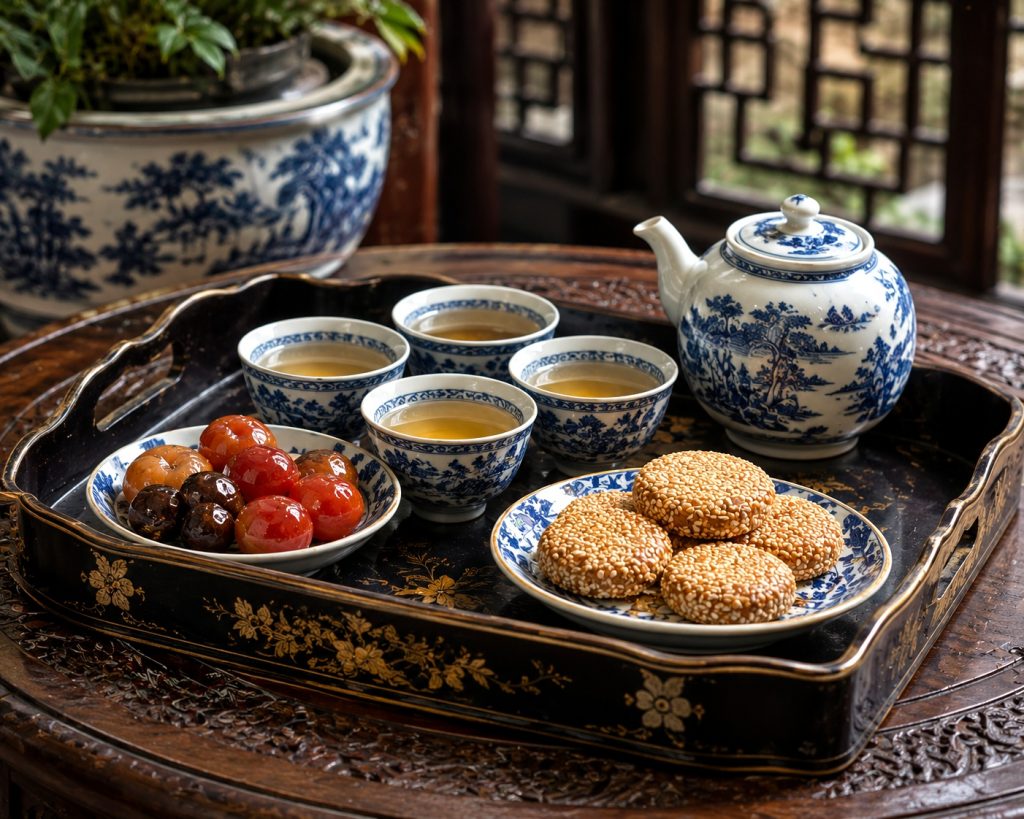
Master Chen took a pastry, and Haaris followed suit. I thought Chen might insult or berate me, but instead he spoke softly: “There is a saying. When the roots are crooked, the branches grow twisted.”
Nai Nai touched her husband’s hand with one finger. “I beg you. Let us have no more of this.” It was the voice of someone pleading for a small mercy she was not certain would be granted.
Master Chen finally looked away from me and sipped his tea.
The Accusation
“We must pray Asr,” Zihan Ma said. “It is getting late.”
One by one we performed wudu’ in a large bathing room with a skylight and a live bamboo tree in a pot. Master Chen then led us to a dedicated prayer room. There he led us in salat. He could not kneel, so he sat in a chair as he prayed. When lifting his head from ruku’, he said, “Sami Allah lamaw zhamidu.” The salam at the end was similarly garbled. No one corrected him, of course.
After prayer we returned to the sitting room. Now Haaris and I did indeed remain silent as the adults spoke of the war, refugees, the farm, and other things. Master Chen’s armaments business was booming. There was no warmth in these conversations. In the time that it took to drink a single cup of tea, Zihan Ma rose.
“It was wonderful to see you both,” he said. “We must leave. We have a long trip ahead and we do not want to be on the road late at night. It’s not safe.”
“You must stay,” Nai Nai protested. “We have plenty of room. Please, for my sake.”
“We cannot,” Zihan Ma replied firmly. “The cows must be milked in the morning, and the gate opened for the farm hands.”
I knew this was not strictly true. The foreman had the key to the gate, and the men could milk the cows, feed the chickens and let the donkeys out. But I too wanted to be away from this oppressive place, and I was worried about Far Away. I wanted to hear his protesting meow when I picked him up and nuzzled him. I even missed Bao Bao, for her kindness toward Far Away had warmed me to her.
Master Chen gave a derisive laugh. “Cows.”
I wanted to say, “Didn’t you put milk in your tea?” But I held my tongue. I did not like this man at all.
The elderly servant wheeled the cart back in, and we picked up our packs and bags. Good byes were said, and final embraces given. Nai Nai hugged me with her thin arms, and I gave her a half-hearted embrace in return. She was my grandmother, and I would like to say that I loved her, but I did not know her.
A female servant opened the door for us and bowed. As we were about to leave, the elderly male servant leaned in toward Master Chen and whispered something in his ear.
“Wait,” Master Chen said. “I am told that certain items have gone missing. A pair of gold bracelets.”
Zihan Ma frowned. “That’s unfortunate. May Allah return them to you. As I said, we must be going.”
“You misunderstand,” Master Chen said sharply. He pointed at me with one rigid arm. “The boy has stolen them. He was seen taking them.”
For a moment I thought I had misheard him.
Zihan Ma said, “That is impossible. He was with us the entire time.”
“He was gone a long time when he went to make wudu. Let him open his pack.”
Zihan Ma’s jaw tightened. “This is unacceptable. Darius is my apprentice, and works hard on the farm. He’s a good boy. You have no cause to suspect him.”
“His father was a thief,” Chen said flatly. He turned to me. “Isn’t that true?” His eyes held a cunning gleam, and I felt the first stirrings of unease in my stomach. Something strange was going on here.
“Yes,” I said honestly. “Though he changed in the last year of his life.”
“And you?” Chen asked, a thin smile on his lips. “Did you steal?”
I considered. I would not dishonor Zihan Ma by lying. My reply was truthful: “When my father was in prison, and I was alone on the farm, I stole food from neighboring farms to survive. A few potatoes here, a cabbage there. Only that.”
At that, Zihan Ma shot me a troubled glance. He had not known that about me.
“You see?” Chen declared triumphantly. “Once a thief, always a thief.”
Zihan Ma began to protest, but I waved him off. “It’s okay, Uncle,” I said. “I have no objection to opening my pack.”
I set the pack down on the floor, untied the strings, and opened the top flap. Inside were the few items I had brought from home: a towel, a spare shirt, and the sabha Zihan Ma had given me. On top sat the three cloth-wrapped gifts I had bought in the marketplace.
Chen’s eyes narrowed. “Take everything out.”
The room had gone utterly silent.
I frowned slightly but obeyed. First I removed the wrapped gifts and set them carefully beside the pack. Then the towel. Then the shirt and the sabha.
Something metallic glimmered at the very bottom of the pack.
For a moment my mind refused to understand what I was seeing.
Then I reached down slowly and picked them up.
Two gold bracelets rested in my palm.
* * *
Come back next week for Part 13 – The Long, Dark Road
Reader comments and constructive criticism are important to me, so please comment!
See the Story Index for Wael Abdelgawad’s other stories on this website.

Wael Abdelgawad’s novels – including Pieces of a Dream, The Repeaters and Zaid Karim Private Investigator – are available in ebook and print form on his author page at Amazon.com.
Related:
As Light As Birdsong: A Ramadan Story
Kill The Courier – Hiding In Plain Sight
The post Far Away [Part 12] – Accused appeared first on MuslimMatters.org.



 ; learning it and transmitting it.
 said: “Whoever wishes to know whether they truly love Allah and His Messenger, let them reflect: if they love the Quran, then they truly love Allah and His Messenger.” This is a deeply theological reality. The Quran is the speech of Allah ﷻ. Love for speech reflects love for the Speaker. If the heart inclines naturally toward the Quran—longing to recite it, understand it, and live by it—then that is a sign of a heart inclined toward Allah ﷻ.
 described the companions as people whose eyes shed tears and whose skin trembled when reciting the Quran. The Quran shaped both their inner and outer states—producing awe, humility, softness, and tears. When Allah ﷻ revealed: “Who will lend to Allah a goodly loan…” Abū al-Daḥdāḥ