
Mothers seek scarce jobs to survive
Israel’s years-long killing spree in Gaza has left nearly one-fifth of all families with women as primary breadwinners.
Darius awakens to discover the guards have been betting on him; Weili makes a plea; and Longwei reveals a frightening secret.
Read Part 1 | Part 2 | Part 3 | Part 4 | Part 5 | Part 6 | Part 7 | Part 8 | Part 9 | Part 10 | Part 11 | Part 12 | Part 13 | Part 14 | Part 15 | Part 16 | Part 17 | Part 18 | Part 19 | Part 20 | Part 21 | Part 22 | Part 23 | Part 24 | Part 25
* * *
QuestionsMy fellow guards helped me onto Belly. I was grateful for it. My back was burning again, my calf throbbed where the poisoned arrow had gone through it, and the man who had tried to strangle me had apparently bruised every part of me that the Afghans and Captain Karim had neglected.
We rode back toward the wagons, and before we had even reached them, men began coming out from beneath the awnings. Someone must have carried word ahead of us, because by the time I dismounted, with two guards helping me down, half the caravan seemed to know that something had happened.
Memdooh was among the first to reach me. “Darius! We heard you killed two men!”
“Are you alright?” Meilin demanded. She took one look at my face and answered her own question. “No. Obviously not.”
I studied her for a moment. Her arm was still in a sling, but aside from that she was her usual sturdy, slightly chubby, oddly athletic self. In any other context, with a different set of clothing, she could have passed for a farm wife. So this woman had offered to take half my lashes…
I must have been smiling, because Meilin said, “Why are you grinning like an idiot?”
“Who were the men?” Memdooh asked. “Why did they attack you?”
“They didn’t. I attacked them.”
Memdooh blinked. “Of course you did.”
Before I could explain, Corporal Bao pushed his way through the gathering crowd. A number of the other guards came with him, all non-Muslims. They surrounded me closely, pushing my Muslim friends to the rear. There was something strange about the expectant way they looked at me. I couldn’t put my finger on it. They seemed unusually interested.
“Let him speak,” Bao said.
The men fell silent.
I looked around at them. They looked back at me.
My entire body hurt. I was hot, exhausted, hungry, and missing the pistachios I could have had, and I had just learned that I was somehow in Persia and had apparently saved the son of the Shahanshah from two assassins.
I looked around at the men and raised my hands questioningly. “What?”
Bao smiled encouragingly. “Nothing. You must have questions.”
Questions… Yes. I did. “How is Gulnur?”
Three or four men immediately shouted in triumph. “Yes!” – “I told you!” – “Hand it over.” Several others groaned.
I stared at them. “What?” I said again, feeling indeed like the idiot that Meilin called me.
“Nothing,” Bao said quickly. “Gulnur is much better. Hakim Yusuf says she will live.”
“Alhamdulillah. That’s great.” Then I remembered what Captain Karim had told me. “I can’t believe we’re in Persia. How long was I asleep?”
This produced a much larger reaction. Men shouted, groaned and slapped one another on the back. One man cursed. Another raised both hands victoriously. Some men handed coins to others.
“Three days!” Bao said.
I forgot the strange behavior immediately. “Three days? SubhanAllah.” I ran my hand over my close-cropped hair. It was a weird sensation, but not unpleasant. Three days? I remembered drinking the medicine Hakim Yusuf had given me, then lying back and thinking that I wasn’t sleepy. After that there was nothing. That opium was powerful stuff. I resolved at that moment that I would avoid taking that drug again except in the most extreme circumstances.
I looked at Belly. He stood beside me with his head down, looking as tired as I felt. “Who took care of Belly?”
This caused an uproar. “That counts!” – “No, it doesn’t!” – “He asked about the horse!” – “He asked who took care of the horse. That’s not the same thing.” – “Of course it’s the same thing!” – “No! Asking if Belly is well is asking about Belly.”
Belly had raised his head at the sound of his name. I stroked his neck, feeling the pain in my back as I did so. He’d saved my life, not for the first time. If I ever went home, this horse was going with me. I would never part from him.
Corporal Bao raised both hands. “Quiet! Quiet!”
I frowned. “What are you all arguing about?” The sun and the exhaustion were starting to get to me. I noticed that my hands were trembling.
“Longwei, Meilin and Memdooh took turns caring for him,” Bao said. “He gave them trouble.”
“He gives everyone trouble,” someone said.
Thirty To OneAnother non-Muslim guard pushed forward. “Darius, is there anything else you want to ask?”
A second man immediately shouted, “Don’t prompt him!”
“I’m not prompting him!”
“Let him speak!” Bao shouted again, and they all fell silent, staring at me like ravens watching a dying fox. I was beginning to think the opium had damaged my mind.
A guard near the back called, “What about Weili?”
Men shouted in protest, and Bao again yelled for them to shut up. They quieted, although several continued glaring at the man who had mentioned Weili.
I shook my head. “I don’t care about that.”
A tremendous groan rose from half the men, while the other half erupted in cheers. They turned to each other in huddles, passing something back and forth.
“What is wrong with all of you?” I demanded.
“Wait!” Memdooh cried.
He forced his way through the crowd and seized my arm, then apparently remembered that I was wounded and let go. “Captain Karim!” he shouted. “Captain! Come here!”
Karim had been speaking with Ahmed a short distance away, ignoring this whole hubbub. He turned.
“What?”
“Darius wants to talk to you.”
I frowned. “I do?”
Karim looked annoyed, but he came over as the guards parted to let him through.
I hadn’t intended to speak to him just then, but there was in fact something I had been wondering about.
“I heard you only gave me seven lashes.”
The crowd became utterly silent.
Karim studied me. “That’s right.”
“You sentenced me to ten.”
“I am aware.”
“I want the other three.”
For one heartbeat there was no reaction at all.
Then Memdooh went insane. “YEEEEESSSSSS!” He jumped into the air, both fists raised. “THIRTY TO ONE! I WON! THIRTY TO ONE!”
The crowd exploded. – “No!” – “You’ve got to be kidding me!” – “Who would ask for three more lashes?” – “I told you he was crazy!”
Memdooh was dancing now, his recently wounded leg seemingly forgotten. “Thirty to one! Pay me! All of you, pay me!”
I stared at him as men began reaching reluctantly into their purses. I was becoming genuinely angry now. I felt that everyone was playing some kind of ugly trick on me, and I was not in the mood at all.
“What are you talking about?” I demanded. “Memdooh?”
The young poet held out both hands as coins began dropping into them. “I won!”
“Won what?”
“The betting pool.”
Who Bet On Me Dying?I looked at Corporal Bao, but he only shrugged.
I gave Memdooh a look that, if looks were iron, would kill. “You were betting on me?”
“On what you would say when you woke up,” Memdooh explained happily. Men continued to drop coins into his hands. “How long were you asleep, that was one. Gulnur was another. Belly. Weili. How’s Meilin’s arm? How is Memdooh’s leg? Did we recover anything from the Silk Store? One man bet you would ask for food.”
“I didn’t say half of those things.”
“Yeah, those people lost.” He began counting his coins.
“And you…” I swallowed hard. I could feel the anger growing in my chest, as hot as the sun above our heads. “You bet that I would ask Captain Karim for the other three lashes?”
Memdooh beamed. “Nobody else thought of it.”
I looked at Corporal Bao. “You organized this?”
For the first time he seemed to become aware of my rage. He held up a hand. “It was an innocent game.”
I stepped forward and seized Bao’s tunic with both hands. My fingers tightened and I brought my face close to his. I heard people saying, “Hey, whoa, no!”
“So you think my pain…” My breath was coming hard now, my nostrils wide. Corporal Bao was of Mongolian stock, and while short, his body was compact and powerful. Yet when he tried to pull away from me, he could not. As for me, all my pain had vanished. I felt all the muscles of my body working together, connected like links in a chain. My father used to say that we bring power up from the ground and transmit it through the legs, then the core, then the torso, and when we do this we become as immovable as a tree, or as irresistible as a charging elephant.
“Let me go!” Bao shouted, a note of panic in his voice.
I tightened my grip. “You think my pain, and injuries, and KILLING TWO MEN are amusing?” I brought my mouth to his ear and whispered. “Who bet on me dying? And who bet on me beating you to a pulp?”
Ahmed stepped close, as if the three of us were confidantes sharing a secret. Yet when he spoke he said, “Memdooh?”
I shot him a confused glance.
“Yes?” Memdooh replied.
“Gambling is haram, is it not? Darius, do you remember the ayah?”
I looked at Ahmed again puzzled. My grip on Bao loosened. “Al-Maidah,” I answered. “You taught me that when people were gambling on the archery contest. ‘O believers! Intoxicants, gambling, idols, and drawing lots for decisions are all evil of Satan’s handiwork. So shun them so you may be successful.’”
“No no no,” Memdooh protested. “This is not gambling.”
Ahmed, still looking at me, raised an eyebrow. “Indeed it is. Right, Darius?”
“I guess.”
“It’s a game,” Memdooh insisted.
“Did you wager money on an outcome you could not know or control?”
Memdooh looked down at the coins in his hands. His shoulders slumped.
Ahmed spread his hands. “That is haram money.”
“What’s the matter with all of you?” Hakim Yusuf came storming through the crowd, as men hastily moved out of his way. “Can’t you see this boy is wounded and exhausted? Go on with your work!”
The crowd scattered. Yusuf took one look at me and paused. “Darius,” he said softly. “You know who I am, right?”
I gave him a faint smile. “Yes.”
“We’re friends, right?”
“Right.”
“Let go of Corporal Bao.”
“Oh.” I opened my hands. “Of course.” I met Bao’s shaken gaze, then patted his chest. “Sorry.”
Suddenly my entire body sagged, and Hakim Yusuf caught me as my legs turned to jelly. Captain Karim rushed forward and helped him lead me to the medical wagon. Behind us, I heard Memdooh complain to Ahmed.
“What am I supposed to do with the money?”
“That,” Ahmed replied, “is an excellent question.”
No OpiumHakim Yusuf washed the blood from my face and neck first, including some that had somehow gotten into my ear. Most of it belonged to the assassin Belly had bitten, though some was mine. Then he unwound the bandages from my back and made a sound through his teeth.
“What?”
“You’re supposed to let your wounds heal, Darius, not open them up again. Maybe you thought I needed more practice.”
“Sorry.”
“Don’t apologize, I’m just teasing. I know you did what you had to do.”
Several of the lash wounds had torn open during the fight. Yusuf washed them carefully with warm water, then disinfected them with one of his medicines. That hurt badly enough that I gripped the sides of the cot and clenched my teeth. When he finished cleaning them, he prepared his needle and thread.
“No opium,” I said. “I don’t want to sleep another three days. That stuff is crazy.”
He smiled. “No worries. I can numb the skin locally.”
The anesthetic did its job and I lay still while he stitched me up. The wagon was hot despite the open flaps, and outside I could hear the ordinary sounds of the caravan: men calling to one another, horses snorting, someone hammering on wood.
When Yusuf finished, he spread ointment over the wounds and wrapped my torso in fresh bandages. Then he brought me a bowl of rice and lamb cooked until both were soft, along with bread and water. I ate everything.
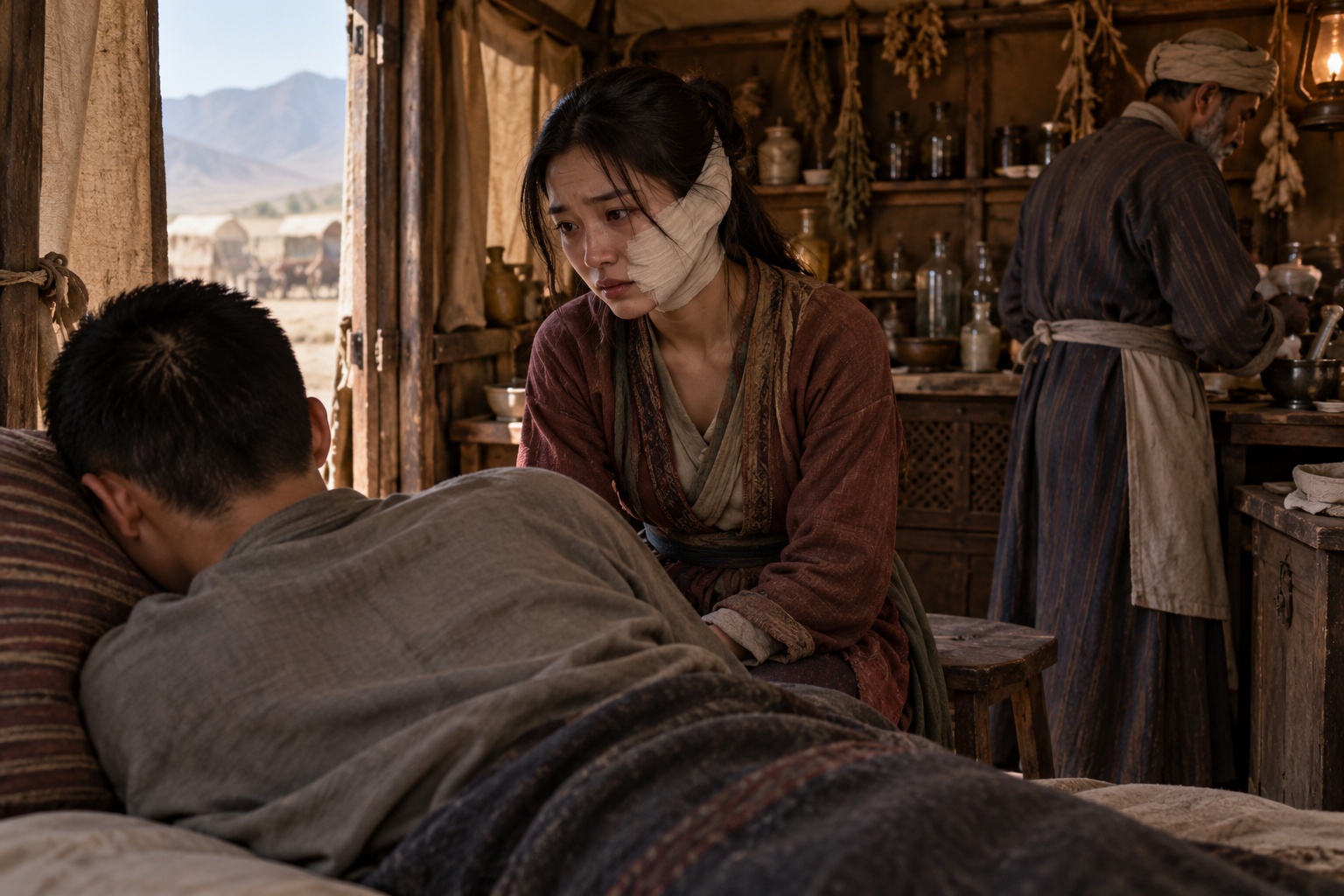
A Heron In a Rice PaddyI lay down and closed my eyes, and when I opened them again it was later afternoon, and Deng Weili was sitting on a stool beside my cot. For a moment I thought I was dreaming. Weili looked terrible. Her skin was pale and damp, there were dark circles beneath her eyes, and her hair was tied back carelessly. She seemed thinner than I remembered. Her entire left cheek was bandaged. She was watching me.
“Darius.”
I turned my head away and looked at Hakim Yusuf’s back. He was puttering about at his mixing table, pretending to ignore us.
“I heard what happened. I heard you killed two men, and that they almost killed you.”
I said nothing.
“I’m sorry.” Her voice trembled. “For everything. Most of all for letting you take my lashes. Karim hurt you so bad.” With this last comment, she began to weep.
I looked at her then, but I did not speak.
“I’ve been sick,” Weili went on, drying her eyes with her sleeve. “Meilin has been taking care of me.”
I looked away again.
“Do you remember,” Weili said softly, leaning in close to me, “what Arslan said before he left?
Just the mention of Arsan’s name made me grimace. I was so tired of all this.
“He said,” Weili continued, “that he wasn’t the one I really loved. He said…” She hesitated. “He said I loved you. I told him he was wrong, but I’ve been thinking about it, and I -”
I raised my hand to stop her.
“Darius, please. I just want to -”
I raised my hand again and turned my face toward the wall.
“It’s because I’m ugly now,” she said bitterly. “My face is scarred. You’re just another shallow man. You only pursued me when I was beautiful.”
I turned back to her and took a deep breath. I had resolved never to speak to her again, but I realized now that certain things had to be said.
“You are not ugly and never could be,” I said. “Once, outside of Deep Harbor, I saw a tall heron standing in a rice paddy. It was so graceful, so pure. To me, you are more beautiful than that. I wouldn’t care if your whole cheek was melted off. To me, you will always be a tiger prowling through the forest, or a bright star in the sky. I remember the first time I saw you, at the archery competition in Deep Harbor, the way you stood so tall and confidently, and fired your arrows fast and true like a hero from a legend. I knew you were special even then.” I paused and licked my lips. “I’m sorry you lost your parents. I’m sorry that life has not been kind to you. I know you need someone you can count on. I thought I could be that person for you. But you used me, and when Arslan appeared you threw me away. Do you remember all the ugly names you called me? A creep, a jealous child, a rat. I don’t know what you think love is, Deng Weili, but that is not it. If I were to take you back, and love you once more, I could never trust you again. No. I don’t want to have anything to do with you. I don’t want to speak to you again, except what the job requires. You go your way, and I’ll go mine.”
Weili looked stricken. She opened her mouth, but nothing came out. Slowly her face shaped itself into a controlled, hopeful smile.
“You look very cute with your hair short like that, did you know that?”
I said nothing. She took a breath, tried again:
“I don’t know why I ever thought you were too young for me. There isn’t a man here who has half your courage, except for the Captain of course.”
I said nothing.
Her composure broke. Her lower lip trembled. “Give me another chance,” she pleaded. “I can be everything you ever dreamed of. It won’t be like before, it will be so much more.”
“No.”
She slapped me, then pulled her hand back and gasped, shocked at what she had done.
Yusuf shot to his feet. “Weili! Get out.”
She stood, took a few steps toward the entrance, then turned. “Darius, I’m sorry.” A moment later she was gone.
The Way of ThingsI woke to twilight and the smell of something cooking outside.
Hakim Yusuf was nowhere to be seen. I sat up carefully and found a small bowl of dates on his table. I ate four of them, took two for Belly, drank some water, then dressed and gathered my things. I had spent enough time in the medical wagon.
Outside, the last traces of red had faded from the western sky. Most of the men were gathering for supper around the campfires, but I went to the water wagon. I made wudu, found a clean patch of ground and prayed Maghreb alone. When I was done, I found Belly tied with the other horses. He greeted me with a low nicker and pushed his nose against my chest.
“Yes, I know. Everyone is an idiot except you.”
He seemed to agree. I fed him the dates and he chewed them happily. Then I found his brush and spent some time working the dust from his coat. Belly stood quietly, occasionally turning his head to watch me. I brushed his neck, his shoulders and his broad back, then combed the tangles from his mane. It was something simple to do, and I liked the steady movement of my hand and the warmth of him beneath it.
When I finished, I took my pack and bedroll to the rear of the caravan, away from the campfires. I spread the bedroll on the ground and sat with my legs stretched out in front of me. Night had settled over the plain. Away from the fires the sky was crowded with stars, thousands upon thousands of them, more than I could ever see in Deep Harbor. My eyes wandered among them, picking out the constellations I knew.
I heard footsteps behind me, and glanced back. Captain Karim stood a few paces away.
“Why aren’t you eating supper with the men?”
“I don’t know.”
He studied me for a moment, then came over and sat beside me.
“A courier came from Herat. We are to dine at the palace tomorrow evening. I have to say, I’m happy about this. Prince Farhad could turn out to be a powerful benefactor. The bosses back home will be pleased. And we owe it to you.”
“I killed two men.”
“But it doesn’t bother you as much as it used to, does it? You feel like you should be bothered, but you’re not.”
I chewed on my lip. “Yeah. You’re right.”
“That’s the way of things.”
Then Karim said, “You put your hands on Corporal Bao today. You violated Five Star regulations and the proper conduct between a guard and his superior officer. Under any other circumstances, you would be disciplined.”
I gave a bitter laugh. “You want to give me those other three lashes now?”
“No.”
I looked at him. Was there anything in the world more solid than Captain Karim? A mountain could not be more dependable. He wasn’t friendly or kind, nor was he cruel. But you always knew where you stood with him. If my father was at one end of my life’s rope, and Zihan Ma at the other, then Karim was the firm earth on which I stood.
“What I want and expect,” he said, “is for you to apologize to Bao. Publicly.”
“Okay.”
“I mean right now. He’s sitting by the large campfire with the others.”
I looked toward the distant campfire. I could see the silhouettes of men gathered around it, eating and talking. “I just got comfortable.”
Karim grinned. “You’re a caravan guard. If you wanted comfort, you picked the wrong career.”
“So I’m learning.”
He stood. “Come on.”
Crispy RiceMost of the guards were around the campfire, sitting on blankets, crates and even saddles, eating supper from bowls and plates. Conversation quieted as we approached. Weili was there, on the opposite side of the fire from where I stood. I ignored her.
Corporal Bao was sitting on an overturned bucket. He looked up at me, then at Karim.
I stopped in front of him, aware of everyone’s eyes upon me. I spoke loudly enough for everyone to hear. “Corporal Bao, I’m very sorry. I had no right to grab you or threaten you. You are my superior officer. I apologize.” I wasn’t just going through the motions. I knew what I had done was unacceptable.
Bao stood. “And I apologize to you. I organized the betting pool. I thought it would be fun, but I didn’t stop to think about how it would feel to you.”
I nodded. “Alright.” We shook hands, and that was the end of it. I turned to walk away.
“Where are you going?” Bao called. “Sit down. Meilin saved a plate for you.”
Meilin was sitting on a folded blanket beside Longwei. She held up a wooden plate piled with rice, roasted lamb, flatbread and vegetables, along with a small bowl of yogurt. My stomach immediately reminded me that a few dates were not supper. I was ravenously hungry.
“Scoot over,” Meilin told Longwei.
Longwei muttered something under his breath, but moved.
I sat between them and accepted the plate. There was plenty of lamb, the rice had been spooned from the part of the pot where it had browned and crisped on the bottom, and there were no cooked carrots.
I looked at Meilin. “How did you know what I like?”
“Because we know you, Darius Lee.” She smiled. “You’re one of us. Even if you look like an adolescent kid now.”
Before I could stop her, she ran a hand playfully over my short hair.
“Hey!”
Everyone laughed.
I looked across the fire at Bao. “You didn’t bet on whether I’d stay for dinner, did you?”
That brought another round of laughter.
Bao raised both hands. “No more betting.”
“Let me tell you all,” Longwei said, “about the time I found myself rappelling down a cliff in Tibet to escape twenty angry Buddhist warrior-monks.”
I began to eat, and after that I made no more conversation, for the hot food going into my stomach was like a gift and a homecoming. From time to time I looked up, and every time I saw Weili watching me. I did not meet her eyes.
Folly and DeathAround the time I was taking the last few bites, someone said, “I can’t believe we’re in Persia. We made it.”
“You know we’ll get major bonuses when we get home,” someone else said.
“Don’t count your gold before you’ve struck it.” This was Meilin.
“I’m going to open a theater,” Memdooh said. “This caravan thing is too intense.”
“A bakery in Deep Harbor for me,” Weili said, and her voice was quiet, devoid of her usual confidence.
“Enough!” Longwei’s voice carried, even when he did not raise it. Everyone fell silent. “Enough of this moronic prattling. Don’t you all understand that there will be nothing to go home to? Take what you have earned so far and stay here, or go anywhere else.”
“What do you mean?” Meilin demanded. “What are you saying?”
“The war,” Longwei said. “The war, the war. Don’t you understand? The invaders who now ravage our country cannot be stopped. They had turned east when we left. They will gut the great cities of the southeast, then return to the heartland. Everywhere they go they slaughter the people and burn everything to the ground. They are giants, some of them twice our size. Their armor and weapons are better than ours. Everything we have attempted against them has failed. Some of you know this.”
“It’s true,” Weili said softly. “They burned my village and killed my parents.”
“Mine too,” someone else said. “They threw the bodies on a pyre.”
“We are a great nation,” Bao protested. “We have never been conquered.”
“Have you fought them?” Longwei asked.
Bao shook his head. “Five Star guards get exemptions.”
“I have. I served two years. I was one of the few who survived my tour of duty. I have seen battle trenches so full of dead men you could march right across. I have come face to face with the invaders. One of them did this to me.” He stood and pulled up his tunic, and the men gasped at the livid scar that ran from just beneath his neck to the bottom of his generous belly. “I pushed my own intestines back into my body. They have a champion.” His voice fell, and men learned forward to hear. “He is the size of a giant. He fights with a sword in one hand and an axe in the other, and no armor. Before every engagement he steps forward. The invaders’ commander issues a challenge. Beat the giant, and the invaders will abandon our country and return home. No one has been able to so much as wound him. He has killed three hundred men in duels. His name is White Wolf.”
The men repeated this name in fearful whispers.
“Darius could beat him,” Weili said.
Longwei threw his head back and laughed, and the sound was like a slap to the face. “Darius is a puppy with sharp teeth. He has been lucky so far. White Wolf would tear him to pieces as a lion tears the flesh from -”
Karim stepped out in front of Longwei. I had not seen him arrive. “Stop,” he said. “Your words are foul, and your call to abandon the caravan is tantamount to betrayal.”
I saw that Meilin had moved away from Longwei and was staring at him in horror.
“To resist the invaders is folly and death,” Longwei went on. His face was twisted into a bitter mask, and his words came quickly now. “Our emperor should surrender and submit our land to their rule. But he loves his power and wealth, and because of this, our nation will fall, and from sea to sea we will become bones beneath their feet. To return to our land is folly and ruin. Our future is one of red suns and redder soil, stained with the blood of -”
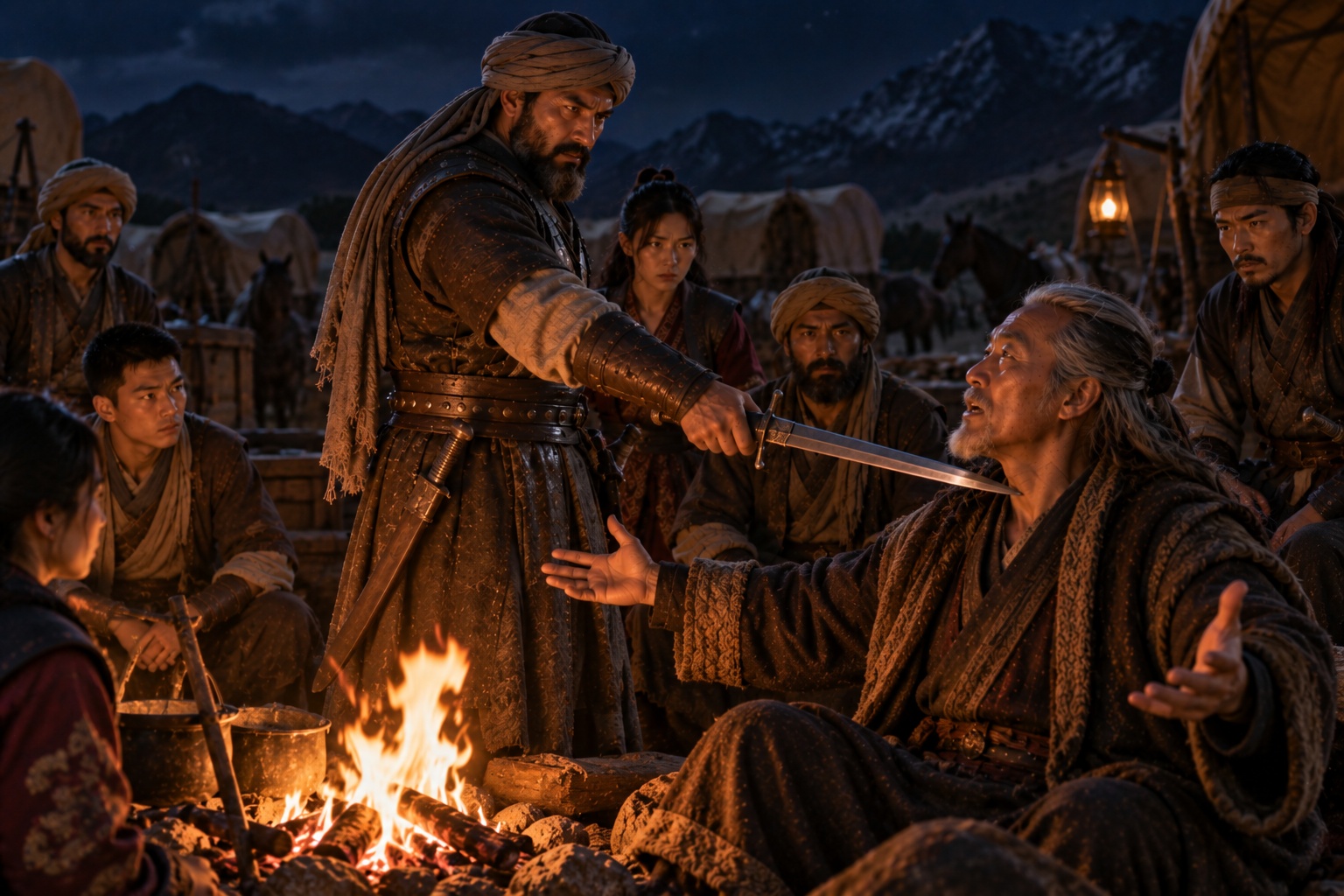
Karim drew his sword and put it to Longwei’s neck. “One more word,” he said, “and I swear, I will end your life right now.” He looked around. “Everyone go to your wagons and bedrolls, and forget the words of Shaytan you heard spoken here, for his job is to cast despair into the hearts of men. Do not believe him, for Shaytan is a liar, and has always been so, from the moment he tricked Adam and Hawa into eating from the tree.”
The men dispersed, as did I. Two conflicting thoughts battled in my head. One, called up by Longwei’s words, was the image of my father, his body rotting in a trench. The other was Karim’s final statement: Shaytan is a liar, and has always been so.
The two thoughts chased each other in circles in my mind, until Karim’s words won. Longwei’s tirade faded away. Lying on my bedroll without a sleeping bag – it was not needed in this warm climate – I watched the stars wheeling above me. I thought of Zihan Ma, Lee Ayi, Haaris, Far Away and Bao Bao. They would not be slaughtered, and the farm would not be burned. Allah would not let that happen, and – by the will of Allah – neither would I.
HeratThe next morning, not long after we had eaten, a troop of Persian cavalry appeared on the road. There were twenty of them, all in matching uniforms, carrying long spears and curved swords. Their officer spoke with Captain Karim and Ahmed, and we learned that Prince Farhad had sent them to escort us into Herat whenever we were ready.
The banquet was not until evening, but Karim saw no reason to wait. For the first time since the raid in Afghanistan, I put on my Five Star uniform. It felt strange after so many days in loose clothing and bandages, and the sword belt pressed uncomfortably against my back. Still, when I looked down at myself I felt more like a caravan guard again and less like one of Hakim Yusuf’s patients.
We were on the road before noon.
I rode Belly near the front with Karim, Ahmed and the other guards, while the Persian cavalry surrounded the caravan. I noticed that Meilin no longer rode with Longwei, and other guards seemed to keep their distance from him as well.
As we approached Herat, the traffic grew heavier. Farmers drove carts piled with melons, grapes and vegetables. Merchants passed us with laden donkeys and camels. There were Persians, Afghans, Uzbeks and people I could not identify, speaking languages I had never heard. Some men wore enormous turbans, others tall caps or fur hats, and the women seemed to favor bright colors and flowing garments.
Then we passed through the city gate, and I forgot about the people.
Herat was green.
After the barren mountains and dry plains we had crossed, I could hardly believe it. Water ran through channels beside the streets. Trees rose above garden walls, and vines spilled over them. Here and there I caught glimpses through open gates of courtyards filled with flowers and fruit trees. Beyond the rooftops rose slender minarets and great domes covered in colored tile.
A little farther on we passed a masjid grander than any building I had seen since Samarkand. Four impossibly tall minarets rose above the surrounding rooftops, and the entrance was framed by an enormous pointed arch covered in blue and turquoise tiles, patterned with flowers, stars and flowing Arabic calligraphy. Seeing it, my mouth fell open in astonishment. Beyond it I could glimpse a broad courtyard surrounded by arched galleries, with a row of fountains at its center for wudu.
It was astounding to me that men and women could build such things. I remembered the ayah in Surat Al-Baqarah where Allah tells the angels that He will create a khalifah for the earth:
˹Remember˺ when your Lord said to the angels, “I am going to place a khalifah on earth.” They asked ˹Allah˺, “Will You place in it someone who will spread corruption there and shed blood while we glorify Your praises and proclaim Your holiness?” Allah responded, “I know what you do not know.”
I could almost imagine that one of things Allah knew, and that the angels did not know, was this: “You cannot imagine what they will build.”
Neither could I, until I had embarked on this journey. I found myself staring back at the masjid until the wagons carried me out of sight.
The streets were so crowded that the caravan slowed to a crawl. People stopped to stare at us. I supposed forty-eight enormous Chinese wagons guarded by Chinese soldiers were not something the people of Herat saw every day.
There were camels everywhere. I had seen a few since leaving China, but here they seemed almost as ordinary as horses. Some traveled in long strings, laden with bales and baskets, moving through the crowds with their long necks held disdainfully above everyone else. Every time we passed them, I stared like a foreigner in a strange land, which of course I was.
Something struck me: this city did not stink. Deep Harbor had stunk of garbage, sewage, body odor, mud and salt. Yet this crowded city, which was hot and therefore should have smelled even worse, actually carried scents of jasmine and spice. And yes, camels too. That was unavoidable.
We followed the Persian cavalry deeper into the city until the streets widened and the crowds thinned. Ahead of us rose a massive fortified complex of high walls and towers.
I looked at Ahmed. “Is that the palace?”
He nodded. “The citadel.”
That reminded me of something.
“Who’s going to guard the wagons while we’re eating?”
“I don’t know. We’ll figure something out.”
I frowned. Five Star had already lost one wagon to the Afghans and most of the Silk Store to the fire. What remained belonged to the company, and I couldn’t imagine Captain Karim leaving it sitting outside the palace while every guard went inside to eat roasted lamb with a prince.
A Little NaiveteThe citadel gates opened.
Our Persian escort rode through as a gate guard waved us in.
The first Five Star wagon followed them, and the guard kept on waving.
I stared. “We’re all going in?”
Apparently we were.
One by one, all forty-eight wagons passed beneath the gates. The horses, the drivers, the servants, the guards, everyone. Persian soldiers directed us into an enormous outer courtyard where there was room for the entire caravan. More soldiers stood along the walls and at the gates.
I laughed. So that was who was going to guard the wagons.
The palace itself rose beyond another set of walls. It was unlike anything I had seen in China. Arched entrances were covered in intricate blue and turquoise tile, and beyond them I could glimpse shaded courtyards, gardens and fountains. Everything seemed designed on a scale meant to remind a visitor that whoever lived here possessed more wealth and power than he did.
Memdooh rode up beside me, staring.
“I’m definitely going to write a poem about this.”
“That’s great,” I said, “but it still won’t be as good as:
I ride from a northern land,
curved sword in my hand.
I’m young but I’m hard,
for I’m a caravan guard!”
Memdooh turned slowly toward me, then he gave me an appreciative smile. “That was a good one, huh? It seems a bit… naive now.”
I shrugged. “Maybe a little naivete is a good thing.”
Happy WagonOnce the caravan was settled in the courtyard, the drivers unharnessed the teams and led the horses away to be watered and fed. Persian servants showed us where we could draw water, and Captain Karim immediately tasked men to inspect and repair the wagons.
Hakim Yusuf found me while I was helping unsaddle Belly.
“Come to the medical wagon when you’re finished. I want to look at your back and change the bandages.”
“I will. There’s something I want to do first.”
I made my way through the rows of wagons until I found the Happy Wagon. I recognized it immediately by the flowers painted along its sides. I knocked on the wooden frame.
Kuangren pulled back the curtain. His face brightened when he saw me.
“Darius! Come in.”
I removed my boots and climbed carefully inside.
I had never been inside the Happy Wagon before, and I was surprised by what they had made of it. A colorful carpet covered the floorboards, and cushions were arranged along the walls for sitting. Their belongings were neatly stored in baskets and wooden boxes, and little touches here and there made the wagon seem less like something used to haul goods across the world and more like a tiny home.
Gulnur sat propped against several cushions. I remember the first time I’d seen this daughter of a Kyrgyz chieftain. Her entire tribe had ridden hard out of their city, in pursuit of Kuangren the scoundrel, who had apparently dishonored her. She’d carried a bow on her back and a knife at her hip, and she had seemed like a falcon, fierce and uncontrollable.
Since she’d been wounded at the raid, however, she had lost a great deal of weight. Her face was thin and her hands looked almost delicate, but when she saw me she smiled.
“Darius.”
I sat across from her. “How are you?”
“Better every day. Hakim Yusuf says I will recover completely. I only need time.”
“Alhamdulillah for that. I’m so glad.”
Kuangren sat beside her, cross-legged, and took her hand in his. He hardly resembled the drunken, carousing rebel who had caused Captain Karim so many problems in the early days of the journey. He was quiet now. In his other hand he held a sabha, moving the beads slowly through his fingers.
“Do you remember,” I said to Kuangren, “when Karim threatened to nail your boots to a wagon with your feet inside them?”
He laughed, but before he could say anything, Gulnur patted him on the head, the way one would do to a child. “No need for that anymore.”
Kuangren put on a mask of pretend anger. “You’d better stop that, woman, or you’ll see just how wild I can still be.”
“By all means,” she replied. “Show me.”
I cleared my throat uncomfortably. “I wanted to tell you both something,” I said. “Both of you fought extraordinarily well in the raid. You held your position even when the Afghans swarmed us. You did exactly what needed to be done. I am sorry how it turned out.”
Kuangren looked at me for a long moment.
“We were only following your commands, Darius,” he said. “And we would do the same today, tomorrow or next year. There is nothing to apologize for.”
My eyes suddenly filled with tears. I rubbed them quickly with the heels of my hands and stood.
“I have to go. Hakim Yusuf wants to change my bandages.”
Gulnur smiled. “Go. Before he comes looking for you.”
I paused at the doorway. “We call this the Happy Wagon, did you know that?”
Kuangren smiled. “It is well named.”
I studied him, remembering how he’d been forced under threat of death to convert to Islam and marry Gulnur.
“No regrets?”
Before he could speak, Gulnur reached out and covered her husband’s mouth with one hand.
“Goodbye, Darius.”
* * *
Come back next week for Part 27 – The Prince’s Ring
Reader comments and constructive criticism are important to me, so please comment!
See the Story Index for Wael Abdelgawad’s other stories on this website.

Wael Abdelgawad’s novels – including Pieces of a Dream, The Repeaters and Zaid Karim Private Investigator – are available in ebook and print form on his author page at Amazon.com.
Related:
The post Far Away [Part 26] – Shaytan Is A Liar appeared first on MuslimMatters.org.
Israeli soldiers, settlers kill two Palestinian teenagers in occupied West Bank.
Brandeis researchers backed by the American Jewish Committee try to explain away their own devastating finding.
Settler violence is driving Palestinians out of their homes.
Dublin government enables weaponization of anti-Semitism.
Eyal Weizman on why the soil matters. Jon Elmer on whether the US can rebuild its bases. Democrats fight Trump but erase Palestine. US “terrorism” sanctions for Palestine Action.
Israel’s Itamar Ben-Gvir dreams of Palestinians being fed into a concentration camp on conveyor belts. Will Berlin supply the equipment?
Today marks the launch of the SIXTH year of the Muslim Book Awards!
The Muslim Book Awards (MBA) is an annual celebration of Muslim voices in publishing, from mainstream publishers, Islamic publishers, or authors who self-publish. Hosted by MuslimMatters.org and featuring a panel of well-known Muslimah reviewers from Bookstagram, the MBA takes in nominations before finally judging the entries and announcing the winners on MuslimMatters!
MuslimMatters is proud to host the Muslim Book Awards.
What is Muslim Bookstagram?
Muslim Bookstagram is the unofficial name for the niche space on Instagram where Muslim book lovers reside! It is a vibrant community of readers, writers, librarians, bookstore owners, and all those who are bookishly inclined.
Book reviews are shared, new and old publications highlighted, and deep discussions about publishing, representation, and storytelling are had. Muslim Bookstagram has become both an amazing space for valuable conversations and a resource for Muslim parents, as well as anyone else interested in diverse, representative literature.
Who are the judges of the MBA 2026?Amire Hoxha is a mechanical drafter by trade, a reader by heart, and the author of “AMAR’S FAJR REWARD“! Her meticulous nature helps her identify quality and assess books. Aside from her online presence, Amire has established, curated and grown her local masjid library for 7 years. Her background in Islamic knowledge has made her an authentic resource for Muslim parents wanting authentic Islamic books. Follow her on Instagram: @muslimkidsbooknook
Shifa Saltagi Safadi is the author of , SISTERS ALONE (Putnam 2026), KAREEM BETWEEN (Putnam 2024), the AMINA BANANA chapter book series (Putnam 2025), the picture book THE GIFT OF EID (Holiday House 2025), and indie Muslim published SPELL IT LIKE SAMAR (2019), HEAVEN AT MAMA’S FEET (2021) and PEPPERONI, PITCHES, AND OTHER PROBLEMS (2021). Shifa shares her favorite Muslim books on her online instagram bookblog @muslimmommyblog and is an ELA middle school teacher, so books are basically her whole life! Shifa was born in Syria and immigrated to the US with her parents as a young girl. She lives near Chicago (GO BEARS!) with her husband and four children.
Kirin Nabi is a former Islamic School Librarian who now stewards three little free libraries, and posts about children’s and YA books by Muslim authors or books containing Muslim characters at www.islamicschoollibrarian.com. Find her on Instagram: @islamicschoollibrarian
Zainab bint Younus is a Canadian Muslim woman who writes on Muslim women’s issues, gender-related injustice in the Muslim community, and Muslim women in Islamic history. She also provides in-depth book reviews of Muslamic literature on her Instagram account, covering everything from YA and adult fiction, academic treatises, and Islamic religious literature. You can find her on Instagram (@bintyounus) and support her via Patreon.
Follow the Muslim Book Reviewers on Instagram to keep up with the latest news about the Awards, catch up on previous finalists and winners, and a peek at what the judges have in store!
Calling all Muslim authors, illustrators, and publishers!Submissions are restricted to Muslim authors, illustrators, and publishers. If you’ve written, illustrated, or published a Muslim-books-awards-worthy book, we want to know about it!
Application Requirements: Written by a Muslim author
A Muslim story: The story must involve clearly Muslim characters and at least some reference to elements of Islam.
Islamically appropriate: The story must not promote beliefs or actions that are clearly prohibited by Islam or go against Islamic values. This does NOT mean that characters don’t experience serious conflicts or go through challenges; it does mean that the final message should not be something that promotes unIslamic beliefs or actions (e.g. shirky beliefs, promoting LBGTQ relationships, praising zina).
Published between January 2026-December 2026.
English language: Unfortunately, we do not have the resources or ability to include non-English-language books.
Must be prepared to provide complimentary physical copies to all 4 judges. (One mailed out to each judge at their personal address. No special mailing requests will be permitted.)
No AI, whether used for writing or illustrations.
Additional notes:
Books that are NOT the right fit for submissions:
Click here to submit your favorite Muslim publication of 2026 for the Muslim Book Awards!
Submissions will close on September 15, 2026, and winners will be announced in January 2027! There’s not much time, so hurry to submit your books today!
Related:
The post The Muslim Book Awards 2026 appeared first on MuslimMatters.org.
Mike Rogers isn’t merely campaigning alongside a controversial supporter. His campaign put an extremist on its faith leadership team
Hasan Piker.
Turn on cable news. Pick up a newspaper. Log on to Twitter. It doesn’t seem to matter where you get your political news: for the past month, the leftist Twitch streamer has become one of the dominant subjects of coverage, conversation and controversy surrounding the crucial Michigan Senate race between the Democrat Abdul El-Sayed and the Republican Mike Rogers.
Continue reading...Darius awakes in a strange land, only to stumble into the midst of an assassination attempt—and once again finds himself fighting for his life.
Read Part 1 | Part 2 | Part 3 | Part 4 | Part 5 | Part 6 | Part 7 | Part 8 | Part 9 | Part 10 | Part 11 | Part 12 | Part 13 | Part 14 | Part 15 | Part 16 | Part 17 | Part 18 | Part 19 | Part 20 | Part 21 | Part 22 | Part 23 | Part 24
* * *
Vendor of Your SoulMy father sat across from me beside a campfire, sharpening a knife on a whetstone. Sparks rose into the darkness above us. He looked older than I remembered, with short hair that had gone entirely white.
“You look terrible, son.”
“I have killed many men.”
He shrugged. “So?” He speared a pear with his knife, and took a bite.
I stared. “I thought you were allergic to pears.”
He gave me a smile that raised goosebumps on my skin, and after a moment I realized it was because I had almost never seen him smile.
I gathered my thoughts. “I never wanted to kill anyone. I didn’t want to kill the blue-eyed man. He was Muslim.”
“So are you.”
I looked away. “I told him to stop. I called him brother. But he made me kill him. And my girl left me, and I saved her, and I got whipped anyway. I don’t want to be here anymore. I hate them.”
My father took another bite. “You know what I didn’t understand when I was alive?”
“What?”
He looked up, and there was a peacefulness in his gaze that I had never seen before. It made him look like a completely different person. Was this the father I could have had? A man who would have loved my mother and I, and treated us kindly? This thought nearly shattered my heart.
“I studied Islam, did you know that?”
I shook my head. “No.”
“I had all the best tutors. Religion, poetry, martial arts, mathematics. But I was a rebel. There is a hadith, one of An-Nawawi’s forty. You may have heard it. The last part says, “The Quran is a proof either for you or against you. Every person starts his day as a vendor of his soul, either freeing it or causing its ruin.”
I nodded my head. “Zihan Ma taught me that one, but I don’t understand it.”
“Every day you wake up and you have a choice. Obey Allah or not. Be an agent of light, or an agent of darkness. Be a healer, caravan guard, painter, poet, blacksmith or robber. But sometimes the initial choice leads you to situations where you are compelled. Being a caravan guard means you must fight. Yet every day is a new sunrise. If you’re not happy with the choice you made, make a different one. The world is vast. I was a poor vendor of my soul. Be better than me.”
“I’m not better than you. You robbed people. You made merchants kneel in the dirt. I saw noblemen beg for their lives. But you never killed anyone.”
“I did later, as a soldier.”
I stared into the fire. “That’s different. You killed the invaders. You’re a better person than me.”
My father barked a laugh. “Not even in your dreams.” He took another bite of the pear, then stretched his arms languidly. Though his hair was white, his arms were well muscled. I flinched as a starling came flitting out of the darkness and landed on his shoulder.
Of course, I realized. This is a dream.
Nevertheless, here was my father sitting in front of me.
“What do you mean?” I asked.
He smiled ruefully. “I was a drunk and a criminal. I neglected you on the best days, and beat you on the worst. You, on the other hand, have a heart as big as the empire. You are sweet and kind, and not afraid to follow your own path. You are the only good thing to come from my life.” His voice broke, and he covered his eyes with one hand. “I love you, Darius.”
My Hair!I awoke to find my eyes brimming with tears.
Hakim Yusuf’s blurry face floated above me. Daylight filtered through the canvas roof of the medical wagon, and I could hear the familiar creak and rattle of wheels. We were moving. Hooves clopped against hard ground outside.
I was lying on my stomach. When I tried to move, pain tore across my back. I cried out and went rigid, gripping the blanket beneath me.
“Easy,” Yusuf said. “I’ll help you sit up.”
Just the act of sitting up made my vision go red with pain. My back hurt so much I could hardly breathe.
“Drink.” He brought a cup to my lips and I drank cautiously. The water was cool and sweet, but my throat seized and I immediately coughed, spraying half of it down my chin.
“Slowly,” Hakim Yusuf said. “The water is not going anywhere.”
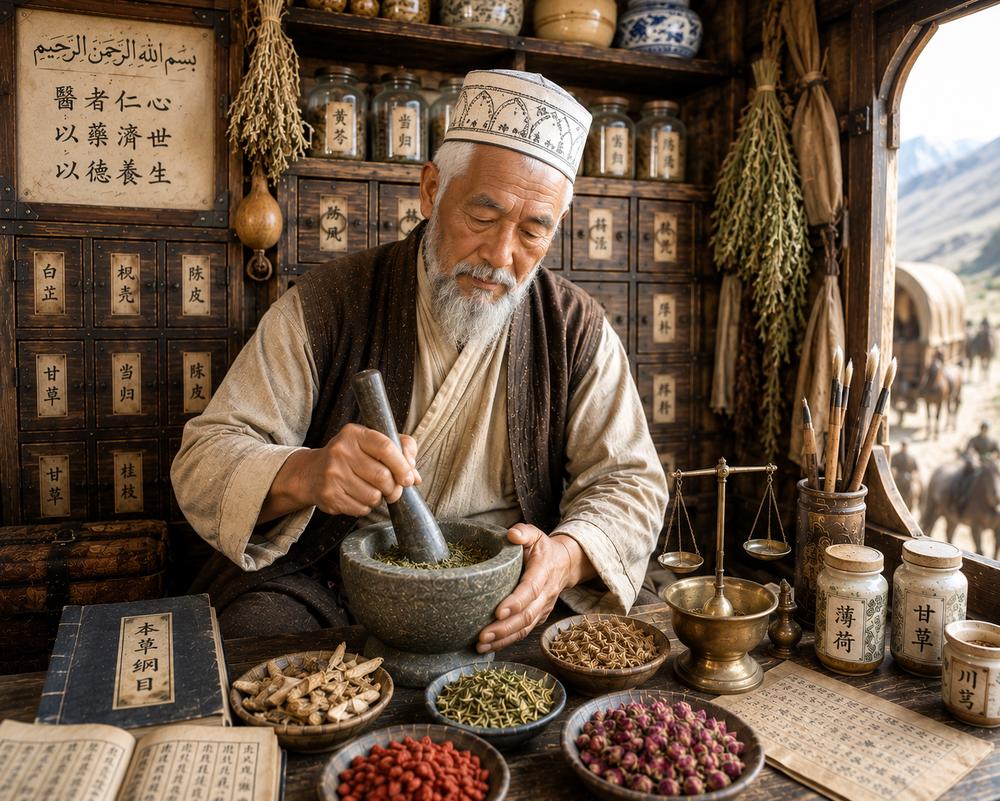 My mouth tasted foul, like smoke and old medicine. My throat was still raw, though not as bad as before. I could smell herbs, sweat, vinegar and something bitter that I associated with Yusuf’s medicines. Beneath it all was the warm, dusty smell of the wagon itself.
I lifted my hand to push my bangs out of my eyes, as I typically did in the morning, and realized that I didn’t have any bangs. My hand shot to my head, and my eyes widened as I felt a scalp covered with close-cropped hair – little more than stubble.
My stomach dropped, and I felt like I might cry. “My hair! Hakim, what did you do to me?”
His expression was solemn. “Much of your hair was burnt off in the fire. I had to cut it all short to check for scalp burns.”
The fire. I had forgotten. Memory returned in pieces. Fire. Weili screaming. Arslan on the floor. Smoke so thick I could not breathe. Karim pacing before us with his hand on his sword. I remembered gripping the wheel of the Spice Market. The whip cutting me open. The smell of cassia, and the memory of my mother making a cupcake. Karim counting, Seven! Then nothing.
“I need to see what I look like.”
Yusuf brought a small handheld mirror, and held it before me. I gazed at my reflection mournfully, hardly recognizing the apparent child who gazed back.
“I look like I’m thirteen years old. Now Weili will really think -” I cut myself off, remembering that I no longer cared what Deng Weili thought.
I chewed my lip, remembering Weili’s burned face and pitiful weeping. I wanted to know how she was. I wanted to know if Yusuf had successfully treated her cheek, and if she was alright. Why wasn’t she here in the wagon? Where was she? I wanted to know many things, and I almost asked. But I remembered her professing her love for Arslan, and shouting that she needed him, even after he rejected her while I nearly died saving them both. In the end I held my tongue.
“Weili is going through opium withdrawal,” Yusuf said. “Meilin is caring for her. It is an agonizing process, and she must suffer through to the other side.”
“I didn’t ask.”
He shrugged. “Nevertheless.”
They All Hate MeI sighed. “Did Karim finish the ten lashes?”
“No.”
“Why?”
Yusuf stared at me as if the answer should have been obvious. “You fell unconscious.”
“Karim said if I fell, he would tie me to the wheel.”
“He didn’t.”
I took a deep breath, let it out. “I don’t know what I’m doing here anymore. They all hate me.”
He put the cup to my lips again. “Drink again.”
I obeyed, more slowly this time.
“Did you hear what Meilin said before you were whipped?”
I thought, then shrugged. “Something about chopping off my foot?”
He laughed. “That was sarcasm. She requested to take half your lashes.”
“She did?” I was very surprised. Meilin of the barbed tongue? Meilin the hard case? Meilin, who’d beaten me black and blue with a wooden sword, wanted to share my punishment?
“Why would she do that?”
“Because people here care about you and admire you. Even the Captain. Otherwise he really would have tied you to the wheel and finished the ten.”
Not Your FatherI looked at Yusuf. I remembered being on my hands and knees in the snow, unable to stop coughing. I remembered his arms around me. I remembered him saying, I know it hurts. I’ll take care of you. I’m with you. Don’t be afraid.
The people of Five Star were my comrades. I fought beside them. Ate with them. Slept beside them. Some I liked, and some I did not. Maybe they hated me, maybe they admired me as Yusuf said. Captain Karim had trusted me with rank and responsibility, and I respected him, but then he’d whipped me. In my mind I understood the necessity, but it still galled me.
Yusuf was different. If I were weak, he would not despise me. If I failed, he would not turn away. When I killed, he did not glorify it. He wanted nothing from me except that I live and be well. He was perhaps the only true friend I’d ever had.
“You are nothing like my father,” I said.
He gave me a surprised look. “Sorry.”
I laughed, which caused my shoulders to move, which pulled on the skin on my back, and I followed the laugh with a groan. “Don’t be sorry. My father was not kind. Except in my dreams, where he’s apparently a great guy.”
“Maybe I’m more like your uncle, the healer.”
“No. Well, yes, in some ways. But he didn’t trust me.”
“Darius…” Yusuf sat on his stool and exhaled loudly. “You are… I can’t think of a good word. You are endowing me with qualities I do not possess. That’s normal, because I am a healer, I care for you. But that’s my job. I get paid for it. You could be a murderer of innocents, and if you were brought to me injured I would treat you. I’m not your father or your uncle, and because of that I don’t have to discipline you when you misbehave. I don’t have to argue when you make poor choices. I don’t have to decide whether to trust you or not. All of this makes me seem like the most kind, gentle, loving man in the world, when in reality I’m just your physician. For all you know, I’m a complete bastard in my personal life.”
I chewed roughly on my lip. “Why are you saying these things?”
“Because I don’t want you to compare your father or uncle to me and find them lacking. They carried responsibilities that I do not. I don’t know either one of them, but I am absolutely sure they both loved you, even if they made mistakes. As for me, don’t make me into something I’m not. I like you very much. You’re a good kid. You’re smart, brave and tough, and you’d make a great healer. But I’m your physician, Darius. Don’t ask me to replace your father or your uncle.”
These words hurt, but what could I say? What I said in the end was, “Okay.”
He sighed. “Let’s get some food in you.”
A Measured DoseHe brought me a small bowl of broth with bits of shredded meat and soft-cooked grain, and three dates. I had not realized how hungry I was until I smelled it. Yusuf fed me a few spoonfuls at a time. The broth was salty and rich, and might have been the finest thing I had ever tasted. After half the bowl, however, my stomach rebelled.
“No more.”
He nodded. “I would have stopped you anyway.”
As for the dates, I wrapped them in a cloth napkin and stuffed them into my trousers pocket to give to Belly later.
When Yusuf lowered me onto my stomach again, the movement pulled at the wounds across my back. I clenched my teeth and buried my face in the bedding until the pain subsided.
Yusuf watched me.“I can give you something for the pain.”
“What is it?”
He hesitated long enough to make me suspicious. “Opium.”
I raised my head. “No way. Are you crazy?”
“Darius -”
I made a slashing gesture and shouted, “No!” The sudden movement sent another sheet of pain across my back, and I gasped.
Yusuf regarded me with kind eyes. “Listen, please. It’s not the same thing Arslan was using. Yes, it’s the same plant. But he was cooking it over a lamp and smoking it for pleasure. I am giving you a measured dose as medicine. You are injured, you are in great pain, and your body needs rest.”
I said nothing.
Yusuf rested a hand on my arm.
“You trust me, don’t you?”
“Of course,” I said softly. In spite of his words about being a bastard – which seemed silly – at that moment I trusted him more than anyone else in the world.
Hakim Yusuf measured the opium with great care, dissolving it into a little warm water before holding the cup to my lips.
“Not too fast.”
I drank. It was bitter, and I made a face.
Yusuf took the cup away. “Now sleep.”
“I’m not sleepy.”
“Wait.”
I wanted to tell him that he was wrong, the medicine wasn’t working, I must have a natural immunity or an especially strong constitution, maybe because I was a martial arts expert – but before I could formulate an argument, something changed. The pain in my back did not disappear all at once. Rather, it began to recede, flowing away from me like a tide. The throbbing in my leg went with it, followed by the ache in my burned hands and arms. A delicious tingling spread outward from my belly and chest, running through my veins like a warm river until it reached my fingertips and toes.
I sighed.
For the first time since the raid, nothing hurt.
My body sank into the bedding. I could hear the wheels turning and the mules plodding along, but the sounds were distant, as if the caravan were traveling away from me rather than carrying me with it.
So this was the feeling Arslan had been chasing.
The thought troubled me, but only for a moment.
Waves of HeatWhen I opened my eyes again, I was hot.
Not merely warm. Hot. My skin was covered in a sheen of sweat, my mouth was so dry that my tongue seemed stuck to the inside of my cheek, and my bladder felt ready to burst.
I pushed myself upright and groaned as the wounds across my back pulled tight. The pain was still there, but it was nothing like the agony of the last time I had awakened. I sat for a moment with my head bowed, waiting for the dizziness to pass.
“Alhamdulillahil-ladhi ahyana ba‘da ma amatana wa ilayhin-nushur,” I muttered. All praise is due to Allah, who gave us life after He caused us to die, and to Him is the return.
Ahmed had taught me that. I said it every day upon awakening.
Passing my hands over my head, I discovered once again that my hair had been shorn. What an embarrassment. Although I had to admit that the feeling of the rough stubble beneath my palms was interesting.
The medical wagon was empty. Sunlight poured through the open rear flap. I was wearing nothing but my trousers and the bandages that encircled my torso. I filled a tin cup from the water jug and drank deeply. My hand was surprisingly steady.
I could not strap my dao across my back – it would hurt too much – so I put on a belt and hung the scabbard from my hip. Then I climbed barefoot from the wagon, and the sun struck me like an open furnace. What was this place? Why was it so hot?
I stopped with one hand on the wagon and squinted upward. The sky was a hard, brilliant blue, and the sun blazed almost directly overhead. I had known hot summer days in my homeland, but I had never felt heat like this. For one confused moment I wondered if I had actually died, and the prayer I had just recited had been more appropriate than I realized.
Was this the Day of Judgment?
I had read that on that Day the sun would be brought close over the heads of humankind, and people would sweat according to their deeds, some so deeply that they would nearly drown in it. I looked around half expecting to see the dead rising from their graves.
Instead I saw the Five Star caravan.
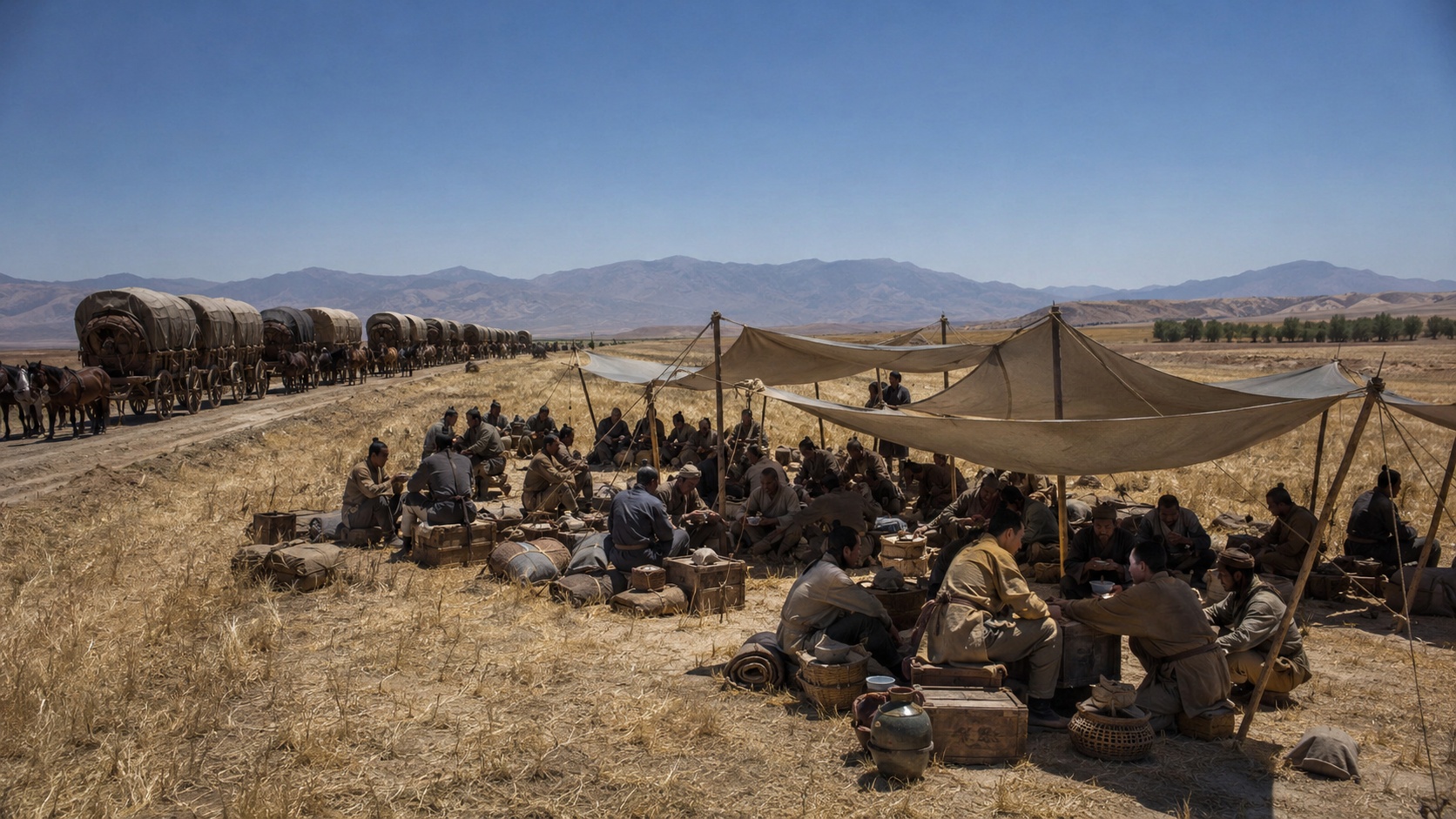
The wagons stood in a long line beside a dusty road, their canvas covers glowing white beneath the sun. Beyond the road stretched a field of tall brown grass, baked nearly golden. Something about this reminded me of my uncle’s safflower fields, even though the color was different. Waves of heat shimmered, making the distant landscape quiver as if I were seeing it through water. Far beyond that, impossibly, rose a range of great mountains with snow gleaming on their peaks. Hadn’t we just been in those mountains? I frowned, but no sensible thought came to my mind.
Our horses and mules grazed in the dry field, and perhaps thirty of the guards had gathered beneath several awnings. They were eating, talking and laughing, throwing dice, playing xiangqi, and – in one group – studying the tall, narrow cards used in the game of ma diao. Someone shouted at someone else, followed by a roar of laughter.
I needed to relieve myself rather urgently, so I went the other way.
An Awkward GaitI slipped between two wagons and found myself looking across an entirely different landscape. Here the brown grass ended abruptly at a broad canal, and on the far side of the water stretched an immense field of green. Men on horseback were riding hard in the distance, racing back and forth across the field. Their shouts occasionally carried to me on the hot wind, along with the faint thunder of hooves.
I was alone on this side of the wagons.
Farther ahead, beyond the end of the caravan, a small grove of trees grew beside the canal. That would do for privacy.
I started toward the grove, moving as quickly as I could manage. This turned out to be more difficult than I had expected. My limbs felt like a collection of branches bound together with strips of cloth, each one functioning without consulting the others. My eyes were crusted with sleep, my gait was awkward, and my stomach felt like a yawning cavern. I could not remember the last time I had eaten.
The dust was hot beneath my bare feet. The canal beside me looked as cool as an autumn morning. I could imagine kneeling there, plunging my face into it and drinking until my stomach was full. But Hakim Yusuf had warned me more than once never to drink water that had not been boiled.
I trudged on toward the trees.
Two For You, One for MeSomething bumped me between the shoulder blades and I nearly jumped out of my skin. I spun, and found myself staring into the enormous brown eyes of a short, sturdy black horse with a white stripe down his forehead and back.
“Belly!”
I threw my arms around his neck and pressed my face against him. He stood patiently while I hugged him. I had not realized until that moment how badly I needed to see someone I loved.
He smelled different. There was something unfamiliar in his coat, a dry, dusty smell mixed with grass and some flower I could not identify. I buried my face in his mane and breathed it in.
“I missed you, buddy.”
Belly immediately began sniffing me. He pushed his nose into my trouser pocket.
“I don’t have anything.”
He snorted and nosed the pocket.
“There’s nothing there.” I shoved a hand into my pocket and encountered a small bundle wrapped in cloth.
“Oh.”
I pulled it out. Three dates lay inside a cloth napkin, somewhat squashed but otherwise intact.
Belly snorted. I held out two dates and Belly swept them up with his lips and chewed noisily. A moment later he worked the pits to the front of his mouth and spat them into the dust.
I laughed, then ate the third date myself, upon which Belly stared at me balefully.
“What? You had two. I had one. That’s fair.” I tucked the empty napkin back into my pocket. “I need a ride, buddy.”
I put one foot into the stirrup, pulled myself upward and immediately felt the wounds across my back stretch. I hissed through my teeth and nearly dropped back to the ground, but Belly stood perfectly still, and I made it.
I patted Belly’s neck. “Let’s go.”
Upon reaching the grove, I brought Belly to a halt in the shade of the first trees and slid carefully to the ground.
“Wait here.”
He flicked an ear.
“I mean it. Don’t go anywhere.”
Belly lowered his head and began tearing at a patch of grass.
The shade felt wonderful after the merciless sun. I picked my way deeper into the grove, stepping carefully over roots and fallen branches with my bare feet. Cicadas buzzed overhead, their shrill chorus rising and falling. The trees were mostly oak, but there were also many tall trees that were heavy with bunches of pink seed pods. Some had split open, and I realized to my surprise that these were pistachios. In my country these were quite expensive, but apparently here – wherever this was – they grew wild. Amazing, subhanAllah.
It was all very foreign, and I had a feeling I might still be dreaming. If my father showed up with a starling on his shoulder, I’d know for sure.
A small stream trickled between the trees. Perfect. I relieved myself, then bent down and washed my hands in the stream. The cool, fresh water felt like a gift from the Creator, which it was. I rinsed out my mouth, then my nose, then washed my face thoroughly. I realized that without even meaning to, I was performing wudu. I would pray in the grassy field, then I would collect an armful of pistachios for myself and Belly. As I washed, the memory came to my mind of my dream father saying, “I love you, Darius.” Why had he said that? My eyes welled up, and I splashed water onto my face. Stop being silly, I told myself. This might all feel like a dream, but it’s not.
AssassinsI was washing my feet when I heard horses approaching from somewhere on the opposite side of the grove from where I had entered. I continued my ablutions, unworried. The hoofbeats came closer, then slowed and stopped. I heard the creak of saddles, the jingle of tack and the soft thump of feet hitting the ground.
There came the faint but unmistakable sound of footsteps on vegetation. Leaves crackled softly. Dry twigs broke. Whoever it was moved stealthily, but total silence was impossible in a dry forest like this one.
There was no conversation, no words spoken at all. That bothered me.
Complacency is deadly.
My father used to say that during our training sessions, usually when I was soaked in sweat and so exhausted that I could barely lift the wooden dao. Sometimes he would wait until I thought the lesson was over, then suddenly rap me on the head with his sword.
The moment you think nothing can happen to you is the moment you’re most vulnerable.
I was done washing, but my gut told me to wait and stay silent. I remained crouched beside the stream, listening. A branch cracked somewhere ahead. By luck, I had positioned myself beside a screen of bushes. The leaves were thick enough to conceal me but offered gaps through which I could see.
Two men were moving through the trees.
They did not look like Afghans, nor any of the races I had seen so far on the journey. Both had dark hair and heavy beards, and wore loose trousers tucked into leather boots, with long tunics belted at the waist and sleeveless outer coats. All their clothing was dark in color. One wore a wrapped black turban, while the other had a rounded felt cap. Their noses were long and straight, and their eyebrows heavy. Their faces were deeply browned by the sun. Each carried a recurved bow in one hand and wore a quiver high across his back.
The bows did not alarm me. Half the men I had encountered since leaving my homeland seemed to carry them. It was the way these two moved that troubled me. They placed each foot carefully and made almost no sound beyond the sort of rustling a fox or hare might make. Neither spoke or even looked at the other. They seemed to know exactly where they were going.
I stayed low and watched.
The men reached the far edge of the grove and crouched among the trees overlooking the great green field. I studied the field carefully for the first time. From here I could see the horsemen more clearly, racing back and forth in groups, wielding long wooden mallets as they chased a small ball between the pounding hooves. This was a more sophisticated version of a game I had seen Uzbeks playing with a stuffed sheep’s stomach. Even from this distance I could hear the shouts of the players. The men playing wore colorful, ornate clothing, except for one who was dressed all in white. Around them, on the edges of the field, were stationed a few dozen guards all dressed in identical brown uniforms, and wearing swords. The polo players must be nobles or very wealthy merchants.
Suddenly those shouts changed as a horse went down.
It happened so quickly that I could not tell why. One moment the man in white was galloping across the field, and the next the animal pitched forward and rolled onto its side. The man in white was thrown, and rolled rather expertly. Men cried out. Several horsemen wheeled around and galloped toward him, while guards came running from the edge of the field. The fallen horse thrashed violently, its legs kicking at the air. The man in white stood and waved at the others to indicate that he was alright.
Trained KillersThe two men in front of me each drew an arrow from his quiver, nocked it and raised his bow. They were assassins! They were aiming at the man in white. I had no idea who he was. I did not know why they wanted him dead. No matter the reason, I could not stand hidden among the bushes and watch two men murder an unarmed man.
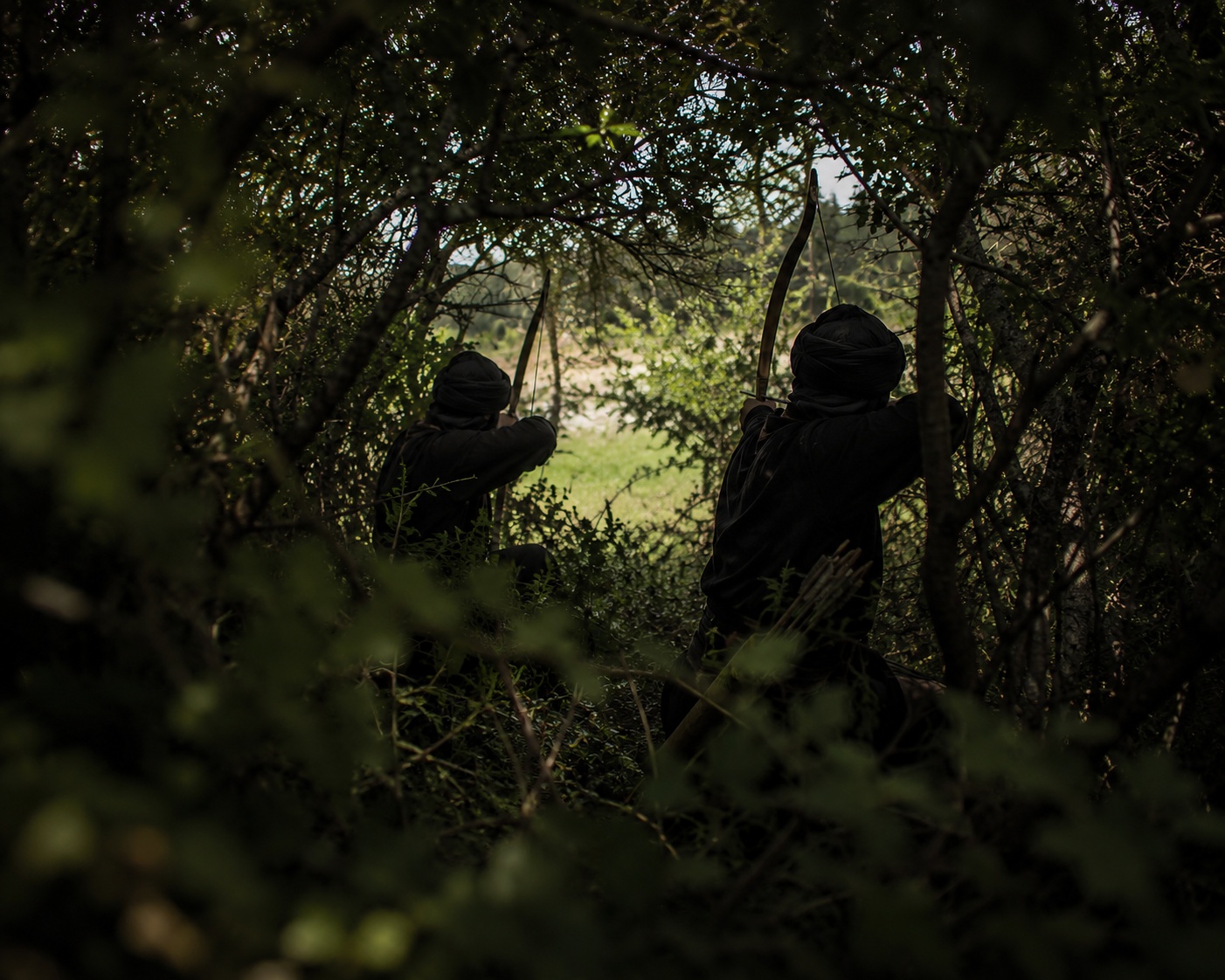
I came to my feet in a smooth motion. All my earlier clumsiness vanished. I drew my dao and charged, as I shouted, “Allahu Akbar!”
Both men jerked in shock and released their bowstrings. One arrow flew out across the field, but the other man had already begun turning toward me when he loosed. His arrow struck a pistachio tree with a loud pang, burying itself in the trunk.
They were fast. Both immediately reached for fresh arrows, but I was already on them. I veered sideways as the nearer man brought his bow around. I hacked my dao into his side just above the hip. The blade cut deeply and he screamed, folding around the wound.
The second assassin already had another arrow nocked.
I caught the wounded man before he could fall, pivoted and dragged him across my body. The bowstring snapped, and the man in my arms jerked violently as an arrow buried itself in his chest.
For an instant his companion simply stared. I threw the dying man aside and lunged at him, my dao flashing toward his neck.
He dropped his bow and moved with astonishing speed. His forearm struck mine while his other hand caught my wrist. He turned beneath my arm and twisted with such precision that pain shot through my hand and my fingers opened. The dao tumbled from my hand.
He’s trained. A trained killer.
The thought had barely formed before he slammed into me. I stumbled backward, and fire ripped across my back as the wounds from the whipping stretched and tore. I cried out, lost my footing and went down hard.
The assassin came down on top of me, closed one powerful hand around my throat and drove his elbow into my face. Light exploded behind my eyes. I tried to bridge him off me, but my body would not obey. Normally I would have thrown a man his size without even thinking about it, yet my legs trembled beneath me and my arms felt hollow. His elbow struck me again, and then again. I tasted blood.
Why was I so weak?
I caught his wrist and tried to turn it, but he tore free and struck me across the mouth. My head bounced against the ground. The trees above me blurred together, green leaves spinning against a brilliant blue sky.
Then I heard something crashing through the undergrowth. A horse screamed. The assassin looked up, and suddenly he was ripped away from me with such violence that he bellowed in fear.
Belly had him.
My horse had charged through the bushes and sunk his teeth into the man’s shoulder. The assassin shrieked and struck at Belly’s face, but Belly shook him viciously, dragging him sideways through the leaves.
The assassin somehow tore himself free, leaving a strip of cloth hanging from Belly’s teeth. He staggered away with one hand clamped over his bleeding shoulder, then spotted his bow on the ground and dove for it.
My dao lay several paces away. I scrambled toward it on my hands and knees, seized the hilt and turned just as the assassin snatched up his bow. His hand went for his quiver.
I threw the dao, powering the throw with both arms, committing all my strength to it.
It was a ridiculous thing to do. You did not throw away your only weapon, especially at a man with a bow. My father would have cracked me over the head for thinking of such a thing. Yet it was not blindly stupid. I had actually practiced this skill, mostly just for fun, both on my father’s farm and on Zihan Ma’s, using hay bales as targets. I knew my distances – how long was required for the dao to complete a revolution – and my aim was good. Yet I’d never imagined doing it in battle.
The dao flashed, spun once in the air and plunged into the assassin’s chest.
He stopped with his hand halfway to his quiver and looked down at the sword protruding from his body, then raised his eyes to me. His black eyes were wide in astonishment. He dropped to his knees, remained there for a moment as if waiting for someone to tell him what to do next, then pitched forward. His body struck the earth and drove the dao deeper.
My chest heaved as I sucked in air. The world tilted beneath me. I put one hand on the ground and waited for it to settle. My back felt wet beneath the bandages, and I knew many or all of the wounds had opened. My face throbbed, my throat hurt, and blood ran from my lower lip. Nearby, Belly snorted and stamped the ground, still furious.
PrisonerBeyond the trees, men were shouting. Many men.
I struggled to my feet just as branches snapped behind me. Before I could turn, powerful hands seized both my arms.
I reacted instinctively, twisting and trying to wrench free, but the brown-uniformed guards were all over me. Someone kicked the back of my knee and forced me down.
“Let me go!”
The men shouted back in Persian. I recognized the language, though it sounded different from the Persian spoken by the Afghans. I understood a fleeting word or two. One of the men wrenched my arms behind my back, sending a terrible bolt of pain across my wounded skin.
“You don’t understand!”
Either he indeed did not understand or did not care. He wrapped a cord around my wrists and pulled it tight.
So much for collecting pistachios.
The men hauled me to my feet and marched me out of the grove, one man gripping each arm. Behind us, other guards dragged the bodies of the two assassins through the trees. Their bows, quivers, knives and my dao were gathered as well.
The brilliance of the sun struck me again as we emerged onto the green field. I squinted and stumbled forward, acutely aware that I was barefoot, half naked and bound like a criminal. The guards dropped the two bodies in the grass and arranged their weapons beside them in a neat row. My dao went down with the rest.
Someone led Belly out of the trees, and I was relieved to see that the man spoke to Belly gently, stroking his neck. Whoever it was had a way with horses. This alone calmed me a bit.
One of the guards turned to me and barked a question.
I caught perhaps one word in five. “I don’t understand.”
He repeated himself more loudly.
I tried the very rudimentary Arabic I had learned from Zihan Ma: “Laa afham.” I don’t understand.
He slapped me.
The blow struck my already battered face. My head snapped sideways and my ears rang. Belly reared up in protest, and men rushed to control him.
Before the interrogator could question me again, the thunder of hooves rolled across the field.
Every guard turned. A mass of horsemen had burst onto the green from the direction of the road, perhaps thirty of them, riding hard toward us. For one alarmed instant I did not recognize them through the dust and shimmering heat. Then I saw familiar clothing, weapons and faces.
Five Star.
ExplanationsThe brown-uniformed guards reacted instantly. Swords came free of scabbards in a metallic chorus, and a dozen men formed a defensive rank between us and the approaching riders. Farther out on the field, another group closed tightly around the man in white, who seemed uninjured except for a slight limp.
Our guards slowed when they saw the line of drawn swords. They halted well beyond sword range, horses tossing their heads and stamping the grass. Two men dismounted, and handed their weapons off to their companions.
Ahmed and Captain Karim.
They walked toward us slowly, unarmed, with their hands raised and empty. Karim looked grim. Ahmed called something out in Persian, his voice carrying easily across the field.
One of the Persian guards answered.
Ahmed replied, and there was a rapid exchange that I could not follow at all. The man who had struck me appeared to be in command. He gestured sharply, and Ahmed and Karim were permitted to approach.
Karim’s eyes went straight to me. His gaze traveled from my bare feet to my bound hands, then to the bloody bandages around my torso and finally to my badly bruised face. His expression became considerably less pleasant.
Ahmed saw the bodies. “What happened?” he asked me.
I swallowed. “I woke up and had to pee.”
Ahmed stared at me. “Are you kidding me? I mean after that.”
The Persian commander spoke sharply. Ahmed answered, then turned back to me.
“Tell us everything.”
So I did. I sped through the part about waking up, being disoriented, and entering the grove to relieve myself and wash up. I slowed down as I talked about the two men entering the grove without speaking, and how I had watched them through the bushes. I explained what happened when the horse fell, how the men had aimed their bows at the fallen rider, and what followed.
Ahmed translated as I spoke.
The Persian commander’s expression changed slowly. His eyes moved from me to the two dead men, then to their bows and quivers laid out in the grass. Finally he looked across the field toward the place where the horse had fallen. He shouted something.
A guard in the distance began searching through the grass. Several others joined him. After a moment one of them shouted and raised an arrow over his head.
The commander stared at it for a long moment, then looked back at me. He gave an order, and the cord around my wrists was cut.
I brought my hands around and rubbed them. I looked at Karim.
“They hit me.”
Karim’s jaw tightened. “I can see that.”
The Noble in WhiteBefore he could say anything else the Persian guards suddenly straightened. The man in white was coming toward us. The guards surrounding him moved with him, but he strode ahead of them rather than hiding among them. He was perhaps thirty years old, tall and broad-shouldered, with a neatly trimmed black beard and the same long, straight nose many of the others possessed. His white coat fell to his knees and was embroidered along the collar and cuffs with gold thread. A wide sash encircled his waist, supporting a curved sword in a jeweled scabbard. His white turban was wrapped around a dark cap, with a small ornament of gold and green stone at its front. He was clearly a noble of some kind.
He did not look like a man who had nearly been crushed beneath a horse. Aside from the slight stiffness in his stride, and a few grass stains on his clothing, one would never guess that anything unusual had happened.
The guards parted for him.
He spoke quietly with their commander, who pointed first toward the bodies, then toward the weapons, and finally toward me. The man listened without interrupting. At one point he frowned and said something sharply. The commander bowed his head.
The noble looked at my swollen face, then at the red marks the cord had left around my wrists. He said something to Ahmed.
Ahmed translated. “He says that you came to his aid at great risk to yourself, and in return his men treated you like a criminal. He apologizes. And he says he will make it up to you.”
I did not know what to say to that. No noble had ever apologized to me before. In fact, very few people of any kind had ever apologized to me. Yet my father’s old disdain for nobles rose up in me, filling my throat until I felt I was choking. The wealthiest man I had ever personally known was Master Chen, and he had framed me for theft. Maybe this man in white was different, maybe not. Yet to me, the real nobles were Teardrop, the girl under the bridge in Deep Harbor who watched people’s belongings and shared her food with those who did not have any; or Meilin, who had offered to take half my lashes; or Far Away, my cat, who had followed me at terrible cost, out of love.
I cleared my throat. “Tell him I accept his gracious apology, and that while he is clearly a noble, that means nothing to me. I could not permit two men to commit murder while I watched. I would have done the same if their target was a street sweeper. He owes me nothing. Though if he would allow me to pick some pistachios for myself and my horse, I’d be grateful.” I gestured at the grove.
Ahmed stared at me. “Are you sure you want me to translate that?”
I nodded, and he did so.
The noble studied me. He looked as if he did not know whether to be offended, amused or impressed. Captain Karim cleared his throat to say something, but the noble put up a hand to forestall him, then spoke again at greater length.
Ahmed listened, and his eyebrows rose.
“He is not precisely a noble. In fact he is Prince Farhad Mirza, son of the Shahanshah, ruler of the Guarded Domains of Iran. He thanks you for the service you have performed for him and for the people of Iran. You and your companions are guests in his country. He insists that courage should be honored, and he invites the officers and guards of the Five Star caravan to a banquet tonight at the Dar al-Imara, the royal palace within the citadel of Herat.”
I stared at Ahmed, then at the noble – uh, the prince. Then at Karim.
“I don’t understand. Iran?”
Karim pressed his lips together. For some reason, he appeared to be fighting a smile.
“What we call Persia. You just saved the life of the prince of Persia.”
I blinked. “We’re in Persia?”
Ahmed translated.
For a heartbeat there was silence. Then Prince Farhad threw back his head and laughed. The guards around him joined in, and the field rang with their hilarity. Karim grinned from ear to ear.
I stood there barefoot and half naked, wondering if this meant that I could finally pick those pistachios.
* * *
Come back next week for Part 26 – The Prince’s Ring
Reader comments and constructive criticism are important to me, so please comment!
See the Story Index for Wael Abdelgawad’s other stories on this website.
Wael Abdelgawad’s novels – including Pieces of a Dream, The Repeaters and Zaid Karim Private Investigator – are available in ebook and print form on his author page at Amazon.com.
Related:
The post Far Away [Part 25] – To Save A Prince appeared first on MuslimMatters.org.
Washington’s international crackdown on Palestine solidarity is already ensnaring philanthropist Fergie Chambers as prominent Democrats remain silent.
Top Israeli officials threaten Palestinian children with expanded airstrikes if they fly paper and plastic kites.
Abubaker Abed on the Irish government rejecting Gaza student visas. Ali Abunimah on upcoming Israeli elections. Jon Elmer on the US war against Iran. And a victory for free speech.
In Episode 2 of the Muslim Money Matters mini-series, brother Adam Taufique breaks things down to the basics! What’s the difference between financial literacy and Islamic financial literacy? How should you start managing your money? Is it all just a numbers game? If you’ve ever struggled to even start handling your finances, this episode is for you!
ABCs of Financial Literacy Resources:
SukoonPath: Financial Literacy Through a Prophetic Lens
Ramit Sethi’s “Money For Couples” Podcast
Related:[Podcast] Will Your Credit Card Send You To Hell? | New Series
The post [Podcast] Muslim Money Matters: Do You Know How to Halal Hustle? | Adam Taufique appeared first on MuslimMatters.org.
Justice Department whistleblower reveals officials predetermined findings, targeted Muslim professors and used federal funding to blackmail universities.