Muslim Matters

Subscribe to Muslim Matters feed Muslim Matters
Discourses in the Intellectual Traditions, Political Situation, and Social Ethics of Muslim Life
Updated: 9 hours 22 min ago

The MM Recap: Our Most Popular Dhul Hijjah And Hajj Articles [2026 Edition]

18 May, 2026 - 18:31

Alhamdulillah we’ve been blessed to make it to that sacred month of the year again – Dhul Hijjah. While some of us have been afforded the privilege of fulfilling this pillar of our deen this year, others are reflecting on their previous Hajj, while even more are waiting to be “invited”, prepping themselves to optimize the most sacred days of the year.

Here, we at MuslimMatters have compiled for you yet another edition of ‘The MM Recap’ with this ultimate Dhul Hijjah and Hajj round-up of articles straight from the MuslimMatters archives. From the educational to the inspiring, from the helpful to the reflective, we hope to provide you with an updated one-stop resource that you can keep coming back to inshaAllah.

Dhul Hijjah

Not Everyone Goes To Hajj…But Everyone Is Called: Gaza, Gratitude, And Dhul Hijjah

Not Everyone Goes To Hajj…But Everyone Is Called: Gaza, Gratitude, And Dhul Hijjah – MuslimMatters.org

When Allah Chooses Something: The Blessings Of Dhul Hijjah

When Allah Chooses Something: The Blessings Of Dhul Hijjah – MuslimMatters.org

Embracing the Sacred: A Heartfelt Journey Through the First 10 Days of Dhul-Hijjah

Embracing the Sacred: A Heartfelt Journey Through the First 10 Days of Dhul-Hijjah – MuslimMatters.org

The Bigger Picture: Understanding Loss, Sacrifice, and Purpose in Dhul Hijjah

The Bigger Picture: Understanding Loss, Sacrifice, and Purpose in Dhul Hijjah – MuslimMatters.org

Optimizing The First 10 Of Dhul Hijjah

Optimizing The First 10 Of Dhul Hijjah – MuslimMatters.org

Hajj

What Is Your Role In The Story Of Islam? : On Hajj, Eid, And Surat Ibrahim

What Is Your Role In The Story Of Islam? : On Hajj, Eid, And Surat Ibrahim – MuslimMatters.org

Experiences, Lessons, And Reality Checks From Hajj 2024

Experiences, Lessons, And Reality Checks From Hajj 2024 – MuslimMatters.org

A Less Than Perfect Hajj: Hajj Reflections

A Less Than Perfect Hajj: Hajj Reflections – MuslimMatters.org

Audio Article: Spiritual Prep For Hajj

Audio Article: Spiritual Prep For Hajj – MuslimMatters.org

Reflections On Hajj I Sh. Furhan Zubairi

Reflections On Hajj I Sh. Furhan Zubairi – MuslimMatters.org

 Dhul Hijjah/Hajj & Parenting

Dhul Hijjah With Kids In The Home And Palestine On Our Minds

Dhul Hijjah With Kids In The Home And Palestine On Our Minds – MuslimMatters.org

3 Fun And Educational Dhul Hijjah Activities For Children

3 Fun And Educational Dhul Hijjah Activities For Children – MuslimMatters.org

Hajar, Motherhood, And Children: Reflections on Dhul Hijjah

Hajar, Motherhood, And Children: Reflections on Dhul Hijjah – MuslimMatters.org

From The MuslimMatters Bookshelf: Hajj And Eid Al-Adha Reads

From The MuslimMatters Bookshelf: Hajj And Eid Al-Adha Reads – MuslimMatters.org

MM Dhul Hijjah/Hajj Series & Resources

The MM Recap: A Dhul-Hijjah And Hajj Resource [2022]

The MM Recap: A Dhul-Hijjah And Hajj Resource – MuslimMatters.org

Reviving The Sacred Months: Dhul Hijjah (Part 1)

Reviving The Sacred Months: Dhul Hijjah (Part 1) – MuslimMatters.org

[Dhul Hijjah Series] Calling Upon the Divine: The Art of Du’a (Part 1)

[Dhul Hijjah Series] Calling Upon the Divine: The Art of Du’a (Part 1) – MuslimMatters.org

The Things He Would Say – [Part 1] – The Call to Hajj

The Things He Would Say – [Part 1] – The Call to Hajj – MuslimMatters.org

15 Things You Didn’t Know About Makkah and the Ka’bah [Part 1]

15 Things You Didn’t Know About Makkah and the Ka’bah [Part 1] – MuslimMatters.org


May Allah subḥānahu wa ta'āla (glorified and exalted be He) accept the Hajj of all the hujjaj, allow us all to make the most of Dhul Hijjah, and give us the privilege of fulfilling this pillar of our deen at least once in our lifetime inshaAllah.

The post The MM Recap: Our Most Popular Dhul Hijjah And Hajj Articles [2026 Edition] appeared first on MuslimMatters.org.

The Spiritual Weight Of Dhul Hijjah And The Sincerity Of Sacrifice

18 May, 2026 - 05:10

There are moments in the Islamic calendar that do more than remind us of worship. They return us to ourselves. Dhul Hijjah is one of those moments. It comes quietly, yet it carries immense spiritual weight. It asks the believer to pause, to look inward, and to confront questions that are often avoided in the busyness of life. What have I placed before Allah subḥānahu wa ta'āla (glorified and exalted be He)? What am I unwilling to surrender? What does my worship reveal about the condition of my heart?

Dhul Hijjah is not merely a season of rituals. It is a season of exposure. It brings to the surface our attachments, distractions, ambitions, hopes, and fears. It reveals not only what we do, but what we love. In that sense, worship becomes a mirror. It reflects the hierarchy of our commitments, the direction of our desires, and the depth of our reliance.

The first ten days of Dhul Hijjah are among the most sacred days of the year:

“And [by] ten nights” [Surah Al-Fajr 89:2]

The Prophet ṣallallāhu 'alayhi wa sallam (peace and blessings of Allāh be upon him) taught that righteous deeds in these days are especially beloved to Allah ṣallallāhu 'alayhi wa sallam (peace and blessings of Allāh be upon him):

He ﷺ said, “No good deeds done on other days are superior to those done on these (first ten days of Dhul Hijja).” Then some companions of the Prophet (ﷺ) said, “Not even Jihad?” He replied, “Not even Jihad, except that of a man who does it by putting himself and his property in danger (for Allah’s sake) and does not return with any of those things.” [Bukhari]

Yet their greatness is not found in quantity alone. It is found in the quality of return. These days invite us back with greater honesty, greater awareness, and a willingness to be changed.

Sacred Time and the Awakening of the Heart

Islam teaches that time is not empty. Certain moments carry weight. Ramadan, Laylat al Qadr, the Day of Arafah, and the days of Dhul Hijjah are not interchangeable with the rest of the year. They are openings.

These openings are not about Allah subḥānahu wa ta'āla (glorified and exalted be He) becoming nearer, but about the human being becoming more receptive. There are moments when the heart is more capable of returning, more ready to soften, more willing to listen.

Ibn Rajab al-Hanbali explained that the first ten days of Dhul Hijjah gather together the major forms of worship1. This is not incidental. It is formative. The believer is engaged at multiple levels. The body is disciplined through fasting and prayer. Wealth is purified through charity. The tongue is refined through remembrance. The ego is confronted through sacrifice.

Sacred time does not impose pressure. It restores possibility. It interrupts the illusion that we are fixed. It reminds us that return remains open, that forgiveness remains accessible, and that the heart can be revived.

Al Nawawi and other scholars emphasized the importance of recognizing such moments2. Not because Allah subḥānahu wa ta'āla (glorified and exalted be He) is distant outside of them, but because human beings often are.

Prophet Ibrahim 'alayhi'l-salām (peace be upon him) and the Meaning of Surrender

At the center of Dhul Hijjah stands Prophet Ibrahim, peace be upon him. His life is not simply remembered. It is revisited as a model of surrender.

The Qur’an presents his response with clarity. When commanded to submit, he submits:

“When his Lord said to him, ‘Submit’, he said, ‘I have submitted [in Islam] to the Lord of the worlds.” [Surah Al-Baqarah, 2:131]

That submission is not abstract. It is lived through trials that reach into the core of human attachment. He leaves Hajar and Ismail in a barren valley (Surah Ibrahim; 14:37). He stands alone against the falsehood of his people. He prepares to sacrifice his son (Surah As-Saffat; 102–107).

Each moment confronts something fundamental. Security. Belonging. Love. Ibrahim 'alayhi'l-salām (peace be upon him) is not tested through what is insignificant. He is tested through what is most difficult to release.

Al Tabari and Ibn Kathir emphasize that these trials were not punishments, but elevations3. Faith is not established by what we claim. It is revealed by what we are willing to surrender.

The question is not historical. It is immediate. Where is my point of surrender? What am I protecting at the expense of trust in Allah subḥānahu wa ta'āla (glorified and exalted be He)? What am I holding onto that I have not placed beneath Him?

Sacrifice and the Reordering of Love

Eid al Adha is often understood through the act of sacrifice, yet the Qur’an redirects the focus inward. Neither the flesh nor the blood reaches Allah subḥānahu wa ta'āla (glorified and exalted be He). What reaches Him is taqwa.

“Their meat will not reach Allah, nor will their blood, but what reaches Him is piety from you. Thus have We subjected them to you that you may glorify Allah for that [to] which He has guided you; and give good tidings to the doers of good.” [Surah Al-Hajj; 22:37]

This reframes everything. The act is not evaluated in isolation. It is understood through what it reveals.

Al Qurtubi explains that this verse dismantles the idea that worship can be reduced to form4. The outward act matters, but its meaning is determined by the state of the heart.

The Prophet ṣallallāhu 'alayhi wa sallam (peace and blessings of Allāh be upon him) said that no action on the Day of Sacrifice is more beloved to Allah subḥānahu wa ta'āla (glorified and exalted be He) than the shedding of blood (Ibn Majah, 3126). Yet even this act derives its value from what it represents.

At its core, sacrifice is the reordering of love. It places every attachment in its proper place. It affirms that nothing created can occupy what belongs to the Creator.

Imam al Ghazali’s reflections are instructive here5. Acts of worship are forms, but their reality lies in what they produce within the soul. If sacrifice does not affect the self, then something essential has been missed.

Hajj as Embodied Theology

Hajj is theology enacted. It is belief carried by the body. It is not only observed. It is lived.


“And proclaim to the people the Hajj [pilgrimage]; they will come to you on foot and on every lean camel; they will come from every distant pass – “ [Surah Al-Hajj; 22:27]

That they may witness benefits for themselves and mention the name of Allah on known days over what He has provided for them of [sacrificial] animals. So eat of them and feed the miserable and poor.” [Surah Al-Hajj; 22:28]

Ibn al Qayyim described Hajj as a journey of the heart before it is a journey of the body6. This becomes clear only through experience.

In 2006, I arrived thinking I understood what Hajj required. I had studied the rituals. I knew the sequence. I believed I was prepared. What I encountered was not simply a series of acts. It was a dismantling.hajj

Standing before the Kaabah, something shifted that I had not anticipated. There was no dramatic moment outwardly. Yet inwardly, there was a quiet collapse. The sense that I was in control of my life, that I was managing myself, began to loosen.

As I moved in tawaf, repetition stripped away distraction. The mind quieted. The heart moved in a way that resisted analysis. I was no longer thinking about what I needed to say. I was becoming aware of what I had been carrying. There was a realization that I had been holding onto myself far too tightly, and that I was never meant to.

There were tears, but they were not forced. They emerged without effort. Not as an expression I initiated, but as a response that overtook me. It was not sadness. It was recognition. A recognition of dependence that had always been true, but not fully acknowledged.

Ihram and the Stripping Away of False Identity

Ihram removes distinction. It strips away the markers that define status, profession, and identity.

The Prophet ṣallallāhu 'alayhi wa sallam (peace and blessings of Allāh be upon him) said that all are from Adam, and Adam was from dust (Tirmidhi). This is not only a statement of origin. It is a reorientation of value.

Standing in ihram among thousands, dressed the same, the usual categories dissolved. There was no title. No recognition. No separation. Only the human being before Allah subḥānahu wa ta'āla (glorified and exalted be He).

Al Ghazali interprets ihram as a reminder of death and resurrection7. The garments resemble the shroud. The state resembles exposure.

During that Hajj, this was no longer theoretical. The identity I had constructed, the one I carried into that space, felt fragile. Yet in that fragility, there was relief. The need to maintain it weakened. What remained was simpler, and more honest.

Hajar and the Courage to Keep Moving

The story of Hajar, peace be upon her, is one of trust joined with action. Left in a barren valley, her response was not passivity.

Her movement between Safa and Marwah is preserved because it captures a condition that extends beyond her moment. Effort continues even when the outcome is unknown.

Ibn Kathir notes that Zamzam emerged from where she did not expect8. Relief did not follow her assumptions.

Walking between Safa and Marwah, her story took on a different weight. It was no longer distant. It was embodied. The movement itself became a form of reflection. We act, but we do not control the outcome. We strive, but we do not determine where relief appears.

Arafah and the Honesty of Standing Before Allah subḥānahu wa ta'āla (glorified and exalted be He)

The day of Arafah is the heart of Hajj. The Prophet ṣallallāhu 'alayhi wa sallam (peace and blessings of Allāh be upon him) said that Hajj is Arafah (Tirmidhi, 889). It is defined not by movement, but by standing.

It was on this day that the completion of the religion was declared. For the individual, however, it is not a moment of completion. It is a moment of exposure.

Standing there in 2006, the structure I had carried began to fall away. There was no sense of performance left. The language of supplication was no longer formal. It was immediate.

I raised my hands, and what emerged was not composed. It was honest. There was no effort to appear as I thought I should. There was only the awareness of who I was before Allah subḥānahu wa ta'āla (glorified and exalted be He).

The tears came again, but differently. Not from reflection, but from presence. It felt as though I had finally stopped holding myself together long enough to be seen as I was.

For those not performing Hajj, fasting on the Day of Arafah expiates the sins of the previous and coming year (Sahih Muslim, 1162). Yet its deeper meaning lies in what it represents. A standing that is unguarded. A return that is unfiltered.

Taqwa as the True Offering

The central offering of Dhul Hijjah is taqwa. It is an awareness that shapes how one sees and acts.

The Qur’an reminds us that the best provision is taqwa.

“Hajj is [during] well-known months, so whoever has made Hajj obligatory upon himself therein [by entering the state of ihram], there is [to be for him] no sexual relations and no disobedience and no disputing during Hajj. And whatever good you do – Allah knows it. And take provisions, but indeed, the best provision is fear of Allah . And fear Me, O you of understanding.” [Surah Al-Baqarah;2:197]

Ibn Taymiyyah defines it as acting in obedience with awareness and refraining from disobedience with awareness9.

This awareness is not theoretical. It is cultivated through practice, through repetition, through moments that require restraint and honesty.

Dhul Hijjah gathers these moments together. Each act addresses a different dimension of the self, gradually reorienting it.

Conclusion

Dhul Hijjah will pass, as all seasons do. The rituals will be completed. Life will resume.

What remains is the question of what has changed.

Hajj in 2006 did not leave me with perfection. It did not resolve every tension. What it left was clearer than that. A deeper awareness of my dependence on Allah subḥānahu wa ta'āla (glorified and exalted be He). A recognition that I am not sustained by my own effort.

Dhul Hijjah returns each year with the same invitation. Not only to act, but to examine. Not only to complete, but to be transformed.

What must I surrender so that I may draw nearer to Allah subḥānahu wa ta'āla (glorified and exalted be He)?


Related:

What Is Your Role In The Story Of Islam? : On Hajj, Eid, And Surat Ibrahim

The Things He Would Say – [Part 1] – The Call to Hajj


1    Ibn Rajab, Lata’if al-Ma’arif2    Al-Nawawi, Riyadh al-Salihin3    Al-Tabari, Tafsir; Ibn Kathir, Tafsir4    Al-Qurtubi, Tafsir5    Al-Ghazali, Ihya Ulum al-Din6    Ibn al-Qayyim, Zad al-Ma’ad7    Al-Ghazali, Ihya Ulum al-Din8    Ibn Kathir, Tafsir9    (Ibn Taymiyyah, Majmu’ al-Fatawa)

The post The Spiritual Weight Of Dhul Hijjah And The Sincerity Of Sacrifice appeared first on MuslimMatters.org.

Far Away [Part 13] – Brotherhood Under A Bridge

18 May, 2026 - 02:43

Alone in Deep Harbor, Darius struggles to survive, finding brotherhood beneath a bridge and fearsome purpose in the sword on his back.

Read Part 1 | Part 2 | Part 3 | Part 4 | Part 5 | Part 6 | Part 7 | Part 8 | Part 9 | Part 10 | Part 11 | Part 12

* * *

Many Kinds of Scams

I stood staring at the two gold bracelets in my hand. Improbably, and even to my own surprise, a smile broke out on my face, and I laughed out loud. In retrospect, it was the worst thing I could have done.

“You find this funny?” my uncle demanded.

I turned to Zihan Ma, whose face was red with anger. “No, subhanAllah. It’s just ridiculous. I’ve never seen these before in my life. Someone put them in my pack.”

“Who would have done that?” Master Chen sneered. “You are the only thief here.” He turned to my aunt Jade. “This is your fault, for bringing this delinquent into your home, and then into mine. If anything else turns up missing, I hold you responsible.”

My eyes flicked from one person to another. Lee Ayi had gone pale. Haaris was frowning. The elderly servant stood behind his master, back erect, stock still. But Nai Nai’s eyes were on her husband, and there was a troubled, questioning look in her eyes.

I put it all together in an instant. My father was indeed a thief, and as I mentioned he had taught me the intricacies of many kinds of scams.

Lee Ayi was stammering an apology to her father-in-law. I stood up straight and interrupted. Inclining my head to the elderly servant, I said, “He did it.”

The servant did not respond, but his body stiffened. Master Chen’s chest puffed up and his eyes narrowed. “Just like a gutter rat,” he said, “To blame a poor, elderly servant who cannot defend himself.”

“Darius, be quiet!” Zihan Ma snapped.

“I will not be quiet. I recognize a scam when I see one. The elderly gentleman placed the bracelets in my bag when they were in his care, most likely at Master Chen’s command. Then, when we were about to leave, the gentleman whispered in Master Chen’s ear, remember? That was to tell him that the deed was done.”

Chen’s chest puffed up as his eyes narrowed. “How dare you,” he snarled. “You piece of street trash. I should have you arrested and flogged.” He turned to Zihan Ma. “You should probably unwrap those other items. Most likely he stole those as well.”

“What do you say to that?” Zihan Ma asked me.

The absurdity of this situation was no longer funny. My face and hands felt heavy, and my heart felt too large and filled with a reservoir of sadness.

“They are gifts,” I sighed. “For you, Lee Ayi and Haaris. I bought them in the marketplace.”

“A street rat buying gifts,” Chen sneered.

“I used the gold coins from my father’s enlistment and salary. I swear it in the name of Allah, and He is my witness.” I put the gold bracelets on a small table. “Whoever is telling the truth, may Allah support him and give him strength. And whoever is lying, may Allah expose him.” I put my belongings and the gifts back in my pack, and slipped the strap over my shoulders. As I did so, Zihan Ma bowed deeply to Master Chen, apologizing, and thanking him for not calling the constables.

Take Care of Far Away

I walked out. Outside the villa, in the street, I waited for my so-called family. I might have walked away, except that my dao was in the wagon, and I did not know the way back to the stable yard.

Walking back to the wagon, no one spoke. I felt as cold and rough inside as the great river that coursed uncaring through this city. Zihan Ma, the man I had almost come to think of as a second father – the man who was my rescuer and teacher – thought I was a lying thief. Or if he did not think so, he had doubts. I was fairly sure that Haaris believed me, and I had no idea what Lee Ayi thought. What a fool to think that a ruffian like myself could be accepted by respectable people. What had Chen called me? A street rat? Maybe that was what I was, and maybe that was what I should be.

When we reached the wagon, I was deeply relieved to find my dao where I had left it, wrapped and hidden beneath a blanket. I strapped it to my back. As the others mounted the wagon, I opened my pack and took the gifts out. Still wrapped, I handed Haaris his gift. “So you don’t have to whistle through leaves anymore,” I said.

As Zihan Ma took his wrapped gift, I said, “A fine needle for a fine healer.”

I handed Lee Ayi the beautiful little comb. “For your lovely hair, Auntie. Also, Lee Ayi, I have a request. Please take care of Far Away. Don’t let him wander off. Be kind to him. Promise me.”

She frowned. “What are you talking about? I always take good care of him. Who do you think feeds him when you are out in the fields?”

I nodded. “Yes, you’re right. It’s just… I couldn’t bear it if anything happened to him.”

“Darius,” Zihan Ma said testily. “Don’t be dramatic. Get in the wagon so we can get home before midnight.”

I drew a shaky breath and shrugged. “I’m not coming. I will say goodbye now. I thank you all for everything you did for me. Allah give you barakah.” I turned and walked away.

I heard footsteps behind me and turned to see all three of them hurrying after me.

Haaris grabbed my sleeve. “Stop! What are you doing?” He began to cry. “You can’t leave, you’re my brother. Who will play games with me?”

His tears scalded my heart, making me feel deeply guilty; but my own hurt and anger were greater. “I can’t stay,” I explained. “Your father thinks I am a liar and a thief. How can I live in a house where people think of me that way?”

“No, he doesn’t!” Haaris protested. “Tell him, Baba.”

Everyone turned to Zihan Ma. “I don’t know what to think,” he said. “The situation is confusing.”

I took Lee Ayi’s hand and kissed it. “Remember your promise. Take care of Far Away.” Once again I turned and strode quickly away, and this time no one followed me. Haaris sobbed, and Lee Ayi called my name, but I did not stop, and soon I was gone, lost in the chaos, noise and crowds of late afternoon in Deep Harbor.

The Meaning of Brotherhood

The time passed in a blur.

I survived because Deep Harbor was a city that consumed labor endlessly. Barges arrived day and night carrying grain, timber, iron, salt fish and refugees. Crates had to be unloaded. Wagons had to be pushed through muddy streets. Messages had to be carried from warehouse to warehouse.

No one cared who I was as long as I worked hard and did not complain.

At dawn I joined laborers at the docks, standing among wiry old men, refugees and orphan boys waiting to be chosen for work. Some days I hauled crates from barges until my shoulders burned and my palms bled. Other days I carried sacks of rice through the market district or delivered bundles of cloth and letters for merchants.

The riverfront never slept.

Even late at night lanterns swung above the water as men shouted from boats and ropes creaked against wooden posts. The smell of Deep Harbor became familiar to me: mud, fish, smoke, wet wood, sewage and spices.

I still had four gold coins remaining from my father’s wages, but I kept them well hidden, always on my person, and did not spend them. With my earnings I bought a thick wool coat from a secondhand stall near the docks. It smelled faintly of mildew and another man’s sweat, but it was warm. I also bought a blanket stuffed with cheap cotton batting. During storms I rented a narrow room at the cheapest inn I could find, sleeping on a straw mat while drunk sailors argued downstairs, but most nights I stayed beneath one of the stone bridges spanning the river channels.

There were dozens of people living there already. Old beggars. Crippled veterans. Widows with children. Men who drank themselves insensible every evening. Some ignored me entirely. Others watched me with the cautious curiosity reserved for newcomers. Still others called the adhaan, formed ranks and prayed there beneath the bridges. When I saw that, I joined them, and for a few moments were not a ragtag group of discards and laborers, but a unified brotherhood, standing together under the most impoverished of circumstances. If a man needed a coat, a Muslim brother would give it. If a woman was hungry, another would share. I learned much about the meaning of brotherhood and sisterhood on those streets and beneath that bridge. It was not a concept. It was a reality that saved lives and warmed the heart on freezing nights.

Trouble

There were also those who wanted to exploit, hurt and steal.

The first trouble came only three nights after I began sleeping beneath the bridge. I was returning from the masjid after the evening halaqah when two older boys stepped out from behind a stack of wooden pallets near the river stairs. One was broad shouldered and missing several teeth. The other carried a brass pipe like a club.

“That’s a fine sword,” the taller one said, nodding toward the dao on my back. “Too fine for a little country boy.”

“It was my father’s,” I replied. “Leave it alone.”

The shorter boy smirked. “Maybe we’ll hold onto it for you.”

He reached for the hilt.

I caught his wrist and twisted sharply. He yelped and bent forward, and I struck the elbow hard with my forearm, shattering it. The boy screamed. Before the other boy could swing the pipe I kicked his knee sideways and drove my elbow into his jaw. He stumbled backward into the pallets, cursing.

The first boy was down and not getting up, but the second one untangled himself from the pallets and rushed me wildly. I sidestepped, seized the back of his coat and hurled him face first into the stone stairs.

As they rolled on the ground in pain, I walked away. I genuinely hoped they would be able to get medical care, the first one in particular, or he would lose that arm. But they would have to find someone else to help them.

The second attack was worse. One night three full-grown men cornered me in an alley beside the fish market. They smelled of wine and river mud. One grabbed my coat sleeve while another demanded my money.

I warned them once, but they only laughed.

The first man lunged for my pack. I drew my dao and cut him across the face so quickly that for a moment he did not understand he had been wounded. The second man came at me with a knife. I stepped aside and chopped downward instinctively.

His arm fell into the mud beside him.

The screaming that followed drew people from nearby alleys and doorways. By the time constables arrived the attackers had dragged the wounded man away themselves.

After that the stories spread, and people began giving me space in the streets. I heard whispers sometimes as I passed:

“The boy with the sword.”
“The farm boy.”
“The one who cut a man’s arm off.”
“The bridge boy.”
“The bridge killer.”

I hated hearing it. Yet at the same time another part of me felt grim satisfaction. Let them fear me. Fear kept people alive.

Figs and Halaqas

Every evening, no matter how tired I was, I went to the great masjid for Maghreb prayer. The warmth there steadied me.

Sometimes I helped sweep the floors afterward or carried water buckets for the old caretaker. Sometimes he gave me figs. After prayer I remained sitting among the worshippers for the Quran taleems and Islamic halaqahs. Scholars, merchants and travelers gathered in circles beneath the lantern light while teachers spoke of fiqh, hadith, tafsir and purification of the heart.

Often I did not fully understand what was being discussed, but I clung to it anyway. I no longer knew who I was supposed to become. Was I a healer? A fighter? A thief’s son? A farm apprentice? A wandering street worker and fighter? A refugee? I did not know. But I knew I was Muslim. No one could take that from me. When I bowed beside the other worshippers, shoulder to shoulder, rich and poor alike, I felt human again.

At night I lay wrapped in my blanket beneath the bridge listening to the river move through the darkness. Ships passed sometimes, their lanterns glowing faintly through the mist while water slapped softly against their hulls.

Those were the hardest hours, for that was when I thought of home. Not my father’s ruined farm. The other home.

I thought of Haaris laughing as we worked in the fields. Lee Ayi humming while she cooked. Zihan Ma bent over a patient with calm concentration. Bao Bao sprawled arrogantly in the sunlight. Far Away sleeping against my side.

More than once I rose before dawn with the idea of walking south to the farm. I imagined hiding in the darkness outside the house just to glimpse the warm lantern light through the shutters. Perhaps I would see Haaris reading. Or Lee Ayi preparing breakfast. Or Far Away sitting in the window. I wanted it so badly that my chest hurt.

But I never went. I knew what would happen if I did. Either they would welcome me back, and I would spend the rest of my life wondering whether Zihan Ma still doubted me, or worse, they would not welcome me at all.

A Familiar Face

Once, a few months since my parting from my family – for I still thought of the that way, I couldn’t help it – I was on my way to the grand masjid for Jum’ah prayer, and as I approached I saw Zihan Ma standing near the entrance to the masjid, watching as the people entered. I pulled back, and watched from behind a parked wagon. What was he doing here? A business trip maybe, selling safflowers? Buying goods for the farm? A visit to Nai Nai? Was he alone?

Tears came to my eyes and I wiped them away angrily. Stupid, Darius! I was not a little child who needed his daddy. Nor was he my father. I didn’t want to see him. There was nothing to say. He thought I was a thief; let him think as he pleased. I walked away and attended Jum’ah at one of the smaller masjids.

The months passed, and Deep Harbor slowly ceased to feel temporary.

The city did not soften, but I learned its rhythms. I learned which dock foremen cheated laborers and which paid honestly. I learned where to buy hot buns cheaply before dawn, and which alleys to avoid after dark. The tides of the river and the moods of the waterfront became familiar to me. Refugees continued to pour into the city. Soldiers marched through the streets regularly. Sometimes funeral processions passed with no mourners except exhausted wives and silent children.

I survived. Aside from my dao, I now also carried a dagger on my left hip, and in my pocket I kept a small cylinder of brass that I could use to strike someone in the face if I just wanted to hurt them without wounding them. I wore sturdy boots, and tied my long hair back – I had not cut it in ages – in a ponytail. Everyone on the street knew me, and no one bothered me.

The Tournament Notice

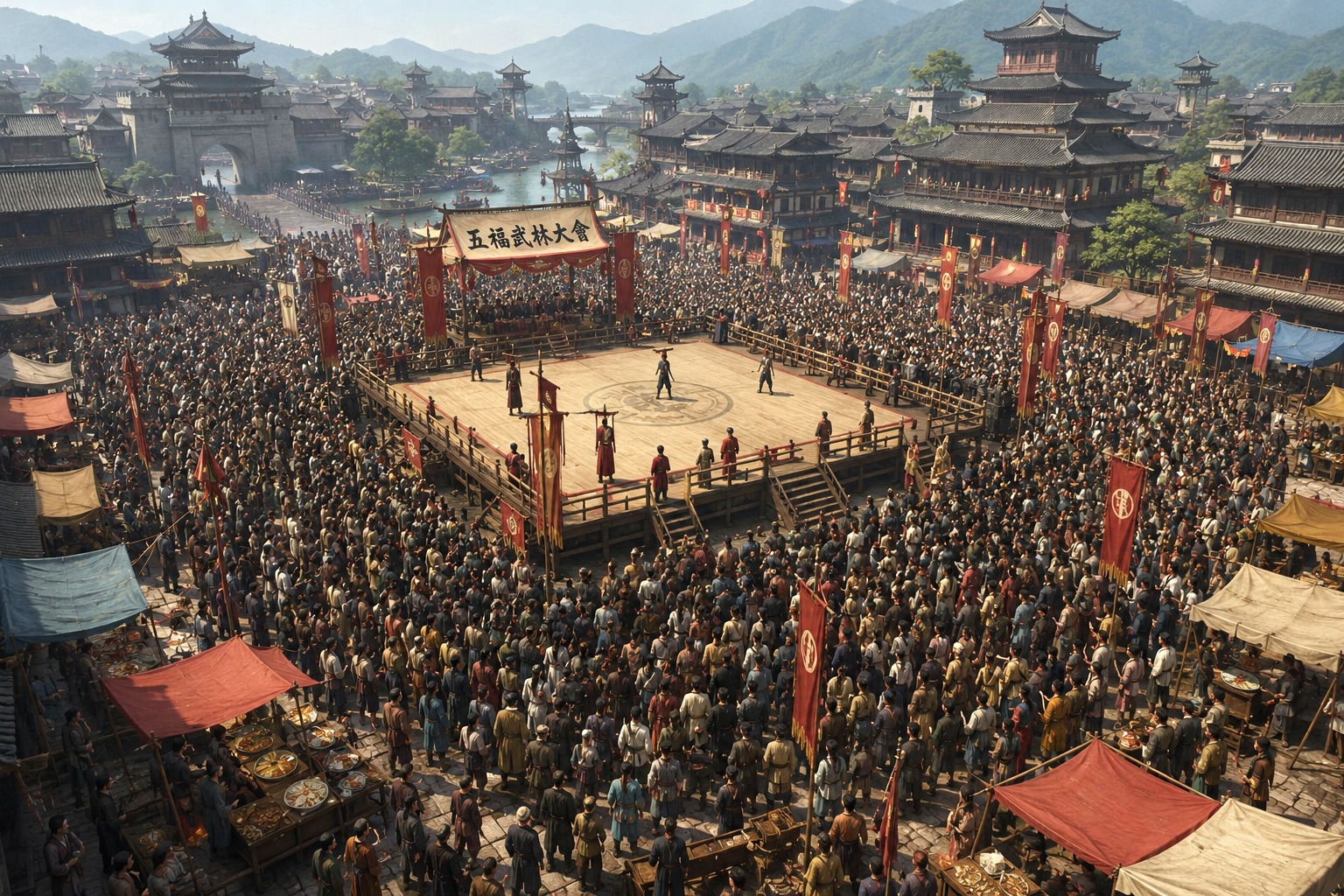
One afternoon, while delivering a crate of dried tea bricks to a warehouse near the eastern market, I noticed a crowd gathered around a large wooden platform draped in red banners. Musicians played flutes and drums while young men demonstrated spear forms and wrestling techniques before cheering spectators.

A notice hung beside the stage announcing a martial tournament to be held three days later.

Open sparring!
Archery!
Weapons demonstrations!

The competition was sponsored by the Five Stars Trading Company. The winners, the notice said, would be given prize money, and the opportunity to interview for jobs as caravan guards.

Five Stars Trading Company belonged to the Shah family. My mother’s family. I stood reading the notice for a long time. Finally I approached a man sitting at a table with a registry book. He was thin, and wore a shirt with a high white collar, and round spectacles with bamboo frames. His thin gray mustache looked painted on.

“I want to sign up,” I said. “Weapons demonstration.”

Without looking up, he said, “School and sifu?”

“What do you mean?”

Now he gave me an annoyed look. “What martial arts school do you attend? Who is your sifu?”

“I don’t attend any school. I work at the docks and other places.”

The man tut-tutted. “Get lost. This is a competition for real wushu artists, not ruffians.”

My shoulders stiffened. “Do you have a supervisor here?”

The man glared at me incredulously. His moustache somehow curled upward, looking like an odd smile, and this made me want to laugh.

“Boss!” the clerk called out.

A tall man in an expensive suit broke away from watching the demonstrations, and came to the table. He was in his late twenties perhaps, pampered and soft looking, but with a hardness to his eyes that reminded me of the thousand year old stones from which the bridges were made. Those bridges had survived war, famine and revolution.

“This dock worker punk,” the clerk said, “doesn’t have a school or sifu.”

“Hello,” the man said. “My name is Shah Suliman. I am sorry, but we have rules.”

I knew this man. Lee Ayi had told me about my relatives on my mother’s side. My uncle – my mother’s older brother – was Shah Amir. This man was his son. He was my cousin.

The thought of lying never entered my mind. Wasn’t that what Master Chen had accused me of? Wasn’t I a Muslim now? Whatever else I was, I must hold fast to that.

“I am Darius Lee,” I said firmly. “Son of Yong Lee and Shah Nur, daughter of Shah Zheng. I have no school, but I am trained in martial arts. My sifu was my father. Register my name, please. Either open sparring, weapons, or both.”

Shah Suliman’s face went white. He rocked back as if buffeted by an invisible wind. He swallowed, and his face registered shock, then wonder, then calculation.

“What do you want?” he said at last.

“I told you. To participate in the tournament.”

“That’s all?”

“Well, yeah. I mean, if I win, I want one of those caravan jobs.”

Suliman snorted. He looked me up and down, taking in my dao and dagger. Understanding dawned on his face. “Are you the one they call the bridge killer? The one who chopped off a man’s arm?”

“Yes. But I haven’t killed anyone. People exaggerate.”

“The Yong family had their own martial arts style. What is it?”

“Five Animals.”

He nodded slowly. “Sign him up.” Then he gave me a withering look. “Not that I believe a word you say. I’m giving you an opportunity to embarrass yourself.” With that, he turned his back and went back to watching the performers.

* * *

Come back next week for Part 13 – Five Star

Reader comments and constructive criticism are important to me, so please comment!


See the Story Index for Wael Abdelgawad’s other stories on this website.

Wael Abdelgawad’s novels – including Pieces of a Dream, The Repeaters and Zaid Karim Private Investigator – are available in ebook and print form on his author page at Amazon.com.

Related:

Kill the Courier |Part 1 – Hiding in Plain Sight

Moonshot: A Novel of Marriage, Love and Cryptocurrency

The post Far Away [Part 13] – Brotherhood Under A Bridge appeared first on MuslimMatters.org.

Not Everyone Goes To Hajj…But Everyone Is Called: Gaza, Gratitude, And Dhul Hijjah

16 May, 2026 - 11:33

Not all of us will stand on the plains of Arafah this year. Not all of us will circle the Kaabah or feel the weight of “Labbayk Allahumma Labbayk” rise from our chests into the sky. Some of us will be in our homes, in unfamiliar cities, in places that don’t feel sacred at all. And yet, somehow, these days of Dhul Hijjah still reach us.

Dhul Hijjah has felt different for my family and me since everything we went through. There was a time when the word sacrifice felt distant to me: a story we told our children before Eid, a lesson wrapped in history about Prophet Ibrahim, his obedience, his trust. We understood it. But we hadn’t lived it. Not in the way that changes you.

After living through the Gaza war, the meaning of words shifts. Sacrifice is no longer something symbolic. It is no longer a concept you reflect on from a safe distance. It becomes something you recognize in the quiet details of life—what was lost, what was taken, what had to be rebuilt from nothing.

We have seen what it means for homes to fall, for entire lives to unravel in moments. We have seen people lose parts of themselves and still hold onto Alhamdulillah. We have said goodbye to people we never imagined we would lose. And even now, after time has passed and we have moved forward, those moments do not really leave you. They settle somewhere deep, reshaping the way you see everything.

Sometimes Allah subḥānahu wa ta'āla (glorified and exalted be He) does not ask you to sacrifice one thing. Sometimes, He subḥānahu wa ta'āla (glorified and exalted be He) allows you to experience what it means to lose much more—and to still remain.

I remember sitting with my children—my daughters, 16 and 14, trying in their own way to make sense of things beyond their years, and my 8-year-old son, still holding onto a kind of softness that asks questions without hesitation. We were not speaking about Eid that day. We were speaking about loss.

“What does Allah subḥānahu wa ta'āla (glorified and exalted be He) want from us?” one of them asked.

It was not a theoretical question. It was not something you answer with memorized words. And I found myself pausing, not because I did not believe—but because some questions deserve to be held before they are answered.

Because when you have lived through something that changes you, you do not rush to simple explanations.

And yet, Dhul Hijjah still came. As it always does. Quietly. Gently. As if to remind us:

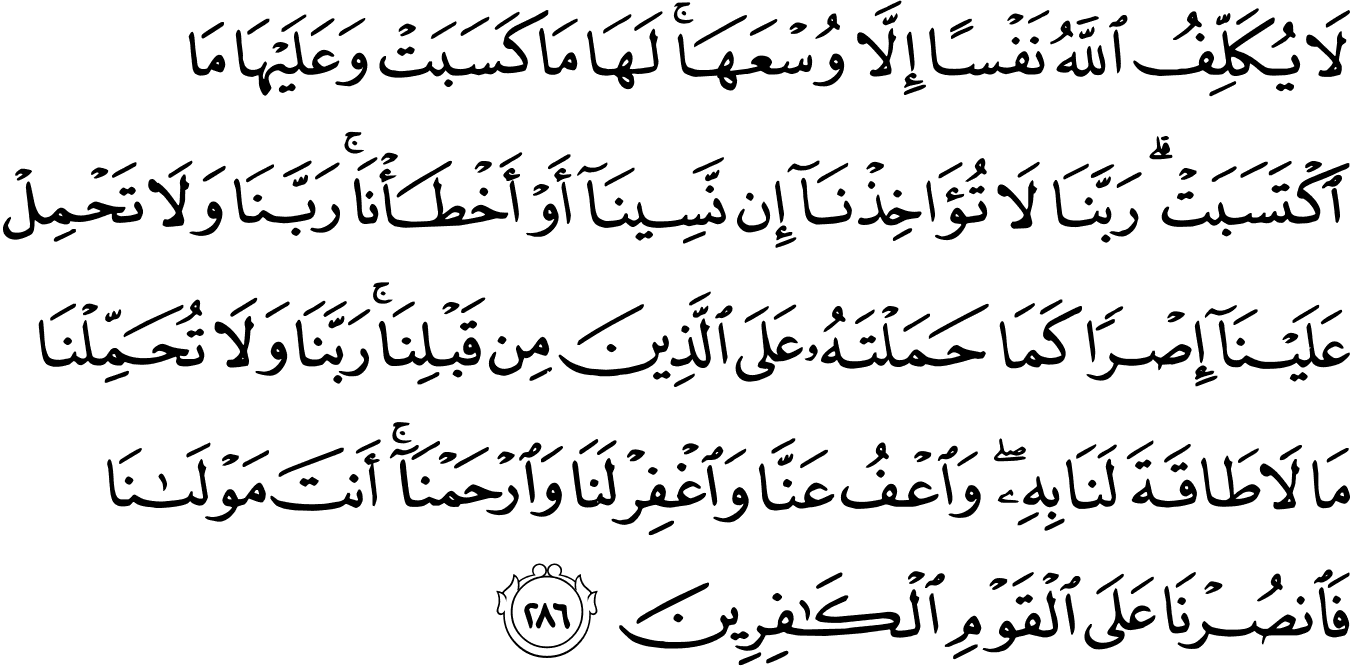
“Allah does not burden a soul beyond that it can bear.”
[Surah Al-Baqarah, 2:286]

What you have lost is seen.
What you have endured is known.
And what you are still carrying…matters.

We found ourselves returning to the story of Ibrahim 'alayhi'l-salām (peace be upon him), but this time it did not feel like a distant story. It felt close. Personal. Real.

It was no longer just about a father who was asked to sacrifice his son. It was about trust when nothing makes sense. About surrender when your heart is heavy. About saying yes to Allah subḥānahu wa ta'āla (glorified and exalted be He) —not because it is easy, but because you believe there is meaning beyond what you can see.

“And when they had both submitted and he laid him down upon his forehead…”
[Surah As-Saffat, 37:103]

My son once asked me, “Did Ibrahim 'alayhi'l-salām (peace be upon him) feel scared?”

And the answer came more honestly than before: yes. Of course he did.

Because faith is not the absence of fear.
It is choosing Allah subḥānahu wa ta'āla (glorified and exalted be He) even when fear exists.

This Eid, when we speak about Udhiyah, I no longer think about the act alone. I think about what has already been given—the comfort that once existed, the sense of safety that felt permanent, the life that was carefully built and then quietly taken apart.

And I remember Allah’s subḥānahu wa ta'āla (glorified and exalted be He) Words:

“Their meat will not reach Allah, nor will their blood, but what reaches Him is piety from you.”
[Surah Al-Hajj, 22:37]

It brings a different kind of understanding; that what matters is not the outward form of sacrifice, but the state of the heart within it.

Not everyone will go to Hajj. But everyone is called to something.

To patience:
                                               “Indeed, Allah is with the patient.”
                                                           [Surah Al-Baqarah, 2:153]

To trust.

To letting go of what we thought we needed.

To holding onto Allah when everything else feels uncertain.


The Prophet ﷺ said: “How amazing is the affair of the believer. Verily, all of his affairs are good for him…” [Muslim]

There was a time when this hadith felt comforting. Now, it feels grounding.

Because understanding it is different when you have lived through both ease and hardship and found that Allah subḥānahu wa ta'āla (glorified and exalted be He) was present in both. Not always through immediate relief, but through the strength to keep going, the people He placed in our path, the prayers that carried us, and the quiet mercy that appeared in moments we least expected it.

There were moments when my children asked me, “Is Allah subḥānahu wa ta'āla (glorified and exalted be He) still with us?” or “Why is this happening to us?” And each time, I would tell them that yes, Allah subḥānahu wa ta'āla (glorified and exalted be He) is always with us — in moments of ease and in moments of hardship. We may not always understand the wisdom behind what we go through, but we trust that Allah subḥānahu wa ta'āla (glorified and exalted be He) sees us, carries us through it, and teaches our hearts through these experiences in ways we may only understand later.

I realized then that faith is not only taught during times of comfort and stability. Sometimes it is taught in the way we hold onto one another during uncertainty, in the way we continue praying through fear, and also in the way we keep returning to Allah subḥānahu wa ta'āla (glorified and exalted be He) even when life feels unbearably heavy.

Our home is not perfect. There are still moments where memories return quietly. There are still traces of what was lived, even as life moves forward in a new place, a new routine, a new beginning.

But there is also something else now.

A kind of steadiness.
A kind of faith that is no longer theoretical.

My daughters do not just hear about sabr—they have experienced it.
My son does not just say Alhamdulillah—he is learning what it means.

And I no longer see Dhul Hijjah as just ten blessed days. I see it as a continuation—a reminder that what we go through is not separate from our faith, but part of how it is shaped.

Because maybe Hajj was never only about a place.

Maybe it was always about the heart.

About reaching a point where you can say:

Ya Allah… I may not understand everything. But I trust You.

The Prophet ﷺ said:

“There are no days in which righteous deeds are more beloved to Allah than these ten days.” [Bukhari]

And perhaps the greatest of those deeds are not always visible.

Perhaps they are found in quiet endurance.
In rebuilding….In continuing.
In holding onto faith, even after everything.

And maybe… just maybe…this, too, is a form of answering the call.


Related:

When Allah Chooses Something: The Blessings Of Dhul Hijjah

The Bigger Picture: Understanding Loss, Sacrifice, and Purpose in Dhul Hijjah


The post Not Everyone Goes To Hajj…But Everyone Is Called: Gaza, Gratitude, And Dhul Hijjah appeared first on MuslimMatters.org.

Far Away [Part 12] – Accused

11 May, 2026 - 19:48

At his grandmother’s opulent riverside estate, Darius finds himself judged not for who he is, but for whose son he is.

Read Part 1 | Part 2 | Part 3 | Part 4 | Part 5 | Part 6 | Part 7 | Part 8 | Part 9 | Part 10 | Part 11

* * *

Self-Controlled

The colorfully dressed doorman opened the gates before we even reached them.

The Chen residence did not resemble any home I had ever seen. Calling it a house seemed absurd. It was a walled compound of white stone and dark wood, with curved roofs layered one behind another like overlapping wings. Red lanterns hung beneath the eaves despite the daylight, and narrow streams of water crossed the inner courtyards beneath little carved bridges. Bamboo rustled softly in the winter breeze.

I slowed, taking it all in. It was like something I might have conjured in a dream.

Haaris, walking beside me, whispered proudly, “Big, right?”

Indeed. “What does Master Chen do for a living?”I whispered.

“He owns a foundry that makes weapons.” replied softly.

Servants moved everywhere, silent and efficient. One swept fallen leaves from the stone paths with a long reed broom. Another carried folded linens across the courtyard. Two men unloaded crates from a wagon near a side gate while a woman directed them sharply.

Something unsettled me immediately. After a few moments, I realized that no one here was comfortable. No one laughed or joked as Haaris and I did when we worked. Everyone was carefully self-controlled, as if they thought they were being watched at every moment.

I felt the absence of my dao acutely. Not that I thought I would need it here. But ever since I’d left it wrapped in cloth beneath the wagon seat in the stable yard, I’d been worried about it. What if someone stole it? It was a gift from my father – the only thing I had from him.

Before we entered the inner residence, an elderly servant approached and bowed stiffly, saying, “I will take your coats and travel packs, honored guests.”

We all handed over our bundles, including my travel pack containing the gifts I had bought in the marketplace. The old servant stacked everything carefully into a lacquered cart beside the entrance, then wheeled the cart away through a side doorway.

A servant girl in pale green robes then led us through a covered walkway into the main receiving hall.

The room was enormous. Dark beams crossed the high ceiling overhead. Silk wall hangings embroidered with Quranic calligraphy hung between painted landscape screens. One scroll depicted mountains rising above misty forests, with tiny travelers crossing a bridge far below. Another showed a river crowded with merchant barges beneath wheeling birds.

Tall porcelain vases stood in carved wooden alcoves, painted in deep blue with scenes of scholars, horses and flowering trees. A bronze incense burner shaped like a crane released thin trails of scented smoke into the air, giving the place a sweet and musky scent. Low tables of carved rosewood stood beside cushioned chairs lacquered black and gold.

Strangely, while I admired the beauty of this place, I was not intimidated. My clothes were new and clean. I had nothing to be ashamed of. And I had seen my father put wealthy merchants on their knees in the highway at the point of a sword before robbing them. They wore fine clothes, but they wept and begged like anyone else. A few wet themselves. I think my father had enjoyed humiliating them. As for me, I had merely felt embarrassed for them.

Furthermore, Zihan Ma had taught me that one of the meanings of laa ilaha il-Allah was that all men were equal before Allah, regardless of caste, color or clothing. Only their – what was the word? Taqwa. Only their taqwa differentiated them.

As a result, I never thought that the wealthy were better than me. Nor was I better than them. People were people. They were either honest or dishonest, kind or cruel. They were street thugs like the men who had tried to rob me – or indeed like my father, who I had no illusions about – or honorable men like Zihan Ma. I had never met the emperor of our land, nor would I, but I knew he was either a good man or a bad one, no matter what trappings of wealth surrounded him, and I knew he could not be a better man than my uncle.

Come Closer

At the far end of the hall sat an elderly woman in layered robes of soft blue silk. A pale gray scarf covered her hair. Beside her sat a thin older man with narrow shoulders and sharp features. His beard was trimmed short and precise. He wore a white robe of fine linen with silver embroidery, and jade rings gleamed on his fingers as he sipped from a porcelain tea cup.

Zihan Ma bowed respectfully toward the older man. “Master Chen.”

“Ma.” The man inclined his head slightly.

His eyes shifted toward me.

“This,” Lee Ayi said carefully, “is Darius Lee.”

I bowed deeply. “As-salamu alaykum Nai Nai and Master Chen.”

His eyes narrowed. “Were you taught to greet the women first?”

Before I could answer, Nai Nai smiled gently and said, “Come closer so I may see you.”

Haaris and I both went to her. Haaris hugged her, then I did. Her hands were warm and soft as she touched my face lightly, studying me with moist eyes. “You have your father’s eyes,” she murmured.

Master Chen snorted quietly into his tea. “An unfortunate inheritance.”

The room fell silent.

Lee Ayi crossed the room quickly and knelt beside her mother, taking both her hands. The warmth between them was immediate and genuine.

“We brought gifts for your birthday,” Lee Ayi said. She opened her bundle and carefully removed a folded silk shawl embroidered with tiny silver flowers. I had seen her making it over the last few weeks, but had not known it was for her mother.

Nai Nai touched the fabric reverently. “It’s beautiful,” she whispered.

Haaris eagerly produced a folded note written in his uneven handwriting. “Mine too!”

Nai Nai laughed softly and accepted it at once. “A letter?”

“A birthday note,” Haaris said proudly. “Baba helped me shape some characters.”

She opened it immediately, smiling as she read.

Then everyone looked at me.

I suddenly felt awkward. My own letter, though heartfelt, seemed childish now compared to the grandeur of this house. Still, I handed it to her. Nai Nai unfolded it slowly and read it in silence. I had written:

I am very happy to meet you, Nai Nai. My father had good qualities and bad, but I am sure that whatever good he possessed came from you. Whatever has befallen me in life, it brought me here to meet you. That is a barakah. I wish you a happy birthday and many to come.

When she finished, she pressed the paper briefly against her chest. “Thank you, Darius,” she said softly. “I will treasure it.” Her sincerity was real, and it moved me.

“Could you not even buy a gift for your grandmother?” Chen sneered. “A paltry letter? That’s fine for Haaris, but you are a young man.”

Nai Nai lowered her hands slowly. “Husband…”

“I merely speak the truth.” His gaze remained fixed on me. “Yong Lee was a troublesome boy long before drink rotted what remained of his judgment. No doubt this child is the same.”

I lifted my chin and met his gaze. I spoke calmly. “My father was more than that.”

Chen set down his tea cup abruptly, the tea spilling onto the porcelain dish beneath it.

Lee Ayi spoke softly. “Master Chen, Darius has traveled far. Let us welcome him peacefully.”

“Peacefully?” Master Chen replied. “Was Yong peaceful? I seem to recall gambling, fighting, drinking and theft following him from one province to the next like stray dogs.”

Haaris shifted uncomfortably beside me.

Zihan Ma’s expression remained calm, but I noticed his jaw tighten slightly.

Lee Ayi had told me to remain silent, but I would not keep my mouth shut while my father was reviled. I would never forget him coming home from prison, finding me half-starved, and weeping as he embraced me. That moment was engraved on my heart.

“My father,” I said, perhaps a little too loudly, “joined the army to fight the invaders. He died in defense of his country. What could be more honorable?”

Servants entered carrying tea for the rest of us, along with trays of candied fruits and little sesame pastries arranged in perfect rows.

Master Chen took a pastry, and Haaris followed suit. I thought Chen might insult or berate me, but instead he spoke softly: “There is a saying. When the roots are crooked, the branches grow twisted.”

Nai Nai touched her husband’s hand with one finger. “I beg you. Let us have no more of this.” It was the voice of someone pleading for a small mercy she was not certain would be granted.

Master Chen finally looked away from me and sipped his tea.

The Accusation

“We must pray Asr,” Zihan Ma said. “It is getting late.”

One by one we performed wudu’ in a large bathing room with a skylight and a live bamboo tree in a pot. Master Chen then led us to a dedicated prayer room. There he led us in salat. He could not kneel, so he sat in a chair as he prayed. When lifting his head from ruku’, he said, “Sami Allah lamaw zhamidu.” The salam at the end was similarly garbled.  No one corrected him, of course.

After prayer we returned to the sitting room. Now Haaris and I did indeed remain silent as the adults spoke of the war, refugees, the farm, and other things. Master Chen’s armaments business was booming. There was no warmth in these conversations. In the time that it took to drink a single cup of tea, Zihan Ma rose.

“It was wonderful to see you both,” he said. “We must leave. We have a long trip ahead and we do not want to be on the road late at night. It’s not safe.”

“You must stay,” Nai Nai protested. “We have plenty of room. Please, for my sake.”

“We cannot,” Zihan Ma replied firmly. “The cows must be milked in the morning, and the gate opened for the farm hands.”

I knew this was not strictly true. The foreman had the key to the gate, and the men could milk the cows, feed the chickens and let the donkeys out. But I too wanted to be away from this oppressive place, and I was worried about Far Away. I wanted to hear his protesting meow when I picked him up and nuzzled him. I even missed Bao Bao, for her kindness toward Far Away had warmed me to her.

Master Chen gave a derisive laugh. “Cows.”

I wanted to say, “Didn’t you put milk in your tea?” But I held my tongue. I did not like this man at all.

The elderly servant wheeled the cart back in, and we picked up our packs and bags. Good byes were said, and final embraces given. Nai Nai hugged me with her thin arms, and I gave her a half-hearted embrace in return. She was my grandmother, and I would like to say that I loved her, but I did not know her.

A female servant opened the door for us and bowed. As we were about to leave, the elderly male servant leaned in toward Master Chen and whispered something in his ear.

“Wait,” Master Chen said. “I am told that certain items have gone missing. A pair of gold bracelets.”

Zihan Ma frowned. “That’s unfortunate. May Allah return them to you. As I said, we must be going.”

“You misunderstand,” Master Chen said sharply. He pointed at me with one rigid arm. “The boy has stolen them. He was seen taking them.”

For a moment I thought I had misheard him.

Zihan Ma said, “That is impossible. He was with us the entire time.”

“He was gone a long time when he went to make wudu. Let him open his pack.”

Zihan Ma’s jaw tightened. “This is unacceptable. Darius is my apprentice, and works hard on the farm. He’s a good boy. You have no cause to suspect him.”

“His father was a thief,” Chen said flatly. He turned to me. “Isn’t that true?” His eyes held a cunning gleam, and I felt the first stirrings of unease in my stomach. Something strange was going on here.

“Yes,” I said honestly. “Though he changed in the last year of his life.”

“And you?” Chen asked, a thin smile on his lips. “Did you steal?”

I considered. I would not dishonor Zihan Ma by lying. My reply was truthful: “When my father was in prison, and I was alone on the farm, I stole food from neighboring farms to survive. A few potatoes here, a cabbage there. Only that.”

At that, Zihan Ma shot me a troubled glance. He had not known that about me.

“You see?” Chen declared triumphantly. “Once a thief, always a thief.”

Zihan Ma began to protest, but I waved him off. “It’s okay, Uncle,” I said. “I have no objection to opening my pack.”

I set the pack down on the floor, untied the strings, and opened the top flap. Inside were the few items I had brought from home: a towel, a spare shirt, and the sabha Zihan Ma had given me. On top sat the three cloth-wrapped gifts I had bought in the marketplace.

Chen’s eyes narrowed. “Take everything out.”

The room had gone utterly silent.

I frowned slightly but obeyed. First I removed the wrapped gifts and set them carefully beside the pack. Then the towel. Then the shirt and the sabha.

Something metallic glimmered at the very bottom of the pack.

For a moment my mind refused to understand what I was seeing.

Then I reached down slowly and picked them up.

Two gold bracelets rested in my palm.

* * *

Come back next week for Part 13 – The Long, Dark Road

Reader comments and constructive criticism are important to me, so please comment!


See the Story Index for Wael Abdelgawad’s other stories on this website.

Wael Abdelgawad’s novels – including Pieces of a Dream, The Repeaters and Zaid Karim Private Investigator – are available in ebook and print form on his author page at Amazon.com.

Related:

As Light As Birdsong: A Ramadan Story

Kill The Courier – Hiding In Plain Sight

The post Far Away [Part 12] – Accused appeared first on MuslimMatters.org.

From the MuslimMatters Bookshelf: Puberty Books for Girls

11 May, 2026 - 12:00

Auntie Aisha Answers

“Auntie Aisha Answers: The Tween Muslim’s Ultimate Guide to Growing Up” by Shaykha Aisha Hussain Rasheed is an absolutely fantastic resource unlike any other books out there on the Muslim market. 

This book is for tweens and teens, written in a genuinely age-appropriate way, and covers a wide range of topics that are so necessary for young Muslims to be exposed to (that they often aren’t). From information about puberty (the physical and emotional bits), to understanding diversity and disabilities, to a spiritual understanding of healthy boundaries and what that looks like both religiously and in friendships/ relationships, to big emotions like anxiety and grief… Auntie Aisha really does give amazing answers! 

This book is also not just for girls; the content applies equally to both genders, and also covers male issues with regards to puberty and more.

Shaykha Aisha’s expertise as both a scholar and someone who understands the right way to bring up sensitive issues with kids really shines through this book. 

Buy your copy here: https://bookshop.rabata.org/products/auntie-aisha-answers-the-muslim-tween-s-ultimate-guide-to-growing-up 

Muslimah Mukallaf: A Muslimah’s Guide to Puberty, Faith, & Personal Care by Jenna bint Hakeem

I’m always on the lookout for solid resources for kids that discuss puberty and related matters from an Islamic perspective, in an age-appropriate way. When the author Jenna bint Hakeem offered me a copy of her book “Muslimah Mukallaf: A Muslimah’s Guide to Puberty, Faith, & Personal Care,” I was intrigued… but also skeptical at first (I feel a type of way about most self-published books!). 

I’m happy to say that this book far exceeded my expectations. The author does a fantastic job doing everything from discussing the biological and Islamic aspects of puberty, how to properly take care of one’s hygiene (down to a detailed shower routine!), understanding emotional changes and managing them, and even tackling heavy topics like sexual abuse, porn, mental health, and more. There’s even an entire section on skincare and haircare!

I really appreciated that she also spent time talking about spirituality in an age-appropriate way, connecting it to the journey of growing up as a young Muslimah. I was impressed that she mentioned the fiqhi opinion of touching the mus’haf while menstruating (albeit this is a minority opinion) and also reminds readers to be respectful of elders who have the other opinion.

A couple of caveats: I wish she’d clarified in an intro about what fiqhi approach she is using. There were also a couple tiny things that could have been included or elaborated on. I would like to see a proper publisher reprint this with necessary improvements around typesetting and an editor.

As always, parents should read before giving to their kids, and be open to discussing differences of opinion and sensitive topics.

Buy yours here: https://bookshop.org/p/books/muslimah-mukallaf-jenna-bint-hakeem 

“The Muslim Girl’s Pocket Guide to Growing Up” by Yasmin El-Husari

This book is exactly what it says it is: a pocket-sized booklet that reassures Muslim girls that everything they’re going through is totally normal! From acne to greasy hair (and hijabs!), periods and vaginal discharge, a brief primer on how and when to do ghusl, and even how to do a bra fitting, this little book packs in a lot of information. 

It is quite concise, so there’s not tons of detail in terms of fiqh, and unfortunately no sourcing provided or mention of which madhab/ fiqh opinions the author is sharing regarding maximum/ minimum days of menses. 

However, this book really is fantastic and laid out in a simple, easy-to-understand, age-appropriate way for girls 9 and up.

Buy yours here: https://www.amazon.ca/Muslim-Girls-Pocket-Guide-Growing 

My First Period by Nur Khairunnisa Iskandar

My mom and I teach a girls puberty workshop, but we’re always on the lookout for good books on the subject – and we finally stumbled on one of the best ones so far! 

This book does make it clear that it’s based on the Shafi’i madh’hab, so fiqh details are oriented accordingly. There are also random bits that are more culturally contextual e.g. a page on how common abandoning babies is in Malaysia (which I did NOT expect).

I’m very impressed with how much content this book covers, from the process of puberty to self-care to how babies are made to the (basic) fiqh of haydh. I’d say this book covers about 85-90% of what we cover in our workshop. I did have a couple mild quibbles (like calling female ejaculation ‘semen’) but by and large this is really well written, age appropriate, and visually great to navigate for younger readers.

I have no idea where international readers can purchase this from, but it is available for sale in Malaysia! Buy here: https://mphonline.com/products/my-first-period

What books do you recommend on this topic? And more importantly, what books on puberty are there for Muslim boys?

Related:

Muslimah’s Guide to Puberty: How to talk to your daughter about Adolescence

My Dear Muslim Son

The post From the MuslimMatters Bookshelf: Puberty Books for Girls appeared first on MuslimMatters.org.

From The Chaplain’s Desk: From Madinah To Our Campuses, Reviving A Quran-Centered Culture

8 May, 2026 - 12:00

Among the greatest accomplishments of the Prophet ﷺ was not merely that he conveyed revelation faithfully, but that he nurtured a generation whose hearts were anchored to revelation. He did not simply deliver verses; he cultivated a civilization shaped by the Quran. The Prophet ﷺ nurtured, trained, and educated an amazing generation of individuals – both men and women – the likes of whom history had never seen before and will never see again. It is said that if the Prophet ﷺ had no other miracle besides his Companions, they would be enough proof for his Prophethood.

He transformed a people whose lives revolved around lineage, tribal honor, and material competition into a community whose identity revolved around the speech of Allah ﷻ. The Quran was not an accessory in Madinah or peripheral to their lives. The Quran played a central and pivotal role in every single aspect of their existence. It shaped and informed their beliefs, how they prayed, how they gave, how they forgave, how they thought, how they governed, how they dealt with hardship, and how they defined success. Divine revelation shaped their worldview, character, conduct, and behavior. 

The Many Dimensions of a Quran Centered Life 

This transformation was not incidental—it was intentional. The Prophet ﷺ, through his teachings and his lived example, established a culture of learning, reciting, memorizing, teaching, and reflecting upon the Quran. He continuously highlighted its virtues, its blessings, its rewards, and its unparalleled value.

He ﷺ said: “The best among you are those who learn the Qur’an and teach it.” This statement redefines status and greatness. In a world that measures superiority through wealth, influence, and visibility, the Prophet ﷺ anchored excellence to engagement with revelation. The most noble person in this ummah is not the most affluent, nor the most eloquent, nor the most influential—but the one most deeply connected to the Book of Allah subḥānahu wa ta'āla (glorified and exalted be He); learning it and transmitting it.

In another narration, he ﷺ said: “Whoever recites a letter from the Book of Allah subḥānahu wa ta'āla (glorified and exalted be He) will have a good deed, and a good deed is multiplied by ten. I’m not saying that alif-lām-mīm is one letter. Rather alif is a letter, lām is a letter, and mīm is a letter.” This reveals something profound about the generosity of Allah ﷻ. Even at the most foundational level—the articulation of individual letters—the believer is rewarded abundantly. Every sound uttered from the Quran carries eternal weight. This is divine speech, and engaging with it is never insignificant.

The Prophet ﷺ did not limit our understanding of the Quran to reward alone. He connected it to ultimate salvation. He ﷺ said: “Recite the Quran, for it will come as an intercessor for its companion on the Day of Judgment.” The Quran will not remain silent on that Day. It will advocate for the one who kept it close—who lived with it, struggled with it, and returned to it consistently. It will testify on behalf of its companion.

He ﷺ also emphasized the communal dimension of Quranic engagement: “No people gather in one of the houses of Allah, reciting the Book of Allah and teaching it to one another, except that tranquility descends upon them, mercy envelops them, the angels surround them, and Allah mentions them to those who are with Him.” This narration describes layers of divine response to a simple gathering centered on the Quran. Sakīnah descends, raḥmah envelops, Angels surround, and Allah ﷻ mentions that gathering in the highest assembly. The masjid, when animated by the Quran, becomes a space where heaven touches earth.

Through these teachings, the Prophet ﷺ created a living culture in Madinah. Some narrations mention that during the time of tahajjud, the streets of Madinah would resonate with the recitation of the Quran. Homes were illuminated not merely with lamps, but with revelation. The city itself pulsed with divine speech.

This culture was not born from obligation alone—it was born from love. The Companions understood that love for the Quran was a reflection of love for Allah ﷻ and His Messenger ﷺ. ʿAbdullāh ibn Masʿūd raḍyAllāhu 'anhu (may Allāh be pleased with him) said: “Whoever wishes to know whether they truly love Allah and His Messenger, let them reflect: if they love the Quran, then they truly love Allah and His Messenger.” This is a deeply theological reality. The Quran is the speech of Allah ﷻ. Love for speech reflects love for the Speaker. If the heart inclines naturally toward the Quran—longing to recite it, understand it, and live by it—then that is a sign of a heart inclined toward Allah ﷻ.

For the companions, the Quran was more valuable than material wealth. When ʿUmar ibn al-Khaṭṭāb raḍyAllāhu 'anhu (may Allāh be pleased with him) saw camels loaded with gold, silver, and other material goods from Iraq, he was reminded of Allah’s subḥānahu wa ta'āla (glorified and exalted be He) Words: “Say: In the grace of Allah and in His mercy—let them rejoice. That is better than what they amass.” He explained that the true grace and mercy of Allah is the Quran—not accumulated wealth. Wealth is what people amass, while revelation is what transforms. This reframing is essential for us today. We live in a culture obsessed with accumulation—wealth, credentials, followers, achievements. Yet the Quran calls us to rejoice in something higher: divine guidance.

The Companions’ lives reflected this prioritization. Al-Awzāʿī رحمه الله mentioned that they excelled in five matters: adhering to the community, following the Sunnah, populating the masājid, reciting the Quran, and striving in the path of Allah subḥānahu wa ta'āla (glorified and exalted be He). These were not isolated acts—they were interconnected dimensions of a Quran-centered life.

ʿUthmān ibn ʿAffān raḍyAllāhu 'anhu (may Allāh be pleased with him) said: “If our hearts were pure, they would never be satiated from the speech of our Lord.” It is reported that his muṣḥaf was worn from frequent recitation—its pages bearing witness to his devotion.

One of the most powerful demonstrations of the Quran’s transformative force is seen in the incident of al-Ifk. When Abū Bakr raḍyAllāhu 'anhu (may Allāh be pleased with him), wounded by betrayal, resolved to cut off support from Miṣṭaḥ, Allah ﷻ revealed: “Let them pardon and forgive. Do you not love that Allah should forgive you?” His response was immediate: “Yes, by Allah, I love that Allah should forgive me.” And he resumed his support.

This is tadabbur embodied. The Quran did not remain abstract—it entered his wounded heart and elevated it. It redirected his deeply personal pain into forgiveness. 

Asmāʾ raḍyAllāhu 'anha (may Allāh be pleased with her) described the companions as people whose eyes shed tears and whose skin trembled when reciting the Quran. The Quran shaped both their inner and outer states—producing awe, humility, softness, and tears. When Allah ﷻ revealed: “Who will lend to Allah a goodly loan…” Abū al-Daḥdāḥ raḍyAllāhu 'anhu (may Allāh be pleased with him) responded not with admiration, but with action—giving away his garden in pursuit of Allah’s subḥānahu wa ta'āla (glorified and exalted be He) Promise. They understood that when Allah ﷻ speaks, He is to be responded to—not merely admired.

The Prophet ﷺ did not simply leave behind a text. He left behind a living model of how to build a Quran-centered life and society—hearts that trembled at its warnings, softened at its mercy, sacrificed at its call, forgave at its instruction, and rejoiced in its guidance. Our responsibility is to revive that culture—within ourselves, within our homes, and within our communities.

And for many of our young Muslims today, one of the most critical arenas for this revival is the university campus.

Building a Culture of Quran on Campus: Practical Steps

Reviving a Quran-centered culture does not begin with grand programs—it begins with consistent, intentional acts that shape hearts and environments. For students seeking to cultivate this culture on campus, consider the following:

  1. Establish consistent Quran gatherings

Even if small, begin with a weekly circle dedicated to recitation and reflection. Consistency is more transformative than scale. The goal is not attendance—it is anchoring hearts.

  1. Prioritize reflection (tadabbur), not just recitation

Create space to discuss meanings, themes, and personal takeaways. Ask: What is Allah ﷻ saying to us through these āyāt? Move from reading the Quran to being read by it.

  1. Normalize Quran in shared spaces

Let the Quran be visible and audible—before meetings, after prayers, in moments of pause. Culture is built through repetition.

  1. Connect the Quran to lived realities

Address stress, identity, purpose, relationships, and struggles through the lens of the Quran. Show that the Quran is not distant—it is deeply relevant.

  1. Build leadership rooted in revelation

Encourage student leaders to frame decisions, priorities, and conflicts through Quranic guidance. A Quran-centered leadership produces a Quran-centered community.

  1. Pair knowledge with action

Every gathering should lead to something practical—an act of charity, forgiveness, service, or personal change. The Quran was revealed to be lived.

  1. Cultivate love, not just discipline

Remind one another of the virtues, rewards, and beauty of the Quran. A culture sustained by love endures far longer than one driven by obligation alone.

  1. Begin with yourself

The most powerful daʿwah is personal transformation. Let your own relationship with the Quran be sincere, visible, and consistent. Hearts are moved by authenticity.


Reviving a Quran-centered culture is not beyond us. It begins the same way it began in Madinah—with individuals who choose to return to the Book of Allah ﷻ, consistently, sincerely, and collectively.

May Allah ﷻ make us from the people of the Quran—those who are His special people and His chosen ones. May He make the Qur’an the spring of our hearts, the light of our chests, the remover of our anxieties, and the guide of our decisions.


Related:

The Art of Tadabbur: Enriching Our Relationship With The Quran

From The Chaplain’s Desk: The Power Of Dua


The post From The Chaplain’s Desk: From Madinah To Our Campuses, Reviving A Quran-Centered Culture appeared first on MuslimMatters.org.

Far Away [Part 11] – Deep Harbor

4 May, 2026 - 00:45

Deep Harbor overwhelms Darius with its immense masjid, refugee camps and wide river, while tensions within the family deepen.

Read Part 1 | Part 2 | Part 3 | Part 4 | Part 5 | Part 6 | Part 7 | Part 8 | Part 9 | Part 10

* * *

Preparing for the Journey

The next day was consumed by work.

Zihan Ma wanted the farm put in order before we left, so Haaris and I labored from dawn until nearly sunset. We repaired a loose section of fence near the north pasture, hauled water, split wood, cleaned the barn and replenished the feed bins. We cut and soaked fodder for the animals, mixing it with bean mash in great steaming buckets while the donkeys brayed impatiently nearby. The weather had turned colder still, and our breath hung white in the air.

Far Away spent most of the day asleep, but by afternoon he had begun moving about the house on his own. His splinted leg forced him into an awkward hobbling gait, and several times I moved instinctively to pick him up, but he glared at me with such offense that I relented.

Bao-Bao shadowed him everywhere.

The old cat behaved as though Far Away were some wounded soldier under her authority. She followed him from room to room, occasionally stopping to lick the fur around his ears or inspect his bandages with grave seriousness. Once I caught Bao-Bao cuffing him lightly on the head after he tried to jump onto a stool and failed.

I laughed despite myself.

“You see?” Haaris said smugly. “Bao-Bao likes him.”

“I think she thinks he’s her long-lost brother or something.”

“That too.”

Far Away eventually settled beside the stove and fell asleep again, while Bao-Bao curled protectively beside him like a guardian spirit.

That evening, after Maghreb, I sat alone in my room looking unhappily at my belongings. I owned very little: my blanket, travel pack, dao and spear, work clothes and the softer set of clothes I wore around the house or to sleep. I had nothing suitable for Jum’ah in a masjid, or a visit to family.

I imagined myself standing among wealthy merchants and educated men dressed like a scarecrow from a muddy farm. The thought filled me with embarrassment.

A while later there came a knock at the doorframe. Zihan Ma entered carrying a folded bundle.

“I nearly forgot,” he said.

He handed the bundle to me. Inside was a new suit of clothing: dark blue trousers, a long tunic of thick but soft cloth, and a black outer vest with careful stitching along the edges. Beneath the clothing lay a pair of sturdy black shoes. The clothes were beautiful and much nicer than anything I’d ever owned.

I stared at them. “For me?”

“Who else?” Zihan Ma said mildly. “You cannot attend Jum’ah looking like a farm hand.”

My throat tightened unexpectedly. “Thank you,” I managed.

He nodded once and left without further words.

The Road North

We departed before sunrise on Jum’ah. I wore my clothing and shoes, the Muslim kufi cap Zihan Ma had given me, and the dhikr beads around my neck. I felt natty and pleased with myself, and happy to be going on this trip. A thread of worry worked its way through my gut – what would happen if we encountered my mother’s family? – but I waved my hand to dismiss these thoughts.

Still, I strapped my dao across my back. It was not only the threat of my mother’s family that worried me. Whatever Zihan Ma believed about violence, the roads were no longer safe. The memory of the six intruders had not left me. Life had repeatedly taught me an important lesson: that there were people out there who saw other human beings as nothing more than prey. I would not be caught unprepared.

The wagon creaked softly as we loaded our things. Lee Ayi packed food for the journey while Haaris secured blankets and water gourds. I strapped my dao across my back before climbing aboard. I also brought my travel pack and a few of the gold coins I’d brought with me to my aunt’s house. I had of course passed through Starling once before – for that, I’d learned, was the name of the city to the south where I’d been assaulted and where Zihan Ma’s sister lived. It had seemed chaotic and overwhelming back then. But at the time it was my first glimpse of a big city, and I was wounded and feverish. Maybe it was actually a nice place. There might be things to buy. I wanted to get something for Haaris in particular. I knew I’d been cold toward him lately, and I needed to make up for it.

Zihan Ma and Lee Ayi sat on the front seat of the wagon, and Haaris and I behind them. As I settled myself, I caught Zihan Ma looking at the dao. Not a glance, but a long, solemn stare. He said nothing, however, and that somehow felt heavier than disapproval.

The wagon rolled out through the gate and onto the main road. Frost silvered the fields. The morning air smelled of damp earth and smoke from distant cookfires.

At the crossroads the wagon turned north.

“Wait,” I said. “We’re not going to Starling?”

“No,” Lee Ayi replied from beside me. “We’re going to Deep Harbor.”

I sat up straighter. “Deep Harbor?”

“My mother lives there,” she explained. “It’s her birthday.”

My stomach tightened slightly at the mention of my grandmother. I had almost forgotten she existed.

The Vendor

We breakfasted on steamed vegetable buns and pickled cabbage as the donkeys trotted along and the wagon rumbled over the dirt road. Fog lay over the fields and the road like the breath of an ice-dragon, and I pulled my tunic tight. All the farms we passed had high walls – many of which looked newly constructed – and had either heavy gates, or guarded entrances. Some sold their farm products at roadside stands.

We passed through a small village halfway to Deep Harbor. and the air brought the scent of roasted chestnuts. Haaris pleaded for some. Relenting with exaggerated reluctance, Zihan Ma dismounted to haggle with a vendor selling a variety of roasted nuts heated in an iron pan over hot coals.

I dismounted to stretch my legs. The vendor, a thin man with a mustache, weighed the nuts on a scale, then scooped them into a paper wrapper, moving quickly with practiced hands.

The vendor cheated my uncle. I saw it with my own eyes. My father had taught me many kinds of scams and tricks, not necessarily to employ them, but to be aware. I bit my upper lip, wrestling with the question of whether to say something, but as it turned out it wasn’t necessary, for Zihan Ma stopped the vendor with an upheld hand.

“Your scale is rigged,” he said mildly. “You charge for a full measure, yet give less.”

The vendor spread his hands innocently. “Impossible, honored uncle.”

Zihan Ma reached into a coat pocket and came out with a small iron disk. “This,” he said, “is a half-jin measure.” He dropped it on the scale, and I watched as the needle on the scale settled on half a jin plus two liang.

The vendor’s face reddened, and he shot a glance at a burly man who stood nearby.

Zihan Ma followed the man’s gaze. “Your boss doesn’t know. You’re pocketing the difference.”

The vendor formed prayer hands and bowed deeply to Zihan Ma. “Please do not say anything, honored uncle. I beg you. I have a family…” He went on like this.

Ignoring him, Zihan Ma called out to the boss and informed him of what was happening.

The boss crossed his arms and set his jaw. “Why should I believe you? Maybe you’re the cheater. This man has worked for me for two years.”

“Believe as you wish,” Zihan Ma said calmly. “It’s your loss.”

He was about to turn to leave, accepting the loss of a few copper coins. I could not accept that. It wasn’t the loss of the coins, but that someone might question the honor of this great man, the best man I had ever known. I pointed to the mustachioed vendor.

“Right front pocket,” I said. “He used a magnet to rig the scale.”

Looking skeptical, the boss slipped a hand into his employee’s pocket and found the magnet I knew was there.

As the boss seized the vendor and began to shout at him, Zihan Ma turned away. A little further down the road, he bought a bag of carrots. Back on the wagon, Lee Ayi, Haaris and I ate our chestnuts in silence as Zihan Ma fed the carrots to the donkeys.

The nuts were salty and rich. I kept licking my fingers for the salt. The vendor might have been a thief, but he cooked good nuts. The scene that had transpired with the vendor did not bother me. I had seen and been through much worse. But Zihan Ma was quiet, and seemed troubled.

Dishonesty

Donkeys fed, we continued on our way. After a while, Zihan Ma looked back at me and asked, “How did you know about the magnet?”

I gave a slight shrug. “My father taught me to ignore people’s words and watch their hands.”

He nodded slowly. “That’s good advice. What did you think of the chestnut vendor?”

Something told me that I was on unsteady ground. Zihan Ma rarely asked casual questions. I weighed my words. “Cheating is wrong.”

“I agree,” my uncle said. “Dishonesty troubles me greatly.”

“Yeah,” Haaris said. “That guy was a crook.”

“Dishonesty among family,” Zihan Ma went on, “is the worst of all, for the closer the relationship, the worse the hurt.”

My uncle glanced back at me, where I sat on the back bench with Haaris. Looking forward again, he said, “If two people practiced martial arts every Friday on my farm, I would likely hear of it. Farmworkers speak. Especially when they are curious.”

Neither Lee Ayi nor I answered. My throat was tight as I swallowed.

“And,” Zihann Ma went on, “if I found part of the far field trampled repeatedly, with familiar footprints in the soil, and if I saw a boy returning late at night carrying a dao…” He shrugged lightly. “I might make certain guesses.”

“Forgive me,” Lee Ayi blurted out. She dropped to her knees in the wagon and pressed her forehead to Zihan Ma’s knees as he drove. Her arms hugged his legs. “Husband, I’m sorry. I should have told you.”

Haaris’s face showed alarm. “What happened? What is it?”

Zihan Ma looked genuinely distressed. “Jade, sit in your place. This is not seemly.”

“No,” she said miserably. “I deceived you.”

He gently took her one arm and lifted her back to her seat.

“You are my wife, not my servant,” he said softly. “Enough.”

I wanted to apologize too. The words gathered in my chest, but would not come out. Because the truth was ugly and tangled: I was sorry for deceiving him, but not for training.

At last I lowered my eyes and said quietly, “I will do better.”

Zihan Ma turned his head to study me for a long moment, and I could not tell if he was satisfied or saddened.

“What are you guys talking about?” Haaris demanded again.

When nobody spoke, I answered him. “Your mom and I were practicing martial arts.”

He sat back with a puzzled frown. “Oh. That’s all?” After a moment, he added, “My mom knows martial arts?”

“All of us Lees do, apparently.” Though my words were dry, something inside me felt heavy. I had been called a liar without the word ever being spoken aloud, and worse still, it was true.

Yet what else could I have done? The dao, the training, the movement of my body through forms and strikes – these things felt less like choices and more like a current carrying me somewhere I could neither understand nor resist.

Sadaqah

For the rest of the drive, my thoughts were jumbled. I didn’t know how to feel. On the one hand, I was scared that Zihan Ma’s opinion of me was souring. I didn’t know what that might mean for my future. On the other hand, I was relieved that the truth was out. At least I didn’t have to pretend anymore.

As we approached the city, I encountered a world I had not seen before. Refugees crowded the roadsides. Some lived beneath crude shelters made of sticks and cloth. Others huddled beneath wagons or slept in ditches wrapped in blankets so thin they scarcely deserved the name. Children watched the road with hollow eyes.

“I had no idea it was this bad,” Lee Ayi said.

“It’s worse in Starling ,” Zihan Ma muttered. “The refugees are coming from the south in great waves.”

Barefoot people trudged along the road with their packs on their backs. Women carried crying babies. An old man with one arm stood beside the road holding out a bowl without speaking. At one point we passed a woman crouched beside a tiny cookfire, boiling common weeds in a small blackened pot while two little girls sat beside her silently, too tired even to cry.

“Stop please,” I said suddenly.

Zihan Ma pulled gently on the reins.

I climbed down from the wagon and retrieved one of the wrapped food bundles Lee Ayi had prepared for the journey. The woman looked up at me uncertainly as I approached.

“For you,” I said awkwardly, offering the food.

One of the little girls stared at the bundle with enormous eyes. The sight of her struck me unexpectedly hard. I remembered another little girl, offering me a sweet treat on a stick while I was wounded and alone in the streets of Starling. I remembered her kindness, small as it had been, and how much it had mattered. Now it was my turn.

The woman accepted the food with trembling hands. “May the ancestors reward you,” she whispered.

Though I did not believe as she did, I said, “Thank you. May Allah make it easy.”

When I climbed back into the wagon, Lee Ayi rubbed my shoulder affectionately.

Zihan Ma smiled faintly. “The Messenger of Allah ﷺ taught that every bone in the body must give charity each day. Today Darius has given his sadaqah before the rest of us. He has set a good example.”

With some of the heaviness inside me lightened, I lowered my eyes awkwardly while Haaris grinned at me proudly.

Deep Harbor

As the sun arrived at its zenith, Deep Harbor appeared.

I had never seen a city so large. Gray walls rose high above the surrounding land, their watchtowers crowned with curved roofs. Beyond them I glimpsed tiled buildings packed together like scales upon a fish. But what struck me most was the river. It was enormous.

I had seen streams, ponds and irrigation channels all my life, but this moving expanse of water seemed like a living thing. Barges floated upon it carrying cargo beneath tall square sails. Smaller boats darted between them like water insects. Hundreds of birds wheeled overhead crying harshly. The air smelled of wet wood, fish, mud, smoke and river water.

I stared openly.

Haaris laughed. “You’ve never seen a real river before.”

“No,” I admitted.

The roads thickened with traffic as we approached the city: merchants, ox carts, laborers, mounted officials, wandering monks, and refugees pressed together in uneasy currents. I noticed that many people carried weapons, from spears to daggers, and a few swords.

The city gates stood open, guarded by weary soldiers carrying spears and wearing armor.

Inside was noise. Vendors shouted from crowded stalls. Metal clanged. Wheels rattled over stone. Steam and smoke drifted through the narrow streets carrying the smells of frying oil, fish, dung, incense and humanity packed too tightly together.

I turned constantly, trying to absorb everything at once.

“There,” Haaris said proudly, pointing ahead.

The masjid stood in the distance among the crowded streets like a place from another world, its twin minarets reaching for the sky.

Before we entered the masjid district, Zihan Ma pulled the wagon into a riverside stable yard thick with the smells of hay, manure and mud. Stable hands shouted, and a bell rang from a nearby ship where dozens of men unloaded crates onto a wooden pier. In the stable, many horses and donkeys were housed, some calmly eating, and others – not used to the city – were nervous, with ears swiveling. Our donkeys were a bit anxious, but Haaris stroked their faces and whispered in their ears, and they calmed down.

“You will not be able to enter the masjid with the dao,” my uncle whispered to me. Conceal it in the wagon, under your blanket.

I chewed my upper lip, thinking. The idea of leaving my weapon unguarded was abhorrent. But what choice did I have? I did as Zihan Ma said, and he paid the stable keeper, and we proceeded on foot to the masjid.

I craned my neck, trying to take it all in. The towering structure was easily the largest I had ever seen. Its architecture resembled the surrounding Chinese buildings, with sweeping tiled roofs and carved beams, yet Arabic calligraphy adorned the entrance in flowing black strokes, and the minarets seemed to pierce the sky. Hui men streamed through guarded gates wearing robes, caps and turbans, speaking in a dozen accents and dialects, while women in hijab entered from a separate gate.

A Resolution at Jum’ah

Lee Ayi bade us all goodbye and entered through the women’s gate.

The adhan began. I had heard Zihan Ma call the adhan many times at the farm, and had learned to call it myself. But this was different. The voice rose high above the noise of the city, echoing against walls and rooftops until it seemed to fill the entire district.

I followed Zihan Ma and Haaris through the courtyard and into the prayer hall. The room was immense. Sunlight filtered through latticed windows onto thick carpets over polished wooden floors. Hundreds of men sat cross-legged, rich and poor alike. I saw merchants in fine silk beside laborers with patched sleeves. Old men leaning on canes. Young boys scarcely older than Haaris.

The khutbah was about the meaning of success in Islam. The Imam said that we insisted on measuring success in material terms, but in Islam that was meaningless. Rather, success was defined as nearness to Allah, sincerity with all people, righteousness in public, and compassion in the home.

It was interesting, but maybe over my head. And I was distracted by the spectacle. When the prayer began, a thousand people stood shoulder to shoulder, and a hush fell over the assembly. I understood in that moment what it meant to belong to something greater than myself. I resolved in that moment that I would try to be the man Zihan Ma wanted me to be. I would put away the sword and take up the acupuncture needles, the sewing thread, and the herbs. I would strive to be the best healer I could be, under his tutelage. It was a great opportunity to be more than I had been raised to be, more than my father had been. I would be a fool not to take it.

When the prayer ended, the worshippers flowed gradually back into the streets of Deep Harbor. The noise of the city returned all at once, as if someone had lifted a curtain. Vendors shouted, gulls wheeled overhead, and somewhere nearby a man hammered metal with steady ringing sounds.

Gifts

The streets near the river were crowded almost beyond belief. We passed spice merchants, tea houses, fishmongers, butchers and wandering peddlers carrying entire shops suspended from shoulder poles. Barges drifted along the river beside us while laborers shouted and unloaded crates by hand.

“Listen carefully,” Lee Ayi said as we walked. “My mother’s name is Safiya Bai. You will address her as Nai Nai.”

I nodded.

“My stepfather is Su Chen. You should call him Master Chen.”

Something in her tone made me glance sideways at her.

“He is… particular,” she said carefully.

“That means he’s mean,” Haaris translated helpfully.

“Haaris.”

“What? It’s true.”

Lee Ayi sighed. “Master Chen values manners very highly. Be polite. Speak little. Don’t argue with him.”

“I don’t argue with people.”

Haaris snorted so loudly that a passing merchant looked over. “You are arguing about arguing.”.

“I am not.”

“Also you argued with me yesterday about whether crows can understand insults.”

“You were being silly.”

Haaris burst into laughter while even Lee Ayi smiled faintly.

We stopped beside a food stall where an old Hui man was pulling noodles by hand. He stretched and folded the dough so quickly I could hardly keep track of his hands. The noodles were dropped into boiling broth along with sliced lamb, greens and oil bright with chili.

We bought four steaming bowls and stood eating beside the man’s stall while gulls cried overhead. It was the best noodle soup I had ever tasted.

Nearby another vendor sold skewers coated in sesame and honey. Haaris wanted three. Zihan Ma allowed him one, and one for me.

As we continued through the marketplace, I found myself studying the stalls carefully. There were things here I had never imagined: tiny carved animals made of jade, lacquered boxes, clocks worked by water, silver rings, embroidered slippers, fishing lures with feathered hooks, paper lanterns painted like flowers.

At one stall I stopped short.

The merchant sold knives.

Not fighting knives. Folding knives, utility blades, skinning knives and carving tools. One particular knife caught my eye. It was compact and sturdy, with a polished wooden handle and a locking brass ring.

It was perfect for Haaris. I imagined buying it for him as a gift, and the delight on his face. Then I imagined Zihan Ma’s disapproving expression, and moved on.

A few stalls later I found an old man selling whistles carved in the shapes of birds. Some were painted brightly, others plain polished wood. When blown, they produced trilling calls remarkably similar to real birdsong. I remembered Haaris trying to learn to whistle through a blade of grass.

I picked up a swallow-shaped whistle carved from dark cedar. “I’ll take this one,” I said. The merchant wrapped it carefully in cloth.

It was the first time in my life I had ever bought a gift for someone. I was surprised by the warm, happy feeling in my chest. I found that I was smiling as I imagined how excited Haaris would be. I loved this feeling, and decided that I would buy gifts for the others as well. Maybe… maybe Zihan Ma would not be angry at me anymore if I got him something nice. My smile slipped for a moment as these sad thoughts intruded, but I continued shopping.

Farther along I found something for myself: a soft leather money belt worn beneath the clothing, with a hidden inner compartment stitched cleverly into the lining. I examined the stitching carefully before buying it. No one looking at it would guess it concealed anything valuable. That alone made me trust it.

At another stall I found a beautiful medical needle set housed in a slim bamboo case alongside fine silk thread. The needles were more delicate than the ones we used at the farm.

“This is excellent steel,” the merchant insisted. “Made in the western provinces.”

I bought it for Zihan Ma and dropped it into my travel pack.

“What’s that?” Haaris asked, craning his neck.

“You’ll see.”

“Come, Darius,” Zihan Ma said. “It’s time to go.”

“One minute!” Hastily I began studying the nearby stalls. My gaze landed on a table covered in combs, pins and ornaments. Some were wooden, and others were fashioned from shell or polished bone. One comb caught my attention. It was simple but elegant, carved from dark wood with tiny inlaid flowers of mother-of-pearl near the handle. I picked it up.

Lee Ayi’s hair was almost always tied back hurriedly for work. I realized suddenly that I had never seen her own anything decorative at all.

“That one,” I said.

The vendor smiled knowingly.

I smiled to myself, thinking of how much fun it would be to give these gifts to my new family. I would surprise them when we returned home. It would be exciting!

We moved away from the river, and the homes around us improved, becoming large, with high walls and ornate gates. We stopped in front of a grand home – a palace to my eyes – with a colorfully dressed guard at the gate.

Lee Ayi regarded me solemnly. “This is Master Chen’s house. Remember what I told you. Do not speak unless spoken to.”

Something in her tone put me on edge, and I felt my warm, cozy feeling disappear.

* * *

Come back next week for Part 12 – Accused

Reader comments and constructive criticism are important to me, so please comment!


See the Story Index for Wael Abdelgawad’s other stories on this website.

Wael Abdelgawad’s novels – including Pieces of a Dream, The Repeaters and Zaid Karim Private Investigator – are available in ebook and print form on his author page at Amazon.com.

Related:

As Light As Birdsong: A Ramadan Story

Kill The Courier – Hiding In Plain Sight

The post Far Away [Part 11] – Deep Harbor appeared first on MuslimMatters.org.

Why Liberation Is Sexual(ized) – The Forces Driving The Unquenchable Thirst To Emancipate Muslim Women

29 April, 2026 - 14:58

Chairman of the American Conservative Union and former White House Director Matthew Schlapp recently offered a bit of illustrative wit. When asked about the 160 Iranian schoolgirls killed in an airstrike that a Pentagon probe and international human rights investigations1 have found the U.S. is likely responsible for2, he replied, they would otherwise have been “alive in a burqa.”3

Misogyny vs Murder

The statement was widely condemned for its callousness and ignorance. As it should be, as society ought at minimum to know murder is typically barbaric. But his remark matters for another interesting reason (beyond general indictment of the U.S. pundit class). The proposition, stated plainly, is the title of this essay. Why is conformity to nonconforming liberal sexual norms marshaled as the primary freedom for women? Also, who does it serve, and why must that framing not be allowed to stand? Women, vulnerable populations, may be detained, dispossessed, starved, bombed, torpedoed, and girls massacred in what is now being scrutinized as the fault of AI or out-of-date target data4, but should a society already bearing the brunt of this fail the cherry-picked test of gender modernity, this renders them civilizationally disqualifying. It is one of the little witticisms of contemporary media morality that misogyny and homophobia are graver offenses than murder.

We usually object by pointing to their hypocrisy, and defend by pointing to women’s autonomy and choice. Most objectors to sentiments like the one Schlapp professed, explain that we, as subjects of and in the West, have little standing to lecture others about progress while backing war. Additionally, conservative deployment of sexual freedom here is especially revealing. The freedoms they prescribe for Iranian women are ones they enjoy privately yet legislate against publicly in the U.S. – extramarital affairs, sexual libertinism, Grindr scandals, to name a few – suggesting that what’s exported is a useful ideological instrument and fantasy. 

Or, as I remember watching a clip of a comedian professing a species of glib progressive banter that, given enough time without being carpet-bombed (note the passive term – these questions seldom indict the doer’s worldview), Gazans might eventually “get to gay.”5 His line of defense for Palestine, good intentions aside, was poor anthropology of satisfactory pacing towards a liberal metropole. But can we go further and look at the epistemic framework? Why the primarily sexual nature of (Muslim) women’s freedom? How is this tenable, given the unspeakable scale of destruction wrought, and pointedly in a post-Epstein revelation?

The Cost-Effectiveness of Women’s Liberation

Part of the answer does lie in modern public political reason. It is very good at recognizing freedoms that can be cast as private acts, such as those of dress, self-expression, intimacy, etc., because they are litigated at relatively low cost. Public reason is far less good at recognizing freedoms that depend on collective provisions. Think of housing security, public transport, and healthcare, all of which require institutions and political economy (in sum, a bikini does not require land reform). This does not mean liberalism does not care for material conditions.6 But dominant contemporary discourse (including media, NGOs, rights discourse, and elite politics) privileges negatively conceived, low-cost liberties. One can therefore be passionately and outwardly exhibiting a desire for women’s liberation, while remaining entirely indifferent to (or supportive of) sanctions, bombardment, austerity, social collapse, the entire gamut of terrible things, and this is an internally consistent position.

We may intuitively know this, but remain hesitant to cross the line beyond calling it a hypocrisy into naming this libidinal economy of humiliation for what it is. No amount of disclaimers as to the true nature of the Shari’a or wrongful politics in the implementation of it, the excellence of Iranian women graduates, or describing the follies of the West – having arrived early to its current enthusiasms now reserving the right to discipline others for exhibiting traits it itself shed recently – will suffice, if we simply stop here.

The larger problem is that Muslim societies are described through a particular lens where time, place, class, institutions, strategy, and state interest are thinned out or disappear altogether7. Processes that could and would elsewhere be located alongside state formation and regional competition/conflict, militarization, or without deep interrogation into doctrine, even when, yes, that language is religious (I’ve previously written about Buddhist nationalism and the ongoing Rohingya ethnic cleansing, for example), are instead read as an indictment of a single theological civilizational body8. Veiling has acquired density now more than its reality, to which we can register anxieties about Islam9. It is made to do too much explanatory work. 

The Muslim Woman and the Libidinal Economy

I do not deny that norms governing women’s dress intersect with legal status, mobility, employment, or family structure. But it is not a proxy for them. It is a shorthand that should be refused, because it replaces concrete inquiry into state power and policy. The consequence is that liberation is displaced from the level of political economy to that of sexual life. Emancipation now is articulated as an exit from the most distinguishing religious norms, producing endless overreach in the process, leading to a severe contraction of the emancipatory horizon. Sovereignty, redistribution, peace, social provisions, the gamut of just things, recede while obscuring the perpetual war machine and its horrific consequences.

Fewer groups have been more burdened by this arrangement than the Muslim woman. She is a woman under compulsion, regardless of all else, one we can violently displace to modernity by becoming a woman in circulation. 

Thus, the expanding sexual market within the libidinal economy. Sex sells, nakedness sells. I don’t need to go down the route of conspiracy to speak plainly of pragmatic expansionary logic and its churn for fresh material (explicit comments on X about pornography and Iranian women, and some diaspora women’s own deployment of sexualized self-presentation on social media, are testimonies to this). The sexual market is a behemoth we (certainly I) do not quite grasp the magnitude of. For example, the global pornography industry generates an estimated tens of billions annually. Advertising, tourism, and surveillance capital all make the question of who profits from the expanded circulation of sex an urgent political-economic one; meanwhile, we Americans have yet to contend with the full enormity of the Epstein files.

Libidinal economies leave untouched those structures that rendered women in these regions precarious in the first place and, in fact, find them conducive to the project of expanding the sexual marketplace. Secular modernity finds the publicly naked body as the body least governed by transcendent authority or any communal or divine norms10. Consider the overbloated and heedless makeup and fashion and influencer realms, lingerie-style dresses masquerading as harmless trends.

Consider pornography production company BangBros launching “Tour of Booty”: a staged fantasy series consisting of videos shot on cameras mounted on the rifles of American soldiers on tour in the Middle East and Afghanistan. (For your own sake, do not look this up.) This is the same company that “pitched the idea of Mia Khalifa wearing the hijab to ‘play up the idea that she was “the pretty Persian girl gone bad”.11’” Another production company created a Hijab Hookup series12, describing its premise: “When growing up in a conservative and traditional culture, you must suppress your deepest desires. The Middle Eastern babes of Hijab Hookup know way too well how hard it is to keep their sexual urges silent, and they are finally ready to let their inhibitions run free! With the help of the right man, these hijabi ladies can’t wait to experience what the rigid cultural rules have withheld from them.”13 The unveiled, sexually available body is the body most fully converted into circulating sexual capital. Religious discipline of any kind, whether or not from the Islamic standpoint is correct, is irrelevant, as they all appear as an obstruction to this circulation. 

This is why defending Muslim women by using the language of choice or pointing to the wisdom of modesty will not work because this framework does not want an answer about veiling; it wants it to displace every other question.

Zionism, the Sexual Marketplace, and the Munitions Industry

One of the ways Israel and Zionist supporters consolidate Western legitimacy is to position themselves as guardians of a sexual modernity that the Muslim world has not yet attained. The effect is that the expansion of the sexual marketplace and the expansion of the security state become mutually reinforcing projects. For example, a small number of ultra-wealthy donors have often had outsized influence on pro-Israel advocacy and U.S. policy discourse. As I write this (on March 23, 2026), headlines announce that Leonid Radvinsky, the owner of OnlyFans, has passed away, after a career profiting from pornography by “first buil[ding] a shady business as a teenager in which he operated websites that claimed to lead users to porn content involving underage children or bestiality.”14 He and his wife reportedly pledged $11 million to AIPAC in 2024.15

The current war with Iran, like its predecessors, recycles the same discourse. What the Shari’a dictates of women and how that has played out in Iran’s socio-politico-historical evolution, what Iranian women are doing or what abuses they face is irrelevant; the U.S. and Israel have already decided a priori that they are sexually deficient and in need. The marketplace, as it turns out, expands in one direction, and the munitions follow. 

The public may have condemned Schlapp’s statement, but it remains a reality that U.S. and Israeli aggression is violently proselytizing so long as it can still imagine itself as delivering women into modernity. So much so that a justification of murder by an audit of gender and sexual mores is respectable enough to conjure some attempt at serious response.

A serious account of liberation would ask what the endpoint is, not whether a woman is visibly “modern.” It would recognize that war rearranges gendered life in ways that peacetime morality and those living in peace scarcely understand, and determine whether they possess durable access to the necessaries of life. Until that confusion is cleared, the world will continue to be instructed, with great moral urgency, that the worst fate imaginable is to be insufficiently promiscuous in one’s intimacies, even while one is buried under rubble.


Related:

Hijab And Niqab In North America: Politics, Identity, And Media Representation

From Sri Lanka – The Niqab Ban and The Politics of Distraction


1    Amnesty International. (2026, March 16). USA/Iran: Those responsible for deadly and unlawful US strike on school that killed over 100 children must be held accountable. https://www.amnesty.org/en/latest/news/2026/03/usa-iran-those-responsible-for-deadly-and-unlawful-us-strike-on-school-that-killed-over-100-children-must-be-held-accountable/. 2    Amnesty International. (2026, March 16). USA/Iran: Those responsible for deadly and unlawful US strike on school that killed over 100 children must be held accountable. https://www.amnesty.org/en/latest/news/2026/03/usa-iran-those-responsible-for-deadly-and-unlawful-us-strike-on-school-that-killed-over-100-children-must-be-held-accountable/. 3     Lubin, R. (2026, March 5). MAGA lobbyist suggests Iranian schoolgirls killed in airstrikes are better off dead than ‘in a burqa’. The Independent. https://www.independent.co.uk/news/world/americas/us-politics/iran-war-schoolgirls-matt-schlapp-piers-morgan-b2932767.html. 4    Copp, T., Mekhennet, S., Kelly, M., Horton, A., & George, S. (2026, March 11). Iranian school was on U.S. target list, may have been mistaken as military site. The Washington Post. https://www.washingtonpost.com/national-security/2026/03/11/us-strike-iran-elementary-school-ai-target-list/. 5    Oganesyan, N. (2024, October 20). ‘SNL’s ‘Weekend Update’ features newcomer Emil Wakim unpacking young people’s support for Gaza: “Just stop bombing them, they’ll get to gay”. Deadline. https://deadline.com/2024/10/snl-weekend-update-emil-wakim-gaza-palestine-1236121223/.6    Liberalism. (2012). In E. N. Zalta (Ed.), The Stanford Encyclopedia of Philosophy (Summer 2012 ed.). https://plato.stanford.edu/archives/sum2012/entries/liberalism/. 7    Chakrabarty, Dipesh. 2000. Provincializing Europe: Postcolonial Thought and Historical Difference. Princeton University Press.8    Asad, T. (1993). Genealogies of religion. Johns Hopkins University Press; Mahmood, S. (2005). Politics of piety. Princeton University Press.9     Ghumkhor, S. (2020). The Political Psychology of the Veil: The Impossible Body. Palgrave Macmillan.10    Mahmood, S. (2005). Politics of piety. Princeton University Press.11    Duran, S. (2025). The hijab as technology: gendered and sexual racialization in ‘hijab porn.’ Porn Studies, 1–16. https://doi.org/10.1080/23268743.2025.2580677. 12    ​​Ibid13    Rashidi, A. (2024, May 27). The image of Arabs in contemporary pornographic production. Raseef22. https://raseef22.net/english/article/1097418-the-image-of-arabs-in-contemporary-pornographic-production. 14    Murray, C. (2026, March 23). Leonid Radvinsky, secretive porn entrepreneur turned OnlyFans billionaire, dies at 43. Forbes.15    McCann Ramirez, N. (2024, February 1). OnlyFans owner pledged $11 million to Israel lobby: Report. Rolling Stone.

The post Why Liberation Is Sexual(ized) – The Forces Driving The Unquenchable Thirst To Emancipate Muslim Women appeared first on MuslimMatters.org.

When Azara Long Found Islam In A San Francisco Linen Shop : A Story From America’s Muslim History

29 April, 2026 - 05:36

As a child, Azara Long often visited a linen shop on Sutter and Powell in San Francisco run by a Lebanese couple. Years later, she told a local newspaper that it was there, in that shop, that her path toward Islam began. “I got very interested in their religion,” she recalled. “It was in their shop that I actually became a Moslem.” Some religious lives begin through repeated human contact, where curiosity is given room to grow.

Long’s story appeared in the San Francisco News in 1958, at a moment when Muslim life in Northern California was still small enough to be overlooked and yet already rooted enough to sustain institutions, ritual life, and families. Her father had come from Yugoslavia, her mother from Italy. At 15, she said, she declared in the presence of Muslims that she had decided to become one. The paper described her as one of the first native San Franciscans to do so. Whether or not that claim can now be verified in full, the article had noticed something real: Islam was not only arriving through immigrants, but also drawing in Americans born around it.

The same newspaper account preserves a different scene. Bay Area Muslims had gathered to mark the feast associated with the pilgrimage to Mecca. The men prayed in the front room, facing the Kaaba. Behind them, about 50 women knelt on the wooden floor, their heads covered. Among them was Long, praying in what the paper called a “becoming blue sack dress” with a silk scarf tied under her chin. Nearby was a small American-born girl, Lila DeCaprio, watching the women closely and beginning to imitate them.

It is a striking image: Long, a convert who had first encountered Islam through the witness of others, now praying beside a child growing up within Muslim life in America. Lila’s father, Dr. Joseph DeCaprio, had converted to Islam six years before in Japan and married Lila’s mother, Menira, a native of Siberia. When the imam gave the sign, Long touched the floor with her head and recited with the others, “There is but one God and Mohammed is his prophet.” Little Lila then followed her example, saying the few Arabic words she knew: Bismillah ir-Rahman ir-Rahim, in the name of God, most gracious, most merciful. In that room in San Francisco, Islam was not only being embraced. It was being handed on.

What survives of early American Muslim history is often fragmentary: a newspaper feature here, a photograph there, a few quoted lines that carry more than the reporter may have realized. But sometimes a fragment is enough to reveal an entire moral world. In Azara Long’s case, the world that emerges is one of immigrant hospitality, serious conversion, women at prayer, children learning by imitation, and an Islamic Center in San Francisco already anchoring a community.

Long herself understood Islam as more than a private conviction. In 1959, the San Francisco News reported that she had for some time dreamed of going to the Middle East, living for a while in an all-Muslim community, and sending her two teenage children to an Islamic school for a year or so. Soon, the paper said, that dream would come true. She was preparing to leave for New York, board an Egyptian liner, and spend time in Cairo. The article quoted the president of the Islamic Center of San Francisco, Mohamedali Mirdad, announcing her departure with a striking phrase: “San Francisco’s loss is Cairo’s gain.”

That line is memorable not only for its warmth but for what it reveals. This was a community with enough coherence to feel the temporary loss of one of its own. Long was not described as a passing curiosity. She was a charter member of the Islamic Center and had served as its secretary for 2 years. The girl who had first encountered Islam in a Lebanese-owned linen shop at 15 had grown into a woman helping build Muslim institutional life in California. Her story belonged not only to conversion, but to commitment.

The same article placed her beside Mirdad, whose own life opened another window into this early Muslim world. Whereas Long was presented as one of the first native San Franciscans to become Muslim, Mirdad was described as one of the few Muslims born in Mecca during the annual Hajj pilgrimage. He had spent years in San Francisco conducting an import-export business while dreaming of seeing family again in Egypt, Saudi Arabia, and India. Even in the compressed language of a newspaper feature, one can glimpse the range of this community: a San Francisco-born convert of Yugoslav and Italian parentage, a child raised in Muslim practice in California, a physician who had embraced Islam when he married in Japan, and an immigrant leader whose life linked the Bay Area to Mecca, Cairo, and the wider Indian Ocean world.

The beginnings of this story are ordinary. Long did not describe herself as having been won over by spectacle or by some public campaign. She became interested in Islam because, as a child, she spent time in the shop of a Lebanese couple and came to know something of their religion there. That detail matters.

These fragments from San Francisco suggest a quieter truth: sometimes Islam is encountered through steadiness, familiarity, and the kind of character that makes a young person want to ask deeper questions.

There is something especially moving in the way the two surviving articles place Long in relation to others. In one, she is a convert remembering where her journey began. In the other, she is a woman at prayer beside little Lila, modeling a gesture of devotion that the child then imitates. The papers do not tell us everything that followed. They do not tell us whether Long remained abroad for as long as she hoped, or what became of her later life. But they preserve enough to show a chain of transmission: hospitality received, faith embraced, community served, example given.

To remember stories like this is not only to correct the historical record. It is also to recover something about how Muslim life in America has often grown: not always through grand institutions or dramatic public attention, but through storefronts, friendships, family prayer, women teaching by example, and communities patient enough to welcome those who were still learning. In Azara Long’s story, the path into Islam begins with curiosity, deepens into conviction, and matures into service.

Azara Long’s life reaches us only in fragments. Even so, those fragments are enough. They let us see an early Muslim San Francisco in miniature: immigrant and native-born, local and transnational, devout and ordinary. They show Islam not as interruption, but as presence.

And they remind us that long before many Americans thought to ask whether Islam belonged here, Muslims were already here — praying, teaching, welcoming, and helping others imagine a life within the faith.


Related:

A Convert’s Story

Podcast: How NOT to Talk to New Muslims | Shaykh Abdullah Oduro

The post When Azara Long Found Islam In A San Francisco Linen Shop : A Story From America’s Muslim History appeared first on MuslimMatters.org.

Far Away [Part 10] – Lost And Found

26 April, 2026 - 20:44

A wounded figure appears in the darkness, and Darius is given a choice between two life paths.

Read Part 1 | Part 2 | Part 3 | Part 4 | Part 5 | Part 6 | Part 7 | Part 8 | Part 9

* * *

A Figure in the Moonlight

The small figure walked unsteadily up the center of the path, not sticking to the shadows, but walking openly in the moonlight. It was a cat, there was no doubt of that. It was large for a cat, with a long frame, but very thin. It walked with a limp, and looked like it might collapse at any moment. There was something about its gait and the way it moved its head, seeking something – I did not know what – that made my breath come ragged and thin. My mouth compressed into a line and my chest began to quiver.

Water spilled down my cheeks. Tears, turned nearly into ice by the late autumn wind. I was crying without knowing why. What was wrong with me?

I took a few steps toward the cat and it froze. I took a few more steps, and the cat let out a plaintive, beseeching meow.

I fell to my hands and knees. I tried to speak but my mouth turned down and a sob escaped. I gathered my breath and whispered, “Far Away?”

The cat came to me as quickly as it could, limping. When it reached me it collapsed in front of me. I reached out a tentative hand. It could not be Far Away. He had run into the forest far from here, and disappeared. That had been over a year ago. It could not be him.

Far Away had been a striped orange tabby. This cat had stripes as well, but in the moonlight everything was black and white. I felt the cat’s chest. Its fur was cold and rough, but it was breathing. Far Away had carried a long scar on the side of his neck, from some battle that occurred before he came to me. I slipped my fingers into this cat’s fur, feeling for the scar, and found it.

I slid one hand down the cat’s thin body. I could feel its ribs, and other scars that were unfamiliar to me. This made me doubt once again. I felt warm wetness on my hand. I brought my hand to my nose and sniffed. It was blood. This cat had an open wound somewhere. I reached out and touched the cat’s tail. Far Away had a kink in the middle of his tail, as if it had been broken and healed badly. You couldn’t see it, but you could feel it. I moved my hand slowly down this cat’s tail, squeezing slightly. Halfway down, I encountered the kink.

It’s My Cat

Something broke inside me, as if my skeleton had been made of thin sticks held together with resin, and the whole flimsy structure had just fallen apart. I began to cry. I scooped the cat into my arms – he was so light – and clutched him to my chest. He was so cold that it seeped into me even through my tunic. My forehead lay in the dirt of the path.

I sobbed as I never had before. It was a wordless wail, sounds breaking out of me like water from a river that had overrun its banks. Incredibly, I could feel Far Away purring against my chest. His claws dug into me rhythmically as he kneaded his paws. Tears poured from me like hot rain. My mouth pressed into the road, my shoulders shook, and I tasted dirt.

I heard the door of the house bang open. Footsteps ran to me.

“Darius?” Lee Ayi’s voice was panicked. “What happened? Are you hurt?”

I lifted my face to her, my expression twisted into a rictus, my cheeks frigid with tears. “It’s my caaaaaaaaaat,” I wailed. “It’s my cat! It’s Far Awaaaaaay.” I dropped my head back into the dirt and sobbed.

Far Away had followed me. He had tracked me somehow. I had left him behind in a strange place, without protection, friendship or food. I had abandoned my only friend. Yet he’d followed me across hundreds of leagues, fighting and starving, suffering who knew what injuries and pain, to find me. No one had ever done that for me. No one had ever cared that much, not even my father.

Where was my father? Why couldn’t he love me enough to stay alive?

I felt hands on me, checking me for wounds perhaps. People were speaking to me.

In that moment, kneeling there, it was not memories of my father that came to me, or even of Far Away, but of my mother. I remembered every sweet song she had sung to me – if not the words, then the feeling of warm, protective love. The way I danced on the dirt floor when she played the flute. The way she fell silent when Father came home, afraid of his drunken temper. I used to run outside and hide in the broken down barn.

I remembered my mother praying. I had completely forgotten that. It was something she did quietly and privately, and only when Father was asleep or away. She stood in the corner, whispering, bowing and prostrating. It was salat, I knew now. She had been a faithful Muslim.

I remembered my mother struggling to breathe before she died, her chest rising and falling like a torn bellows, a sound like a kitten’s soft meow coming from her lungs. I laid my head on her chest, clutching her waist as if she were my lifeline in a stormy sea. Her last words returned to me: “I will always love you, I will always be proud of you, even when you one day forget my face, even when the blows of life strike you down. I will love you from wherever I am. That’s why you will always get back up.”

I had forgotten those words until right now.

Treatment

I felt Zihan Ma’s strong hands trying to pull me up by my arms. At the same time a pair of small arms encircled my back, and I heard Haaris crying. He didn’t even know what was happening. He was crying for me.

Zihan Ma heaved and pulled me up to a standing position. I turned away from him, clutching Far Away tighter against my chest.

“Let me see him,” Zihan Ma said.

“No!” I jerked back, twisting away. “You can’t take him away!”

My voice broke on the last word. I staggered a step, nearly losing my footing, then righted myself, holding the cat as if someone might tear him from me.

Lee Ayi came to me at once. She did not reach for the cat. Instead she placed her hand gently against my cheek, her thumb brushing away the wetness there.

“Darius,” she said softly. “No one is taking him. Zihan Ma only wants to help.”

I looked from her to my uncle. He stood still, watching me. His eyes were sleepy and his hair rumpled, but his expression was steady and patient. The panic drained out of me all at once, leaving me hollow and ashamed. I swallowed hard, drew in a shaky breath, and straightened.

“No,” I said, more quietly. “I will do it.” I had been Zihan Ma’s apprentice for many months now. I knew what to do. I turned without waiting for an answer and walked into the house, cradling Far Away as carefully as I could. My hands trembled, but I forced them to be steady.

In the treatment room I put a towel down and laid him gently on the table, supporting his body so that the injured leg did not bear any weight. Zihan Ma entered behind me and lit the lantern, adjusting the wick until the light grew strong and clear. The familiar sweet smell of herbs and oil filled the room.

I moved automatically, as I had seen my uncle do so many times. Cloth, basin, water, needles, thread, poultices. My hands knew where everything was before I had fully thought of it. From a small jar I took a pinch of crushed herbs and mixed them with a little water, stirring it into a thin, bitter liquid. I drew it up into a narrow bamboo dropper and knelt beside the table. This was a sedative that would make Far Away drowsy, and numb his pain so I could work on him. I made sure to adjust the amounts downward, using far less than I would for a human.

“Easy,” I murmured, cradling Far Away’s head in my palm. I touched the dropper to the side of his mouth and let a few drops fall in. He resisted weakly at first, turning his head, but I held him gently, waiting for him to swallow before giving him more. I did not force it. A little, then a pause. Another drop. I stroked his throat with my thumb until he swallowed again.

“You will feel better soon,” I told him. “You found me, you big dummy. You’re home now, I will take care of you.” Saying these words almost made me start crying again, but I was in healing mode now, and I pushed those feelings away.

Zihan Ma instructed Lee Ayi to boil some water, then he began gathering ingredients. I knew he was making an herbal paste to apply to the wound, to reduce heat and eliminate toxins.

I dipped the cloth into the basin and wrung it out, then began to wash Far Away. I could not find the wound until I first took care of the dirt, dried blood and matted fur. I worked slowly, pausing whenever his body tensed, giving him a moment to settle before continuing. He flinched once, then stilled, his body weak beneath my hands.

“Do not rush,” Zihan Ma instructed. “Let him breathe.”

“Yes sir,” I muttered, and adjusted my pace.

Lee Ayi returned with a pot of boiled water. “What cat is it?” she whispered. “I don’t understand.”

“It’s Far Away,” Haaris replied. “The cat that ran away on the journey here.” He knew my story better than anyone, from the countless hours we’d spent chatting as we worked and played.

“How is that possible? SubhanAllah.”

“Quiet,” Zihan Ma commanded. “Let him concentrate.”

I found the wound. It was not large, but it was deep enough, the edges ragged and inflamed. I felt my chest tighten, but I pushed it aside.

I poured a thin stream of the purified water over the wound, letting it run rather than pressing, watching the blood wash away in diluted streaks. Then I took a smaller cloth and cleaned it carefully. When Far Away tensed, I stopped, resting my hand lightly against him until he settled again.

“Good,” Zihan Ma said. “Now look closely. Is it clean?”

I leaned in, squinting in the lantern light.

“Yes.”

“Then close it.”

I hesitated only a moment before I took up the needle. I had watched this done many times. I had practiced on scraps of leather, on pieces of cloth. Never like this.

I set the first stitch. Too shallow.

“Deeper,” Zihan Ma said.

I nodded, adjusted, and placed the next one properly. Then another. And another. My breathing slowed as I fell into the work, the world narrowing to the needle, the thread, the edges of the wound drawing together.

A Life Saved

As I worked I was aware of Zihan Ma watching. He had seen the dao on my back. He had seen me outside, at that hour, with a blade.

He was an intelligent man. He would have drawn his own conclusions. I did not know what they were. Perhaps he thought I had been wandering. Or looking for trouble. Or worse. Whatever he believed, I knew this much: he would not approve. Yet he said nothing. He was a professional. This was a time for treatment.

I knew, though, that there would be a reckoning, and I feared what he might do.

When the stitching was done, Zihan Ma handed me a small pot of crushed herbs. I applied the medicine, pressing it carefully into the wound, then bound it with clean cloth.

I turned my attention to Far Away’s leg, examining it carefully, running my fingers along the bone. The cat twitched but did not cry out.

“Not broken cleanly,” Zihan Ma said. “A fracture. But it will not bear weight.”

I nodded and began to prepare the splint from two small lengths of wood, wrapped in cloth. I set them along the leg and bound them in place, firm but not tight. I checked it once, twice, adjusting until it sat correctly.

When I finished, I stood back.

For a moment I simply looked at Far Away. He looked smaller somehow, lying there on the table, wrapped and still, but breathing. He was alive. My cat was alive. In my mind, I echoed my aunt: “SubhanAllah. Alhamdulillah. Allahu Akbar. La ilaha il-Allah.”

I turned to Zihan Ma, waiting for the stern words I knew would come. The rebuke, the anger, and maybe even exile. My heart felt unmoored in my chest. Please, I thought. Please do not send me away. I cannot take that right now. What would I do with Far Away ?

I said nothing, but my gaze said it all.

My uncle studied the cat, then me. His gaze lingered for a moment, thoughtful, unreadable.

“Wrap him in a blanket,” he said at last. “And go to bed. Your cat needs to rest and heal.”

“I will take him with me,” I said.

He hesitated. “Very well,” he said finally. “But be careful.”

I gathered Far Away into my arms once more. Lee Ayi stepped aside to let me pass, her hand brushing my shoulder. Haaris stood watching, his eyes wide and shining.

I went to my room and lay down, placing Far Away beside me. I rested only the fingers of one hand on his side, feeling the rise and fall of his breathing.

I expected sleep to be troubled. I expected nightmares – I don’t know why. Instead, sleep came over me like cool water in summer, soft and complete, and I slept as I had not slept in a long time, like a man who, if his sins had not been forgiven, had at least been given a reprieve.

A Reckoning

We prayed Fajr. When we were done I started to rise, but Zihan Ma asked me to stay, so I settled back down with a feeling of dread in the pit of my stomach. We sat in silence as Lee Ayi went to begin her work in the kitchen, and Haaris went out to care for the animals.

The room grew very still after they left. The faint light of dawn crept in through the window, turning the walls a pale gray.

Zihan Ma did not look at me immediately. He sat with his hands resting on his knees, his gaze lowered, as if considering how to begin.

“At what hour did you go out last night?” he asked at last.

My throat tightened. “Late,” I said. “After everyone was asleep.”

“And why?”

There was no anger in his voice. That made it worse.

I hesitated, and in that hesitation I felt the weight of all the possible answers pressing on me. I could say I had heard something. I could say I had gone to relieve myself. I could say anything. But each lie seemed smaller than the truth.

“I was training,” I said.

The words fell into the space between us and seemed to settle there.

“With the dao?”

“Yes.”

He nodded once, slowly, as if confirming something to himself. “For how long have you been doing this?”

“Not long,” I said. Then, after a pause, “I go out some nights.”

He was silent again. When he finally looked at me, his gaze was steady, not angry, but searching.

“You have been studying medicine with me,” he said. “You have shown skill and care.”

I swallowed but said nothing.

“And yet,” he continued, “you go out into the night with a blade, practicing to harm.”

“To protect,” I said quickly, before I could stop myself.

His eyes sharpened slightly. “Protection is not separate from harm.”

I lowered my gaze.

“For many years,” he said, more quietly now, “I have treated wounds made by men who believed they were protecting something. Their homes. Their honor. Their pride.” He shook his head faintly. “The body does not know the difference.”

The words settled heavily on me.

He drew in a breath, then let it out slowly. “You stand at a crossroads,” he said. “Whether you see it or not. A man may devote himself to healing, or to violence. The two do not walk together.”

My hands had begun to tremble. I pressed them against my thighs to still them.

He looked at me fully now.

“Tell me the truth,” he said. “If I were to ask you to give this up – your training, your weapons – would you?”

The question struck me like a blow, and for a moment I could not speak. Images rose unbidden in my mind: the feel of the dao in my hand, the clean arc of a strike, the certainty of movement. Then Far Away, broken and bleeding in the dirt. Then my own hands, steady and sure, saving Far Away’s life. My talent with the dao would not have saved him. But my medicine did.

My chest tightened.

“Yes,” I said.

The word came out too quickly. Even as I spoke it, something inside me recoiled. A sharp, restrictive pain, like a belt being pulled much too tight.

Zihan Ma did not respond at once. He watched me, his gaze lingering not on my face, but on my hands.

“Very well,” he said at last. “Attend to your work.”

A Day’s Work

I rose, put on my boots and went out to join Haaris. But I was confused. Zihan Ma had said, “If I were to ask…” But he had not actually asked, had he? Or was it implied?

The day’s work distracted me from such thoughts. Haaris and I went out to the fields as usual, the frost still clinging in patches where the sun had not yet touched. We milked the cows, fed the animals and put the donkeys out to graze. We cut fodder, hauled water, checked the fences along the ditch. My body moved through the tasks with ease now. I had learned the rhythms of the farm, and my hands knew what to do without thought. But my mind was elsewhere.

Every so often I would excuse myself and go inside to check on Far Away. At midday I found him awake. He was too weak to stand, so I fed him by hand, giving him a mixture of ground organ meat and vegetables that Lee Ayi had kindly prepared.

We chopped firewood. I kept glancing back toward the house.

Haaris noticed. “He’ll be fine,” he said, pushing a bundle of cut hay toward the trough. “You did a good job. I’m proud of you.”

I smiled. “Thanks.”

“What were you doing outside so late anyway?”

“I, um, I heard him meowing.” Yes, I lied to Haaris. He didn’t need to know.

We finished the work more quickly than usual. As soon as we were done, I wiped my hands on my trousers and headed back toward the house.

“Where are you going?” Haaris called after me.

“To check on him.”

“You just checked on him!”

I did not answer.

Inside, the house was warm again. The smell of broth lingered faintly in the air. I went straight to my room. Far Away had gone back to sleep. He lay where I had left him, though he lifted his head when I entered, blinking slowly.

I knelt beside him and examined the bandage. There was a small seep of blood, but nothing alarming. I prepared a damp cloth and cleaned around the wound, speaking to him quietly as I worked. “You silly beast,” I said. “You big dummy. Walking all this way. I hope it was worth it.” What I really wanted to do was beg his forgiveness, but I didn’t have the heart to say the words.

He purred, a faint, uneven sound. I gave him water, and left him to rest.

Reliving the Past

This became my pattern over the next few days. Work, then back to Far Away. Study, then back again. Even when I sat with Zihan Ma during his treatments, I found my thoughts drifting, wondering if the cat had shifted, if he had tried to stand, if the splint had held.

At night I did not go out to train. I could not risk angering Zihan Ma. This was my home. I could not lose it. The dao remained beneath my mattress. I knew it was there. I felt its presence as one feels a heavy purse in a pocket.

Though I’d slept well that first night when Far Away arrived, after that I found myself lying awake in bed, my hands and feet twitching as I ran through fighting movements in my mind. When I trained for real, I performed Five Animals forms and improvised new movements. But when I trained in my mind like this, I found myself drawn to the real fights I’d been in. I relived the life-or-death battle I’d had with the robbers: parry the knife attack and stab the man in the throat. Dodge the other one’s blow and open his belly.

When I replayed the attack in the street, I changed it. Instead of being distracted by the constable, I focused. Instead of being fooled by the feinted kick, I sidestepped the kick while simultaneously driving the point of my spear into the thug’s throat.

Each time I mentally reviewed these fights, I reacted sooner, moved faster. I almost wished I could go back in time and redeem myself.

Not surprisingly, the abstinence from training did not last. On the fourth night I could not restrain myself any longer. I needed the movement, I hungered for it. I rose from bed late at night, when everyone was asleep, and practiced in my room, in my bare feet, running through traditional Five Animal forms as well as my own improvised techniques. I knew I was disobeying Zihan Ma’s wishes, and I felt ashamed. But I couldn’t help myself.

The night after that, I had barely risen to my feet when I had an intuition, then saw the faint glow of light moving across the floor just beyond the doorway. Footsteps, soft and careful. They paused. I tiptoed to my bed and got under the covers just before the door opened partway and Zihan Ma peeked in. He was checking to make sure I had not gone out.

My eyes were open a fraction. I did not move, and kept my breathing slow and even.

After that I could no longer risk it. I stayed in bed, and it was good that I did, because on some nights a shadow passed the doorway, or a board gave a slight creak. I sensed a quiet presence, listening, confirming. This did not make me feel safe. It made something tighten inside me, a small, hard knot of anger, for Zihan Ma did not trust me.

For all the talk of me being welcome here, being Haaris’s brother, this wasn’t my home. At that moment, I felt that I had no one, nothing, except Far Away. Maybe that was extreme, but I had my father’s pride, and I still didn’t fully trust the idea of a loving, caring family. It was foreign to me. What I knew and understood was rejection and abuse.

Those nights, I lay there in the darkness, my hand resting on Far Away, and stared at the ceiling until my eyes burned. Beside me, the cat shifted slightly, pressing closer into my side, his warmth steady and unquestioning. I closed my eyes and forced myself to sleep.

Tension

In my medicinal studies I continued to learn about the chi meridians and the effects of the many pressure points. When patients came, Zihan Ma sometimes allowed me to place the needles. In Islamic studies I began studying the asbab an-nuzool – the historical events behind the revelation of specific Quran surahs and ayahs. There was an unspoken tension between myself and Zihan Ma. I felt myself slowly pulling away from him emotionally, as if I were building a suit of armor that fit me like an invisible second skin.

One afternoon as I was tending to Far Away, Haaris came into the room and stood watching me as I changed the bandage.

“You’re always with him now,” he complained.

“He’s injured.”

“So?” Haaris spread his hands. “Baba will take care of him.”

“I’m his healer,” I said, not looking up. “I have to keep an eye on him.”

Haaris made a face, half annoyed, half hurt. “You used to play with me.”

“I still do.”

“When?” he demanded.

I tied off the cloth and sat back. “When there’s time.”

“There’s always time,” he muttered.

I looked at him then. His expression softened a little, but the edge remained. “I’m busy,” I said.

He nodded, but it was a stiff, unsatisfied nod. After a moment he turned and left. I watched him go, then turned back to Far Away, adjusting the bandage once more though it did not need it.

When Thursday arrived, Zihan Ma surprised me. Still sitting on the floor after Fajr, he said, “Make sure today that all the tools are put away at the end of the day. Water the animals well and leave extra feed for them. Stack the firewood under the overhang, so it doesn’t get rained on. Make sure Far Away and Bao-bao-Bao-bao have plenty of food and water as well. Make a cushion for Far Away on the floor, in case he gets up. And check with your aunt to see if there’s any work she needs you to do.”

Haaris looked at his father with a grin. “Is he -?”

“Yes. Darius, you are coming with us to Jum’ah tomorrow. Your auntie Lee as well.”

My mouth fell open. What about my mother’s family, who would supposedly kill me if they knew I existed? And who would watch the farm while we were gone? But I asked no questions. I broke into a wide, excited smile. I was going to Jum’ah for the first time! I would meet other Muslims, see the inside of a masjid, and maybe even eat some city treats. It would be a good day for sure.

* * *

Come back next week for Part 11 – Deep Harbor

Reader comments and constructive criticism are important to me, so please comment!


See the Story Index for Wael Abdelgawad’s other stories on this website.

Wael Abdelgawad’s novels – including Pieces of a Dream, The Repeaters and Zaid Karim Private Investigator – are available in ebook and print form on his author page at Amazon.com.

Related:

As Light As Birdsong: A Ramadan Story

Kill The Courier – Hiding In Plain Sight

The post Far Away [Part 10] – Lost And Found appeared first on MuslimMatters.org.

Beyond Representation: Reclaiming Spiritual Storytelling For Muslim Children

26 April, 2026 - 19:36

For years, conversations about Muslim children’s books have centred around one word: representation. We’ve been rightly focused on ensuring that Muslim children see themselves on the page – that they recognise their names, their families, their skin tones, and their dress. It was necessary and overdue, and it mattered deeply.

But representation was only ever supposed to be the beginning. What our children need now isn’t just to see themselves reflected. They need stories that speak to their souls – stories that centre faith not as a backdrop, but as the beating heart of their world. And they need the adults around them to actively seek out and find these books.

Diverse books became a publishing movement, and it opened doors. Over the last ten years, we’ve seen a beautiful selection of Muslim-authored picture books enter the market. From Ramadan and Eid books, family and food books, and so many more – representation in books sends a message to children. Whether it is ‘you exist’ or ‘your celebrations are important’, or ‘this is how things are done in your home too’, books that reflect traditionally underrepresented communities, that actually belong to the global majority, are still necessary and needed. What I’ve loved seeing is Muslim authors going a leap further.

Culturally connected stories tell children they matter. Spiritual storytelling tells them – you are connected to something divine.

The first affirms identity and the second nourishes the soul. Our children need both.

When I wrote my picture book, Zamzam for Everyone, I didn’t just want to explain Hajj. I wanted to invite children into it and to let them feel what faith feels like when it flows through a story. I wanted to represent faith as a living, breathing experience. Hajj is more than a once-in-a-lifetime obligation; it is a symbolic, faith-filled journey. It is community, it is connection – to Allah subḥānahu wa ta'āla (glorified and exalted be He) and to those we share our world with. I wanted children to sense awe. To understand that when their parents tell them stories of faith, it connects them to something vast and alive – history, belonging, hope.

A Ramadan Night by Nadine Presley does something similar. It evokes deep emotions that are both individual and communal. A little boy’s journey to the masjid for Taraweeh prayer in Damascus, Syria, leads to an evocative exploration of how Ramadan nights feel – this is deeply personal, rich with faith and fondness of a month that is both challenging and rewarding

Ramadan For Everyone by Aya Khalil gently introduces the concept of taqwa, awareness, mindfulness and love for Allah subḥānahu wa ta'āla (glorified and exalted be He). Ramadan is experienced wholeheartedly and beautifully from within its deep tradition. Family, faith, and fondness fill the pages.

spiritual storytelling

“When children grow up with spiritual representation, they grow up with confidence in what matters most.” (PC: Rendy Novantino)

Ramadan Rain by Jamilah Thompkins Bigelow is lyrical and light in words, but deep and resonant in its message. Layers of meaning fill the pages – du’as accepted at the time of rain, and in Ramadan; the quiet friction between having and not having that is present in communities, and an exploration of what truly makes a gift.

 All three Ramadan books mention Taraweeh, the beautiful but long prayer in Ramadan. It is a prayer that seems long and arduous, and yet Muslims worldwide cling to it fervently. Faith shines from and through these books, luminous and lovely.

Stories like these don’t aim to just represent Muslim culture. They aim to awaken recognition of the sacred, the kind that lives deep inside the fitrah of every child.

It’s not just picture books that do this, but books for older readers too. Shifa Safadi Saltagi has written an NBA-winning middle-grade novel in verse, Kareem Between, as well as the chapter book series, Amina Banana

Graphic novelist Huda Fahmy does a wonderful job of writing from within in all her young adult titles. Autumn Allen has a new book releasing in July called You Only Live Twice, about a Black Muslim teenager’s desire to deepen her connection to her faith – Autumn is also my editor at Barefoot Books, and so much of my books’ success is because of her hard work. And SK Ali’s young adult books are a must-read for any young Muslim – her characters’ faith and identity are portrayed with nuance and confidence.

When children grow up with spiritual representation, they grow up with confidence in what matters most.  

What Happens When We Don’t Write Spiritually

The absence of spiritual storytelling leaves a vacuum. Into that vacuum rushes everything else, whether it’s stories that define value by achievement, power, and consumption or stories that elevate the self as the ultimate source of meaning.

Children internalise what stories repeatedly tell them – you are enough, you are powerful, you are in control. These are definitely important and worthy. But faith-based stories offer something radically different – a child learns that they are beloved, that they belong to Allah subḥānahu wa ta'āla (glorified and exalted be He), and that surrender is not weakness but peace.

This isn’t about moralising. It’s about offering children a spiritual framework for wonder and resilience.

The Need to Write From the Inside

There’s a quiet revolution happening among Muslim storytellers. Writers are no longer just writing about faith, but from within it. This distinction matters.

Writing about faith often seeks translation, whether it is explanation, justification, or softening.
Writing from faith assumes understanding. Trusting the reader to enter the world as it is.

When Muslim writers write from within faith, they reclaim narrative sovereignty. They create stories that aren’t seeking validation but offering vision. They remind children that Islam isn’t a cultural identity, but rather it is a living relationship with Allah subḥānahu wa ta'āla (glorified and exalted be He) that shapes how we see, love, and create.

From Visibility to Vision

We’ve had the era of “mirrors and windows” – the call for diverse books that reflect different faces and experiences. But it’s time to go further. Muslim stories must now offer lamps by way of stories that illuminate the unseen, that help our children make meaning, that show light even in the dark.

Representation was a necessary start. But vision is what will carry us forward.

It’s time to reclaim children’s storytelling as a space of dhikr – remembrance. A space where imagination and iman are not separate pursuits, but twin acts of worship.

The stories we tell our children will either train them to explain their faith or empower them to live it.

If representation is about being seen, then spiritual storytelling is about seeing with the heart.

That is the next frontier of Muslim children’s literature – not books that merely say we belong, but books that whisper we believe.

As Muslim authors, we need the market to now support us. To buy the books, share the books, celebrate the books. Muslim authors are stepping up and writing the stories that speak our truths and fill the gaps that our generation found large and absent. Now, Muslim parents, teachers and communities need to get these stories into the hands of children worldwide.

Spiritual Storytelling Across Media

Children’s literature might be leading the way for other forms of media and storytelling. This deep-seated confidence that picture book writers, their editors, and publishers are showing should be adapted across all forms of media – TV, films, etc. 

For storytelling sits at the very heart of Islamic history and tradition. The Qur’an itself teaches through stories. These narratives are not distant tales; they are living lessons. The Prophets of Islam followed this same path, teaching through parables and moments that met people where they were. Storytelling, by its very nature, is light in its touch yet deep in its impact, allowing faith to be absorbed. This is why the Ummah needs Muslim storytellers today, who remain rooted in their faith, who write authentically from within the tradition, and who honour this sacred legacy. 

Let’s work together to strengthen our own faith and that of our next generation by doing the work, insisting that our stories are told from within faith, and reigniting the legacy of spiritual storytelling that is a part of our history. 

And when our children grow up surrounded by those stories, they’ll know that faith is not something to perform, but something to cherish.


Related:

 – On Representation And Intersectionality: What It Means To Be A “Muslim Author”

Owning Our Stories: The Importance Of Latino Muslim Narratives


The post Beyond Representation: Reclaiming Spiritual Storytelling For Muslim Children appeared first on MuslimMatters.org.

The Year Of Sorrow: Key Lessons On Spiritual Resilience From The Seerah

25 April, 2026 - 16:19

The Sira preserves moments that reveal the depth of the Prophet’s ﷺ humanity and the strength of his trust in Allah subḥānahu wa ta'āla (glorified and exalted be He). Among the most poignant of these is the period known as ʿĀm al-Ḥuzn — the Year of Sorrow, in which the Prophet ﷺ experienced the loss of two of the most significant pillars of support in his life: his beloved wife Khadījah raḍyAllāhu 'anha (may Allāh be pleased with her) and his uncle Abū Ṭālib.

Khadījah raḍyAllāhu 'anha (may Allāh be pleased with her) was the first person to embrace the Prophet’s ﷺ message, offering comfort and support as the first verses of the Qur’an were revealed and the weighty responsibility of prophethood began to take shape. 

Shortly thereafter, the Prophet ﷺ also suffered the loss of Abū Ṭālib, who had safeguarded the public dissemination of the message within Makkah. Upon his demise, animosity towards the Prophet ṣallallāhu 'alayhi wa sallam (peace and blessings of Allāh be upon him) escalated.

For believers, the Year of Sorrow symbolises more than a mere historical event. It strongly highlights the undeniable fact that even prophets, who stand as the pinnacle of creation, faced difficulties.

Khadījah raḍyAllāhu 'anha (may Allāh be pleased with her): Strength at the Dawn of Revelation

At the dawn of revelation, when the first encounter with Jibrīl in the Cave of Ḥirā marked the beginning of prophethood, the Prophet ﷺ returned home deeply shaken by the magnitude of what had unfolded before him. At this juncture, Khadījah raḍyAllāhu 'anha (may Allāh be pleased with her) provided him with solace and encouragement. Her words are among the most profound affirmations chronicled in the Sira:

“Allah will never disgrace you. You maintain ties of kinship, you speak truth, you bear the burdens of the weak, you honour the guest, and you assist those afflicted by hardship.” [Bukhari]

Khadījah’s raḍyAllāhu 'anha (may Allāh be pleased with her) statements offer more than just comfort; they articulate a divine and spiritual truth by outlining key ethical behaviors in Islam, such as maintaining family ties, truthfulness, charity, hospitality, and supporting the vulnerable. Her response demonstrates an innate understanding that Allah subḥānahu wa ta'āla (glorified and exalted be He) does not abandon those whose lives are directed towards truth, devotion, and service to others. Her words continue to fortify the hearts of believers, serving as a reminder that a life founded on sincere intention and devout commitment is never forsaken by Allah subḥānahu wa ta'āla (glorified and exalted be He).

Abū Ṭālib: Protection Amid Opposition

The Prophet ﷺ not only mourned the death of Khadījah raḍyAllāhu 'anha (may Allāh be pleased with her) but also suffered the loss of his uncle, Abū Ṭālib. Abū Ṭālib had nurtured him since childhood and was a staunch and unwavering guardian of his nephew. Due to his esteemed position as a leader of Banū Hāshim, Abū Ṭālib was instrumental in securing the Prophet’s ṣallallāhu 'alayhi wa sallam (peace and blessings of Allāh be upon him) safety in a social structure where tribal affiliation was the sole determinant of individual protection.  

Even though he did not embrace Islam, Abu Talib publicly and resolutely supported the Prophet ﷺ. He upheld this position despite the relentless pressure he endured from the Quraysh leaders because he recognised the Prophet’s ﷺ sincerity and moral integrity.

His death marked a significant change in the outward circumstances of the Prophetic mission. Although the divine message continued to be conveyed, the environment became increasingly difficult.  

With both his inner support and outer shield now gone, the Prophet ﷺ faced a much steeper path ahead.

Ṭā’if: A Day of Profound Difficulty

Given the escalating resistance to his message in Makkah, the Prophet ﷺ looked for a setting where his teachings might be met with openness. This prompted his journey to Ṭā’if. He was hopeful that its leaders would be receptive and would offer a platform for the Islamic message.

Sadly, the response he encountered in Ṭā’if was deeply distressing. He was met with rejection and harsh treatment. Even in this moment of profound difficulty, the Sira reveals something remarkable. The Angel of the Mountains appeared, offering to crush the inhabitants between the mountain ranges due to their defiance. However, the Prophet ﷺ did not display anger or seek vengeance. Instead, his response was marked by forgiveness and an enduring hope that future generations descended from them would dedicate their devotion solely to Allah subḥānahu wa ta'āla (glorified and exalted be He).

In the aftermath of Ṭā’if, the Prophet ﷺ turned to Allah subḥānahu wa ta'āla (glorified and exalted be He) with words that reveal the depth of his reliance upon his Lord:

“O Allah, to You I complain of my weakness, my limited ability, and my insignificance in the sight of people.
O Most Merciful of those who show mercy, You are the Lord of the oppressed, and You are my Lord.
If You are not displeased with me, then I do not mind what I face, though Your protection is greater comfort for me.”

Sorrow does not distance the believer from Allah subḥānahu wa ta'āla (glorified and exalted be He). Rather, it draws the heart closer to the One who knows the weights of its burdens. The Prophet’s ﷺ serves as a blueprint for spiritual resilience – prioritising Divine Pleasure over creation, recognising the difficulty of the moment, yet his concern remains firmly focused on Allah subḥānahu wa ta'āla (glorified and exalted be He).

He does not measure success through the response of people:

If You are not displeased with me, then I do not mind what I face…

In this heartfelt supplication, the heart is directed towards the true measure of success. While human acceptance wavers, circumstances may shift, and outcomes may remain hidden, the believer finds stability in seeking the pleasure of Allah subḥānahu wa ta'āla (glorified and exalted be He) above all else.

In the wake of Ta’if’s hardships, this duʿā reveals a heart that is entirely anchored in Allah subḥānahu wa ta'āla (glorified and exalted be He). It powerfully demonstrates the Prophet’s ﷺ boundless generosity of spirit, even at his most vulnerable state; he met cruelty with grace, proving that his nobility was shielded by a deep awareness of Divine Care. 

Despite fierce opposition, the core truth of the divine message remained untarnished. The Prophet’s ﷺ sincerity was unyielding, anchored by a steadfast resolve that no pressure could break. Throughout every trial, he found his ultimate strength and solace in Allah subḥānahu wa ta'āla (glorified and exalted be He) alone. 

Spiritual Insights from the Year of Sorrow 1. Faith: The Spiritual Anchor

The Sira shows that grief does not contradict spiritual strength. The Prophet ﷺ experienced deep loss, yet his trust in Allah subḥānahu wa ta'āla (glorified and exalted be He) remained an unwavering anchor amidst the waves of sorrow. Faith does not remove sorrow but calms and steadies the soul, orienting it towards Allah subḥānahu wa ta'āla (glorified and exalted be He).

2. Sincerity: The Mark of Faith

Khadījah’s raḍyAllāhu 'anha (may Allāh be pleased with her) words show us that sincerity to Allah subḥānahu wa ta'āla (glorified and exalted be He) is reflected in good character. Upholding ties of kinship, speaking the truth, supporting those in need, and caring for the vulnerable are signs of a heart devoted to Allah subḥānahu wa ta'āla (glorified and exalted be He). A life marked by generosity, integrity, and concern for others is never insignificant with Allah subḥānahu wa ta'āla (glorified and exalted be He).

3. Allah subḥānahu wa ta'āla (glorified and exalted be He) Alone: The Eternal Source of Strength

The presence of Khadījah raḍyAllāhu 'anha (may Allāh be pleased with her) and the protection of Abū Ṭālib show that Allah subḥānahu wa ta'āla (glorified and exalted be He) places means through which His Servants are strengthened. Yet, the Sira is a powerful reminder that human support is limited, imperfect, and falters. Allah subḥānahu wa ta'āla (glorified and exalted be He) alone is Al-Ḥayy, the Ever-Living, and Al-Qayyūm, the One who sustains and upholds all things. Consequently, we learn that our ultimate trust should be placed in the One whose sustenance is never-ending.

4. Compassion – The Pinnacle of Resilience

The Prophet’s ﷺ response to the cruelty of Ṭā’if redefines strength. Years later, when ‘Aishah raḍyAllāhu 'anha (may Allāh be pleased with her) asked if any day had been more difficult than the battle of Uhud, he ﷺ identified Ṭā’if as one of the most painful days of his life. Yet it was in this moment of peak suffering that his character shone. This proves that a heart connected to Allah subḥānahu wa ta'āla (glorified and exalted be He) is clear and compassionate, even when broken. True resilience is not just the ability to survive hardship, but also being magnanimous in a harsh world; choosing mercy over vengeance, and guidance over grievance.

5. Divine Pleasure: The Sanctuary of the Soul

The heartfelt prayer at Ṭā’if reorients the heart towards the true measure of success: seeking the pleasure of Allah subḥānahu wa ta'āla (glorified and exalted be He) above all else. When the believer finds sanctuary in Allah’s subḥānahu wa ta'āla (glorified and exalted be He) Pleasure, even fluctuating circumstances, no matter how harsh, cannot shake the foundations of faith.


The Prophet’s ﷺ  legacy reminds us that while the world can be harsh and cruel, in those moments our response must be grounded in our faith: a God-centred life can be a source of light for the world. 


Related:

On Prophetic Wisdom and Speaking to Children in Times of Distress

Prophetic Lessons From The Muslim Men In Gaza


The post The Year Of Sorrow: Key Lessons On Spiritual Resilience From The Seerah appeared first on MuslimMatters.org.

Kut and Thrust: The Ottoman Victory That Humiliated The British Empire In 1916

25 April, 2026 - 01:10

A look at the Ottoman Empire’s rare and dramatic victory over the British at the 1916 siege of Kut, and what it reveals about colonial ambitions and Muslim resistance.

By Ibrahim Moiz for MuslimMatters

A Rare Ottoman Victory

The First World War was a seminal moment in modern Islamic history, setting off a chain of events that led to the collapse of the longstanding Ottoman Sultanate, which theoretically claimed leadership over the world’s Muslims as a caliphate, and the imposition of colonial rule in much of the Near East, with administrative structures and borders that have long outlasted the actual colonies.

The war also saw the encroachment of Western European, namely British and French, power in the region for the first time since the medieval era, with Britain in particular playing a major role in establishing a regional dominance unmatched by any non-Muslim power until the United States displaced and inherited its hegemony later in the twentieth century.

Yet at the outset of the war British success was far from certain, and stiff opposition, whether by Ottoman forces or local Muslim militants, continued for decades. This month marks eleven decades since a rare Ottoman victory against the British Empire, at the siege of Kut in central Iraq during the spring of 1916, which will be the subject of this article: the first of several examining key moments in the colonization of the Muslim world’s centre during these years.

Background and Build-Up

The Ottoman Empire just before World War I

British relations with the Ottomans had begun in the sixteenth century, and apart from a period of hostility in the early 1800s, where Britain backed the secession of Greece, had been more or less cordial for most of the nineteenth century.

Over this period Britain came to rule probably the single largest amalgamation of Muslim populations in the world, including such far-flung regions as Egypt and India, which became the regional bases for British policy toward the Middle East. Generally Britain maintained a legal fiction of simply “protecting” its vassals, such as various nobles in India and sheikhs in Arabia, as well as former enemies such as the former caliphal aristocracy of Sokoto and the religious orders of Sudan, which Britain had defeated at the turn of the twentieth century.

In practice, however, it held the whip hand. This was demonstrated in late 1914, shortly after the outbreak of the World War; when Cairo’s nominally independent government supported the Ottomans, its British “protectors” simply replaced it.

The British elite’s stance towards Muslims was mixed; parts of the imperial elite were outright hostile, while others, particularly the so-called “Arabists”, were fascinated, and a handful even embraced Islam. Circles within this elite had tended to favor Ottomans as a check against the powerful Russian Empire; others, particularly liberals, caricatured the “Turks” as oriental tyrants and, for either racial or religious reasons, sympathized with the Russian policy of trying to foment Christian minorities against the Ottomans.

It was not until the early twentieth century that Britain put this policy into practice.

Epitomized by Horatio Kitchener—the ruthless defense minister legendary throughout the British Empire for his exploits in Sudan, South Africa, and the Indo-Afghan borderland—the British elite had long feared that the Ottoman sultanate might incite an international jihad by the Muslims under or around their rule. When the Ottomans joined the World War and did just this, they found takers aplenty.

Muslim discontent in India, overlapping with calls for independence, was high, and many Muslim soldiers deserted the British army. Cairo had to be subdued from joining the Ottomans; the governments of Iran (then Persia) and Afghanistan formally declared neutrality despite severe pressure, and the Afghan regime at least hosted a largely Muslim “Free Indian” government in exile and intermittently supported Pashtun raids on the Indian frontier.

In Africa the Darfur sultanate, the Sanousi order in Libya, and the Dervish emirate in Somalia also lent support to the Ottomans. These were too scattered to change the war’s eventual outcome, but they did create a major headache for the British empire.

Under the rule of the energetic but heavy-handed “Young Turk” junta, the Ottomans in their core territories had managed to antagonize considerable proportions of their ethnic and religious minorities over the 1910s. Yet among at least its Muslim subjects support for the Ottoman cause remained extraordinarily high: only a small minority of Arabs and Kurds defected, many thousands instead fighting and dying under Ottoman colors in such arenas as Libya, eastern Anatolia, and the Dardanelles.

Messing with Mesopotamia

The strategically located and diversely ethnosectarian land of Iraq was one strategic arena: Britain had long suspected it to hold rich oil wealth, and it lay between three oil-rich regions—west of Persia, south of the Caucasus, and east of the Ottoman heartland on the Persian Gulf.

Britain would soon develop an obsession that Mosul was a hotbed of oil, but it was protecting their oil interests in Persia that were the first focus of their campaign. Britain had an arrangement with an Arab chieftain in the Ahwaz region of southern Persia, Khazal Jabir, to protect their pipeline and wanted to prevent its interception by the Ottomans.

For their part, despite a history of dissent in Iraq the Ottomans were able to rally widespread support; their commander in Iraq Hasan Cavit was even able to rally Shia clansmen and gain the support of the Shia cleric Kazim Tabatabai, who had a generally accommodationist attitude toward authority and would lose his own son in the war.

Ottoman soldiers

A British expedition, led by Arthur Barrett, landed in the Basran delta in autumn 1914 and after hard fighting managed to push back Cavit’s lieutenant there, Suphi Bey. Thousands of Arab clansmen, led by sheikhs Ajaimi Saadoun and Umran Saadoun, assembled a riverine fleet to sail to the coast to fight.

Meanwhile the Lami clan led by Ghadban Bunayya, a rival of Khazal, sabotaged the British pipeline at Ahwaz and ambushed the British reinforcements that arrived in response. In turn the British army, led by George Gorringe, ravaged the marshlands of southeast Iraq, his heavy bombardment killing hundreds in an attempt to dissuade Arab clansmen from joining the Ottomans.

By this point Britain was in some consternation after its early hopes of conquering Istanbul by sea had been shattered at the Battle of Gallipoli. Their new commander Eccles Nixon now set his sights on conquering Iraq.

In April 1915 he was encouraged with a major success at Shuaiba. The Ottoman army, usually based in Baghdad, was already overstretched, and relied heavily on the volunteering Arab clansmen under Muntafiqi chieftains Saadouns Abdullah and Ajaimi. Despite their courage, they were routed and their field commander Suleiman Askeri committed suicide.

The new Ottoman commander Mehmet Nurettin—known as “Bearded Nurettin” as the only Ottoman general to sport a beard—would earn a reputation as a ruthless, even fanatical, soldier; but, contrary to racialized British ideas of “oriental” incompetence that should have been put to bed at Gallipoli, he could fight.

The Ottomans had often relied on their German allies to provide military advice, if not outright command, as at Gallipoli, and much European opinion assumed that in the absence of German officers the “Turks” made good soldiers but poor commanders. Their overconfidence soared when by the summer the British army took the cities of Nasiria and Kut: Charles Townshend, commanding the British vanguard, dreamt of becoming “governor of Mesopotamia”.

Kut Cut Down to Size

Something of a vainglorious maverick, known for playing ribald songs on a banjo and bursting into bouts of spontaneous French, Townshend was already famous as “Chitral Charlie” in Britain for having led a besieged garrison in the highlands of the Indian frontier, now in northern Pakistan, against an Afghan siege twenty years earlier.

Nixon now ordered him to march all the way up to Baghdad. Though he romanticized about the fabled city, Townshend realized that his army might be overstretched. He preferred to stay at Kut, the Tigris town upriver of Baghdad. But despite his objections he was ordered forward.

By then, the British army had telegraphed its intention long enough for Nurettin to make thorough preparations.

The armies met in November 1915 at the site of the former Sassanid capital Ctesiphon, once the world’s largest city known as “Madain”, or metropolis, by the early Muslims, but now a backwater of Baghdad. It was an appropriate stage for a climactic battle, where the advantage tilted one way and another and nerves frayed.

Rendering of the Ctesiphon arch as it would have appeared in 1916.

At various stages both Townshend and Nurettin contemplated retreat as thousands were killed. However, it was the British army that buckled first, and Townshend fought his way out back to Kut with Nurettin in hot pursuit.

The British garrison in Kut was surrounded and a long siege set in over the winter as British supplies dwindled.

It was a rare moment of Ottoman advantage over Britain, and the Ottoman defense minister Ismail Enver, who had planned the Ottoman coalition against Britain’s Entente the previous year, arrived to soak in the moment.

Enver had spent much of the previous year in a bitter, bloody, and costly war to the north against Russia, whose main “achievement” had been the destruction of the Armenian community in response to a Russian-backed Armenian insurgency. He now replaced Nurettin with veterans of that campaign: firstly his uncle Halil, and secondly an experienced Prussian general recalled from retirement by Germany to help the Ottomans, Colmar Goltz.

If Nurettin had a reputation as a hard man, Halil was positively remorseless in the massacres against the Armenians. But he was tenacious; he had ridden on horseback to Iraq ignoring a serious, untreated injury, and his commitment to the cause was undoubted.

Goltz, for his part, had been advising the Ottoman military for decades, and though he had threatened to resign in order to stop the anti-Armenian slaughter, he was also committed to the Ottoman military, whom he saw as the engine to recover Turkish prestige.

Halil and Goltz took over just as the British army was preparing to counterattack in the new year. In early 1916 the British commanders, Fenton Aylmer and Gorringe, made three enormous attacks on Ottoman lines east of Kut; each one was repelled with thousands of soldiers slain.

Morale in the British army, both inside and outside Kut, sank; the Ottomans helpfully incited Muslim soldiery to defect from the British ranks to join their fellow Muslims; and Townshend, rotting inside Kut, blamed Nixon for ever having sent him toward Baghdad.

Indeed Nixon, whose nerves were shot to pieces, resigned, but his replacement Percy Lake had no more luck in relieving Kut.

Surrender and Aftermath

Even the death of their German taskmaster Goltz, who had spent much of his seventy-odd years with the Turks, did not dampen Ottoman spirits; it was an upbeat Halil and a glum Townshend who met on the Tigris river to arrange the terms of surrender in April 1916.

In the tradition of Ottoman soldiery, Halil was a sporting enemy—he congratulated Townshend on his heroic defense—but quite determined not to let his prey go. Townshend suggested a large financial sum in return for letting the garrison evacuate Iraq, but Halil cheerfully refused what he regarded as a bribe.

Similarly his nephew Enver, still relishing his checkmate of the infamous Kitchener, dismissed the British defense minister’s offer of payment in return for evacuation. When news of these offers spread, it embarrassed Britain greatly; Arnold Wilson, then a soldier and later to hold high office, bitterly complained about “our incredibly stupid attempt to secure by British gold what British military virtue was unable to compass.”

Kitchener would be killed two months later, in the summer of 1916, just before the bloodiest battles of the World War’s Western front. He left a long shadow that loomed not least over the Muslim world and Britain’s conquests therein, among his last experiences the humiliation against a Muslim army at Kut.

Halil would thereafter adopt the town’s name, Kut, as his personal surname. Its British garrison was captured and marched off to Anatolia, many soldiers dying on the route; however, Townshend was given a comfortable imprisonment at Istanbul and, much impressed with his captors’ gentlemanly treatment, would become a firm advocate for an arrangement with the Turks.

That came after Britain, “Kut” down to size by its experience in Iraq, resorted to subterfuge to undermine their Ottoman opponents, an episode that will be the next article in this series in sha Allah.

Related:

Part I | The Decline of the Ottoman Empire

Nationalism And Its Kurdish Discontents [Part I of II]: Kurds In An Ottoman Dusk

The post Kut and Thrust: The Ottoman Victory That Humiliated The British Empire In 1916 appeared first on MuslimMatters.org.

[Podcast] Can the Golden Age of Islam Save Us? | Sh Abdullah Mullanee

21 April, 2026 - 12:00

Shaykh Abdullah Mullanee and Zainab bint Younus muse over the nostalgia of the Golden Age of Islam, and question the tendency to romanticize the past without living up to its spirit. This episode pushes us to stop resting on our historic laurels and to examine how we can take the lessons of the past to rebuild the Ummah today: with creativity, curiosity, and exciting new contributions. So can the Golden Age of Islam actually save us, or is it just another legend that we tell without doing anything about the state of our Ummah today?

Related:

The Unsung Heroines Of Islamic History

Stats not Stories: Problems with our Islamic History

The post [Podcast] Can the Golden Age of Islam Save Us? | Sh Abdullah Mullanee appeared first on MuslimMatters.org.

If The Four Great Imams Sat At The Same Table Today

17 April, 2026 - 10:12
How the Four Great Imams Might Model Unity, Humility, and Principled Disagreement Today

“And hold firmly to the rope of Allah all together and do not become divided.” Qur’an 3:103

Introduction

The Muslim community has never been entirely free of disagreement, nor should disagreement itself be treated as a sign of failure. Difference in interpretation, legal reasoning, and scholarly judgment has long existed within the Islamic tradition. At its best, that diversity reflected the richness of a civilization rooted in revelation, disciplined by scholarship, and guided by a sincere search for truth. Yet in our own time, disagreement often feels less like a mercy and more like a fracture. What was once carried with adab is now too often expressed through suspicion, polemics, and the urge to delegitimize those who differ.

In such a climate, it is worth pausing to imagine a different model. What if the four great Imams of Sunni jurisprudence, Abu Hanifah, Malik ibn Anas, Muhammad ibn Idris al-Shafi‘i, and Ahmad ibn Hanbal, were seated together at the same table today? What would their conversation reveal about knowledge, humility, disagreement, and responsibility in a divided age? More importantly, what might their example teach a community that is struggling not simply with difference, but with the loss of the ethical discipline required to navigate it?

To imagine such a gathering is not to romanticize the past or pretend that these towering scholars agreed on every matter. They did not. Their differences were real, substantive, and at times significant. Yet those differences unfolded within a shared moral and intellectual universe, one anchored in reverence for the Qur’an, fidelity to the Sunnah of the Prophet Muhammad ﷺ, and deep awareness of the responsibility of speaking about the religion of Allah. They disagreed without abandoning humility, and they defended principle without surrendering respect. Their legacy reminds us that the true measure of scholarship is not only what one knows, but how one carries that knowledge before Allah and before others.

A Gathering Rooted in Humility

The first quality that would likely become evident in such a gathering is humility. Each of these scholars understood the weight of speaking about the religion of Allah, and none of them claimed absolute infallibility. Abu Hanifah held his conclusions with seriousness, yet without arrogance, recognizing that legal reasoning is an effort to approach the truth, not to possess it completely.

Imam Malik famously taught that every statement may be accepted or rejected except that of the Messenger of Allah ﷺ. Imam al-Shafi‘i revised a number of his own legal views during his lifetime, demonstrating that intellectual maturity includes the willingness to refine one’s understanding. Ahmad ibn Hanbal preserved and transmitted narrations even when they challenged his own inclinations, placing fidelity to the Sunnah above personal preference.

If these four Imams were gathered today, their humility would shape the tone of the room from the beginning. The purpose would not be to defeat one another, nor to defend positions for the sake of pride, but to strive collectively toward what is most faithful to revelation and most beneficial for the Ummah. Their example reminds us that sincere scholarship requires openness to correction and fear of Allah in every word that is spoken.

Anchored in the Teachings of the Prophet ﷺ

Despite their methodological differences, the four Imams shared an unshakable foundation. Their scholarship was rooted in the Qur’an and the Sunnah of the Prophet Muhammad ﷺ. These were not merely sources among others. They were the compass that guided every discussion, every disagreement, and every legal conclusion.

Abu Hanifah, often associated with the use of reasoning and analogy, never placed personal opinion above authentic Prophetic guidance. He understood reason as a tool to apply revelation faithfully, especially when new situations required careful judgment. Imam Malik built much of his legal method upon the inherited practice of the people of Madinah, believing that the living tradition of the city of the Prophet ﷺ preserved the Sunnah in action. His work Al-Muwatta became one of the earliest systematic efforts to gather hadith and legal rulings rooted in the Prophetic tradition.

Imam al-Shafi‘i clarified the authority of the Sunnah within Islamic law and established a structured methodology that balanced the Qur’an, the Sunnah, consensus, and analogy. Ahmad ibn Hanbal devoted his life to preserving the words and actions of the Prophet ﷺ, compiling vast collections of hadith and refusing to compromise the authority of revelation even under political pressure. Though their methods differed, their devotion to the guidance of the Prophet ﷺ united them more strongly than any disagreement could divide them.

Listening Before Speaking

A defining feature of classical Islamic scholarship was the discipline of listening. These scholars were not formed in isolation. They studied with one another, learned through chains of transmission, and inherited traditions of respectful engagement. Imam al-Shafi‘i studied with Imam Malik. Ahmad ibn Hanbal studied with Imam al-Shafi‘i. Their relationships were built upon learning, not rivalry.

If they were seated together today, they would begin not with accusation, but with careful listening. Abu Hanifah might explain the role of analogy in addressing new circumstances. Imam Malik might emphasize the importance of preserving the living tradition of the community. Imam al-Shafi‘i would clarify the principles that govern sound legal reasoning. Ahmad ibn Hanbal would insist that speculation must remain anchored to authentic narrations. Each would listen before speaking, knowing that justice in scholarship requires understanding before judgment.

Advising with Wisdom and Respect

Their disagreements would be real, but they would not be stripped of adab. Islamic intellectual history shows that strong debate can exist alongside deep respect. The Imams differed on many issues, yet they spoke of one another with honor. Advice would be given with sincerity, not hostility. Correction would be offered as a means of preserving the truth, not defeating an opponent. In an age when disagreement is often driven by ego, their example teaches that sincere counsel can itself be an act of mercy.

Scholarship Lived Through Moral Courage

These Imams were not only scholars of law. They were people of moral courage. Abu Hanifah refused positions offered by rulers when he feared that authority might compromise justice. Imam Malik endured punishment for speaking truthfully. Ahmad ibn Hanbal remained steadfast under pressure rather than surrender what he believed to be the truth. Their lives remind us that scholarship carries responsibility, and that knowledge without integrity becomes a source of harm.

If they were to address the Muslim community today, their guidance would likely extend beyond individual legal questions. They would call for scholars to work together across schools of thought. They would encourage consultation and disciplined dialogue. They would remind students that disagreement has always existed within the tradition, but that it must be carried with humility and restraint. They would emphasize that the health of the Ummah depends not only on correct rulings, but on correct character.

Civil Debate as an Act of Worship

For the four Imams, debate was never entertainment or a contest for dominance. It was part of fulfilling the trust of knowledge before Allah. Disagreement was approached with seriousness, patience, and awareness that every word spoken about religion carries accountability. When governed by sincerity and taqwa, disagreement could become a source of mercy. When governed by pride, it became a source of division.

A Model for Today’s Muslim Community

The real lesson of imagining this gathering is not to ask what rulings the Imams would give today, but to ask how they would conduct themselves. They would listen deeply. They would advise sincerely. They would disagree honestly. They would preserve conviction without arrogance. They would hold firmly to the truth while maintaining respect for those who sought it sincerely.

The schools of law they established were never meant to divide the Ummah into factions. They provided structured ways for Muslims across different lands and generations to live according to the guidance of the Qur’an and the Sunnah. Their diversity was not a weakness of the tradition, but a sign of its depth and flexibility.

Conclusion

If the four great Imams were sitting together today, they would remind us that the real crisis is not that Muslims disagree. The real crisis is that we have forgotten how to disagree. We have mistaken loudness for strength, suspicion for piety, and factional loyalty for faithfulness to the truth.

Their legacy teaches that unity does not require uniformity. It requires humility, discipline, and fear of Allah. It requires scholars who speak with integrity and communities that value adab as much as argument. The future strength of the Ummah will not come from winning debates, but from producing people of character, scholars of sincerity, and communities that hold firmly to the rope of Allah without allowing difference to break their bonds.

In an age of division, the example of Abu Hanifah, Malik, al-Shafi‘i, and Ahmad ibn Hanbal calls us back to a more excellent path, one in which knowledge is joined to humility, conviction is joined to mercy, and disagreement is carried with dignity before Allah.

Related:

The Rise of the Scholarly Gig Economy and Fall of Community Development

Common Mistakes When Dealing With Crisis in the Ummah

The post If The Four Great Imams Sat At The Same Table Today appeared first on MuslimMatters.org.

For Muslims In The US, Recognition Does Not Guarantee Safety

16 April, 2026 - 05:00
The Weight of Symbolic Recognition

When I saw the image, I stopped scrolling. A mosque with an American flag in front of it. The words across the bottom: Ramadan has officially been recognized in Washington. And then the comments: Alhamdulillah. Historic moment. Muslim Americans are valued, respected, and part of the fabric of this nation.

I read it twice. And I felt something I wasn’t expecting—not joy, not gratitude. Something heavier. Something that has been building for a long time. I understand the impulse to find something to hold onto when you have been made to feel invisible for so long. I understand what it means to want proof that you exist in the eyes of a country that has spent years making clear it would prefer you didn’t.

But I struggle with the idea that Washington State’s proclamation is proof that we are valued and respected in this country. We have never fully been given that. Not without condition. We have been here, worked here, built here, and raised our children here. We have fasted every Ramadan and celebrated every Eid without waiting for anyone’s permission or recognition.

The Exception vs. The Baseline

I know what the asking for proof of belonging looks like up close. A supervisor once found out I was Muslim; he looked at me and said, “You’re one of the good ones”. He said it casually, as if it were a compliment. What it meant was that the rest—my community, my family—were not. That contempt for Muslims was his baseline, and I was the exception he was willing to tolerate.

In 2017, I came across a Facebook discussion in which a man stated plainly that all Muslims should be expelled from the United States—even those who are citizens. For the ones he deemed acceptable, they would be given a year to sell their homes; for the rest, he suggested death or immediate banishment. No whispers. No shame. No consequences. When I challenged him, he told me that I, too, should get my affairs in order and leave.

A Climate of Manufactured Enmity

We are told that Islam hates America, yet Muslims died in those towers on September 11th and were among the first responders. And then a President manufactured and circulated videos of Muslims celebrating that day—videos that were debunked and designed to rewrite the truth—to tell the country that we were the enemy.

That climate produces real-world consequences. A man who believed those lies walked up to my seventy-year-old mother on a street in December 2016. She had to run into a store where strangers helped her and called the police. This is the environment in which Washington State has chosen to recognize Ramadan—not an environment of genuine inclusion. It is an environment where rhetoric from top officials has portrayed Muslims as criminals, fueling racial profiling and hate crimes.

The Human Cost of Asymmetry

I know what this climate produces beyond the rhetoric. In June 2025, a 55-year-old mother of five was beaten on the E train in Queens after she confirmed she was Muslim. In October 2023, six-year-old Wadea Al-Fayoume was stabbed twenty-six times by his landlord in Illinois. Wadea was American. He was born here.

On social media, I recently saw an ad raising money for Muslim orphans. In the comments, people posted images of the Twin Towers and called us terrorists. I responded to one, noting that it is remarkable they feel free to dehumanize us this way—but if I were to do the same, heaven and earth would move to stop me. That asymmetry is not a coincidence. It is a climate.

Faith Without Validation

A signature cannot close the distance between symbol and safety. It does not protect a mother on the street, and it does not bring back a six-year-old boy. Freedom of religion is not a gift the United States government gives to Muslims; it is the First Amendment and the foundational promise of this country.

Muslims have been on this land since before its founding, kept alive in secret by enslaved Africans who fasted and prayed with no recognition from anyone1. They did not need a proclamation then. We do not need one now.

What we need is to be treated as full human beings. We were never waiting for their permission to fast, and we were never waiting for their recognition to know our worth. We will continue to celebrate—with or without their proclamations. Our hope is part and parcel of imaan, and it has survived every generation that tried to break it.


Related:

[Podcast] How to Fight Islamophobia | Monia Mazigh

Islamophobia In American Public Schools


1    The Smithsonian’s National Museum of African American History and Culture (https://nmaahc.si.edu/explore/stories/african-muslims-early-america) and Sylviane Diouf’s Servants of Allah: African Muslims Enslaved in the Americas (NYU Press, 2013).

The post For Muslims In The US, Recognition Does Not Guarantee Safety appeared first on MuslimMatters.org.

Communist Anxiety And The Liberal Defanging Of Islam In Kerala

14 April, 2026 - 21:36
Kerala in Context: Postcolonial Secularism and Neo-Marxist Influence

Notwithstanding the diverse cultural and historical trajectories of modern societies, contemporary debates on religion and modernity frequently operate on the assumption that religious fervor must be restrained in order to achieve social progress and adapt to the changing demands of modern life.  Although this assumption is commonly associated with Western liberalism, it is equally visible within the neo-colonial dynamics of postcolonial Kerala’s communist–secular project1.

Kerala, widely celebrated for its religious pluralism, high literacy, and cultural diversity, has in recent years become the subject of growing criticism from religious and cultural practitioners and leaders.  Within the broader context of neoliberal and neo-colonial transformation, neo-Marxist forces have played a leading role in advancing what critics describe as dialectical reinforcements that erode religious and cultural identities, particularly those of Muslim communities. These ideological pressures have increasingly generated anxiety and discouragement among religious populations regarding the future of cultural and religious pluralism, as modernity and liberalism advance their marginalizing tendencies (Osella and Osella 2008)2.

The contemporary neo-Marxist influence in Kerala thus appears to reproduce patterns of cultural suppression reminiscent of colonial regimes.  Drawing on theories of cultural alienation, ideological state apparatuses, and postcolonial critique, this article demonstrates how Kerala’s Marxist secularism operates within a distinct postcolonial and communist context while simultaneously mirroring this ideological formation’s objective of defanging Islam. 

The Construction of the ‘Progressive Muslim’

This process of cultural degradation echoes the colonial disruption of the Orient analyzed by  Edward Said in Orientalism, where the so-called “civilizing mission” of colonial powers functioned not as enlightenment but as a project of cultural suppression and the construction of new ideological apparatuses of identity. These tensions, which have intensified over years of political governance, are now deeply embedded in the everyday lived realities of Keralites.

The philosophical roots of this dynamic can be traced to Hegel’s assertion that the ultimate goal of the individual is the attainment of “human-consciousness,” a notion further developed by Francis Fukuyama through his concept of the “struggle for recognition” as a central motor of historical development. Within Kerala’s contemporary political culture, this pursuit has materialized in the construction of the figure of the “progressive Muslim,” whose religious identity is accepted only insofar as Islamic belief is rendered socially innocuous under the rhetoric of emancipation and rationality. 

Liberalism, Marxism, and the Regulation of Religious Identity

Visible practices of piety, such as hijab-wearing or the observance of traditional rituals, are often framed in public discourse as markers of ‘backwardness,’ whereas secular-liberal behaviors are celebrated as symbols of modernity. These representations, I argue, reflect not simply individual choice but the operation of ideological frameworks that subtly reshape Muslim subjectivity. Rather than promoting authentic religious freedom, such interventions can function as mechanisms for aligning community practices with secular-liberal and neo-Marxist norms. Carool Kersten, in Contemporary Thought in the Muslim World, referencing Abdolkarim Soroush, observes that when religion becomes ideology, it risks becoming a tool of oppression3. Yet this insight is frequently misappropriated in Marxist discourse to suggest that religious ideology itself is inherently oppressive, particularly in the case of Islam.

muslim women in kerala

“Visible practices of piety, such as hijab-wearing or the observance of traditional rituals, are often framed in public discourse as markers of ‘backwardness,’ whereas secular-liberal behaviors are celebrated as symbols of modernity.”

While early Marxist critiques emerged from specific  European conditions—notably the entanglement of church and state that necessitated their separation—contemporary Marxist politics in Kerala deploy this framework to justify the extraction of religious “passion” from Muslim consciousness. From within the rational framework of Islamic theology, however, Muslim resistance to such interventions is neither reactionary nor irrational. Moreover, Islamic disapproval of certain religious celebrations does not translate into hostility toward other faith communities, underscoring that theological commitment and social coexistence are not mutually exclusive. 

The castration of religion is not necessary for religious harmony; rather, it depends on the internal rationality of the religious tradition itself. Certain interpretations of Islam, particularly as practiced within Kerala’s socio-political context, can be in tension with some liberal principles, such as secular-liberal educational norms or gender expectations. While liberalism historically negotiated its relationship with Christianity in the West, the engagement with Islam involves distinct theological, legal, and cultural considerations that resist straightforward assimilation into liberal frameworks. It is therefore clear that one does not become more “enlightened” or “progressive” as a Muslim by adopting the Marxists’ agenda and its conceited arguments. Instead, the absurdity of liberal logic has been deceiving its practitioners into distancing themselves from religion itself. As a socio-political theory, neo-Marxist secularism in Kerala is characterized by deep anxiety toward religion. Much of its cultural and political endeavor is governed by this anxiety rather than by a genuine commitment to social good. With the advent of this framework, it developed the myth of religious violence and oppression, which holds that religion—particularly Islam—is fundamentally backward, irrational, and exclusively responsible for emotional instability, social stagnation, and even violence if not strictly controlled. This assumption lies at the heart of this intellectual stance. 

Education, Culture, and Ideological Intervention in Kerala

A concrete illustration of this process can be observed in recent educational and cultural interventions in Kerala. The introduction and enforcement of Zumba dance programs in schools, for instance, alongside the restructuring of academic schedules in ways that conflict with Madrasa education,  have been promoted under the language of physical well-being and progressive pedagogy. Yet these measures remain largely inconspicuous to parents, students, teachers, and community members as instruments of ideological transformation. Public remarks by political figures,  including Anil Kumar4, further reinforce this trajectory by framing such interventions as necessary components of liberation and modernization. In practice, however, these initiatives operate as mechanisms for the displacement of inherited religious and cultural values, replacing them with new normative frameworks aligned with contemporary Marxist ideology5.

This process extends beyond educational policy into the domains of media and public discourse, where selective narratives, the monopolization of major communication channels, and digital attention economies cultivate new habits of perception, evaluation, and expression. Through these means, the  Ideological State Apparatus disseminates revised cultural forms that undermine religious traditions while normalizing secular-liberal values. The result is a systematic reshaping of subjectivity in which religious communities are encouraged to internalize ideological assumptions that erode their own cultural and moral foundations in the name of modernity and progress. 

Defanging Islam: Secular Anxiety and its Consequences

Although the communist approach to the alleged “problem” of religion is presented as liberation and tolerance, it in fact serves as a project of neutralization. This ideology seeks to strip Islam of its moral force, transforming it into a defanged identity with no authority over behavior or values,  rather than genuinely defending religious freedom. Religious sensibility is repeatedly violated in order to desensitize Muslim culture to its own ethical obligations, through media narratives,  educational reforms, and social regulation of personal choices carried out in the name of liberation theology. The underlying assumption is that once religious passion and zeal are removed, religion can be controlled and rendered compatible with contemporary modern life.

However, this assumption rests on a fundamental error. Islam is a comprehensive moral and intellectual tradition,  recognized as a complete way of life that integrates reason, rationality, spirituality, law, and social responsibility. This is clearly affirmed in the Qur’an itself, where human beings are described as vicegerents on earth. This reality stands in direct contrast to the claim that Islam is an irrational system of blind emotional imitation. Consequently, Muslim resistance to certain secular-liberal practices is not rooted in fanaticism or uncontrolled passion, but rather reflects a more nuanced, rational, and ethical position. 

This dogma continues to serve as one of the central explanations for the ongoing regulation,  mockery, and restructuring of Muslim life in Kerala, despite the absence of substantial historical or empirical evidence to support such claims. As Saʿad Yacoob argues, liberalism is not grounded in genuine rational inquiry but is instead an emotional reaction concealed beneath the language of reason and concern over religious passion. Likewise, Marxist discourse operates through emotional responses shaped by colonial modernity, producing a rigid binary in which secularism is portrayed as rational and progressive, while religion is framed as passion and regression. Within this framework, religious passion is assumed to be inherently prone to extremism and emotional outbursts, which are then collapsed into the single category of religious violence. This binary is thus constructed as the central challenge facing contemporary religious communities in Kerala. 

Yet many religious individuals continue to support the Communist regime because it offers liberal ideologies that are presented as progressive and indispensable for the modern world. In reality, this support reflects a profound delusion generated by the irrationality of this ideological framework,  through which religious individuals are persuaded to participate in the defanging of their own tradition, particularly Islam. In conclusion, when religious communities embrace the ideological positions promoted by the Communist movement, they actively weaken the seriousness and distinctiveness of their own religious heritage. 

In sum, while neo-Marxists exalt liberal-secular lifestyles as symbols of enlightenment, they simultaneously promote the portrayal of religious practices—such as hijab-wearing, cultural and ritual observance, and ethical restraint—as backward and non-progressive. As a result, in the contemporary cultural climate, Muslims who seek to be regarded as “modern” or “progressive”  increasingly find themselves under pressure to disengage from and dismantle their inherited religious traditions. Islam thus continues, ipso facto, to pose a serious challenge to Communist secular reasoning, which advances liberal ideas that seek to uproot religious passion from the believer. Muslims do not become enlightened by abandoning the coherence of their own heritage in favor of Marxist or other liberal ideologies; rather, they become dependent upon an ideology that requires them to surrender their cultural and spiritual agency—an agency originally formed in response to the very emotional anxieties toward religion that these ideologies themselves embody.


Related:

Can India’s Financial System Make Room For Faith?

Perpetual Outsiders: Accounts Of The History Of Islam In The Indian Subcontinent

1     1. In this article, the following terms are used in the context of Kerala: Marxist theory refers to political parties and intellectual traditions. Neo-Marxists refer to those who emphasize cultural critique in addition to classical economic analysis. Communism is not used as so much a theoretical position but as a political party (e.g., CPI (M)). Liberal denotes a commitment to individual rights, secular reasoning, and pluralism. In India, the term “secular” refers to the state’s neutrality towards religion rather than its hostility. 2    Osella, Caroline, and Filippo Osella. Islamism and Social Reform in Kerala, South India. Modern Asian Studies, vol. 42, no. 2–3, 2008, pp. 317–346.3    Carool Kersten, Contemporary Thought in the Muslim World: Trends, Themes, and Issues (London: Routledge, 2019), pp. 107.4    . This is in line with what Anil Kumar (a prominent political communist leader in Kerala) stated during the most recent election: the Communist Party frees Muslim girls from the oppression of Hijab-wearing, enforced by Islamic law. It turned into a point of dispute that spread throughout Kerala. 5    Religious-cultural practitioners or performers are backward and not cultural, or that the girl who applied the Bindi or tilak (a traditional vermilion spot on the forehead that has deep spiritual and cultural significance in the Hindu community and other religious practices) remind Karl Marx of his false consciousness, are examples of the religious-cultural practitioners who are backward and non-civilized.

The post Communist Anxiety And The Liberal Defanging Of Islam In Kerala appeared first on MuslimMatters.org.

The Daughter Who Stayed

13 April, 2026 - 10:20

A weary caregiver and her successful sister clash over sacrifice and faith, only to discover that each has been quietly carrying a life the other cannot see.

The kitchen smelled faintly of sugar and vanilla, with something warmer underneath, perhaps yeast and butter lingering from the cookies that had come out of the oven an hour ago. Two cooling racks sat on the counter, with four varieties of cookies waiting to be decorated or frosted, while a smear of icing clung to the edge of a metal bowl, half-whipped.

Zaynab wiped her hands on a dish towel, then wiped them again, though there was nothing left on them. She felt jittery and bottled up.

She hadn’t been to the gym in three days. In that time she had lifted her mother in and out of bed, helped her in and out of the bath, clipped her toenails, applied skin cream to her arthritic joints, managed her medication, cooked and cleaned, and answered the same questions more than once because her mother forgot or pretended to forget.

Aside from that she ran her small bakery business, which meant evenings and late nights measuring flour, cracking eggs, going on grocery runs, and making midnight deliveries so that her clients would have the cookies ready for customers in the morning.

She moved constantly without any genuine release, and the energy had nowhere to go. It sat in her chest and shoulders and jaw, making her restless, irritable, as if something inside her needed to break loose or it would harden into something worse.

She glanced at the clock. Her sister Heba would be here soon. She visited every Friday night.

Part of her looked forward to the interruption, the presence of another person in the house, someone who could take over for a few minutes even if only symbolically. But another part of her resented it. She resented the neatness of it, the way her sister could arrive, perform some act of kindness, and then leave again, returning to a life that moved forward instead of circling the same small rooms.

She knew it wasn’t fair, but that knowledge did nothing to soften the feeling.

“I’m going to the gym,” she said, tying her hair back with a rubber band she had stretched too many times. “Heba should be here soon.”

From the recliner in the adjoining room, her mother shifted, the fabric creaking, while the television murmured low, some silly sitcom with canned laughter rising and falling in tired waves. It was an old-fashioned, non-digital TV. “I like a TV with a knob that I can turn,” her mother would insist. “Not one of those flat black monstrosities that look like portals to Jahannam.”

“Stop at the store,” her mother said without looking away from the screen, “and get me -”

“Eggs?” Her mother always wanted eggs.

“What?”

“Eggs.”

“No. Toilet paper.”

She paused, one sneaker half on. “So you don’t want eggs?”

“I want toilet paper and eggs.”

A small smile tugged at Zaynab’s lips. “So I was right.”

Her mother’s eyes flicked toward her then, still sharp. “About what?”

“About the eggs.”

A dry breath escaped her mother. “What do you want, a prize? If you wanted a prize, you should have gone to college. I would have bought you a graduation gift.”

Zaynab’s smile disappeared. There was no point in responding. If she did, an argument would ensue, which would end in her mother weeping and screaming, “I’m an old woman! Why are you torturing me?” Then they’d give each other the silent treatment for three days. Zaynab had been through that cycle often enough to know that she desperately needed to move past it.

The refrigerator hummed in the background as a car passed outside, its tires whispering over asphalt. Zaynab stood still, breathing softly.

“I’ll get your toilet paper,” she said.

A key turned in the lock. The door opened.

Her sister Heba stepped in, carrying a leather Versace tote bag over one shoulder.

“As-salamu alaykum!” she called out. Removing her blue hijab, she hung it on the hat rack near the door.

For a moment the younger sister simply stared, struck again by how much they resembled each other. They had the same eyes, the same shape of mouth, the same dark hair, though Heba’s was smoother, finely coiffed and pulled back neatly instead of tied in haste. They were the same medium height, built on the same slender frame, but the differences lay in the details: flour on her own sleeve, a faint smear of icing near her wrist, scuffed sneakers, while her sister wore a pressed blouse, designer slacks, and shoes that looked expensive without needing to say so.

She’s the sister who matters, Zaynab thought bitterly. The one who made the right choices, went to law school, and pays all the bills. Mom’s favorite. The lawyer. Looking at her was like looking into a mirror that reflected a different life – the one she might have had if she had been less rebellious, stayed in school… and of course if Mom had not gotten ill.

“I said,” Heba repeated, “As-salamu alaykum. What is this, a house of zombies?”

“I was just about to go out for eggs and toilet paper,” Zaynab said.

Her sister winced slightly. “Don’t use the T-word, please.”

“The what?”

“Toilet paper. Just… say something else.”

She stared at her. “Like what? That’s what it is.”

Her sister set her bag down by the wall. “Hygienic paper.”

“That’s not a thing. No one says that.”

“They do in Spanish,” her sister replied as she slipped off her shoes. “Papel higiénico.”

A short laugh escaped. “You can’t help yourself, can you?”

“What do you mean?”

“Reminding me you went to college. I know you minored in Spanish. That doesn’t mean you have to come in here and try to change how we talk.”

Her sister held her gaze briefly, then looked away. “I didn’t mean it like that.” She crossed the room, bent, and kissed their mother on the cheek. “How are you, Mama? A bit heavy on the menthol skin cream, no? It’s like I’m in a mint factory.”

“It helps with her arthritis,” Zaynab said defensively. She was the one who’d applied it.

“You’re late,” their mother said.

“I came as soon as I could.”

“Are you pregnant yet?”

Heba winced as if she’d been slapped. But her voice remained soft as she said, “No, Mama.”

The older sister straightened, stepped back, and then hugged the younger one briefly. She smelled of perfume and hushed office spaces.

“Good to see you, Zuzu,” Heba said.

“Don’t call me Zuzu. I’ve told you that many times.”

“Sorry.” Heba swallowed, touched Zaynab’s shoulder. “Could you – could you be nice to me tonight, please? I really need it.”

Zaynab was about to utter something caustic, but, looking in her sister’s eyes, she saw the same confusion and loss that she saw in her own eyes in the mirror sometimes, as if she had been carrying the secret to life and death in a little glass ball, but had dropped it and watched it shatter.

So instead she turned away and gestured to the kitchen. “Have a cookie. It’s an order for tomorrow, but I always make extras.”

“They smell delicious.”

They wandered into the kitchen. Zaynab watched as Heba took a semi-sweet chocolate chip cookie, bit into it and moaned in pleasure. “You could go places with this.”

“What’s that supposed to mean? I’m doing my best.”

Heba sighed. “I know.”

Her sister moved to the sink, rolled up her sleeves, and turned on the faucet. Water splashed against a stack of plates. Grabbing the sponge, she began washing the dishes.

Dishes in the kitchen sink

“I was going to do that,” Zaynab objected.

“I know. I’m just… staying busy. Moving my hands.”

Zaynab watched her older sister, listening to the clink as Heba loaded the dishes into the dishwasher.

“I said I was going to do it.”

Her sister nodded, but continued.

“Why do you do that?” Zaynab asked.

“Do what?”

“Come in here and act like everything’s fine.”

“I’m not acting.”

“You are.”

Her sister rinsed another plate.

“You come in, you hug her, you kiss her, and you ignore the cruel things she says.”

“She’s our mother,” her sister said quietly.

“And I’m the one who’s here,” Zaynab countered. “I’m the one who stayed. I have to hear it every day. The put-downs and negativity.”

“I know.”

“No, you don’t. You can’t fathom what it’s like. It’s smothering me. I can’t breathe.”

“It’s the illness talking. She doesn’t mean it.”

“I know that!” Zaynab snapped. She let out a breath in a huff and rested her elbows on the prep island in the center of the kitchen. “I feel like knocking someone out.”

Heba shot her a worried glance. “Not me or Mama, I hope.”

Zaynab gave an annoyed cluck of the tongue. “Of course not. Someone else. Some robbers. I want some robbers to break in so I can knock them out. Maybe even stab them.”

Her sister laughed loudly, then covered her mouth. “You can’t always get what you want,” she said, turning off the faucet.

Zaynab blinked. “But if you try sometimes…” She gestured to her sister, but only got a frown in return. “You just might find..” Still no response…. “you get what you need.”

Heba nodded. “That’s surprisingly profound.”

“It’s the Rolling Stones.”

“The what?”

“You’re kidding. You don’t know the Rolling Stones?”

“Is that a band? I don’t know music.”

“What do you listen to in the car?”

“The Quran.”

Zaynab felt the words settle between them like a recrimination. “You can’t know both?”

“I don’t have a lot of free time. I choose to invest it in the Quran.”

“So you’re a good Muslim and I’m not?”

“Not at all.” She met Zaynab’s eyes with a serious look. “It’s the other way around. You’re the one taking care of Mama. You’re the one earning Jannah. You stayed. You put your life on hold.”

“Someone had to.”

“I know.”

“And it wasn’t you.”

“I know.”

The younger sister frowned. “You say that like it’s nothing. You come here once a week, wash a few dishes, say a few nice things, then go back to your life.”

“My life isn’t -”

“What? Perfect? Yeah, right.”

Her sister’s breath caught. “Do you want my life?” she asked. “Do you want to trade? You want what I have? Working twelve hours a day, sometimes all night, coming home to -” She stopped.

“What?”

Heba looked down at her hands. “He left.”

“What do you mean?”

“My husband Basim,” her sister added quietly. “He left me.”

The refrigerator hummed, and a clatter sounded as ice cubes dropped into the tray in the freezer. In the living room, canned laughter rose from the TV.

“You didn’t tell me.”

“I didn’t tell anyone.”

“Why?”

Her sister gave a faint, tired smile. “Because I come here and I see you, and I think… what right do I have to complain? You are the hero of the family, not me.”

Zaynab pursed her lips. “You’re mocking me.”

She was stunned when Heba suddenly seized her cheeks in both hands and brought her face almost nose to nose. “I’m not! I mean it. You are the believer here. You are doing what matters.”

She heard the truth in her sister’s words, and tears welled in her eyes. It felt like something was breaking inside her. “Okay,” she said. “Let go.”

But Heba did not release her. Zaynab smelled the sweetness of chocolate on her sister’s breath.

“Do you want my life?” Heba asked again, more gently. Her hands gripped Zaynab’s cheeks even harder. “Wallahil-atheem I will trade with you. I swear by Allah. You take my apartment, and I will quit my job and live here with Mama. Just say the words.”

“I don’t know!”

“I will do it,” Heba insisted.

“No I don’t want to trade ! Let go now, majnoonah!”

With this, Zaynab burst into tears. Her sister released her, and she slid down to the floor with her back against the cabinets, face in her hands. Heba lowered herself to sit beside her, and put an arm around her shoulders.

“What’s going on in there?” Mom called from the living room. “Did you get my toilet paper?”

The younger sister exhaled. She wiped the tears from her cheeks with a flour-stained sleeve.

“Not yet,” she called back, then added, louder, “And call it papel high-jenico, Mom.”

A pause.

“What the devil is that?” their mother called back.

Zaynab turned toward her sister, and something unguarded passed between them. Heba smiled, and Zaynab felt a laugh rise up in her own chest before she could stop it.

“Happiness is where you find it,” Zuzu,” Heba said.

Zaynab wanted to say, “At least you have the opportunity. I’m stuck here.” But that argument had already passed. And studying her sister now, she saw what she had missed earlier: the dark circles beneath the eyes, the worry lines, the sadness.

So instead she quoted:

Dostoevsky

“Man is fond of counting his troubles, but he does not count his joys.”

Her sister looked at her. “What is that? Your Running Stones again?”

Zaynab chuckled. “It’s Dostoevsky.”

“You read Russian literature?”

“Just because I didn’t go to college doesn’t mean -”

“Zaynab,” Heba said in a low, threatening tone. “Don’t start that again.”

“Sorry. Habit.”

“Wanna know what the Quran says?”

“Sure.”

“It says, Surely in the remembrance of Allah do the hearts find contentment.”

“So it’s that easy?”

“Why not? Allah created us. He knows what we need.”

“Then why aren’t all Muslims happy?”

Heba pursed her lips. “I suppose they’re chasing other things besides Allah. Attaching themselves to other things, coveting other things.”

“Like thousand dollar Versace purses?”

Heba nodded slowly. “Yes. Like that.”

Zaynab stood, then sat back down with two cookies in her hand. She gave one to Heba. “Dark chocolate with macadamia nuts.”

They ate in silence. After a minute, Heba said, “You’re talented, mashaAllah.”

“I know. I’m the best.”

“And humble too,” Heba added.

Zaynab gave a snort of laughter.

“Do we have any nonfat milk?” the elder sister asked.

“No. We have two percent like normal people.”

Heba stood and poured them each a glass. They sat on the floor, eating their cookies and drinking cold milk. Warmth radiated from the oven even through the closed door, and water dripped softly from the sink.

THE END


Reader comments and constructive criticism are important to me, so please comment!

See the Story Index for Wael Abdelgawad’s other stories on this website.

Wael Abdelgawad’s novels – including Pieces of a Dream, The Repeaters and Zaid Karim Private Investigator – are available in ebook and print form on his author page at Amazon.com.


Related:

A Wish And A Cosmic Bird: A Play

Searching for Signs of Spring: A Short Story


The post The Daughter Who Stayed appeared first on MuslimMatters.org.

The Boycott: A Simulation Of The Valley Of Shib Abi Ṭalib

11 April, 2026 - 20:14

[This narrative scene is excerpted from The Interrogation Vault trilogy. Set within a digital simulation of the three-year boycott of the Banu Hashim (7th–10th year of the Prophetic mission), the story follows a protagonist and an extraterrestrial visitor as they analyze the logistical warfare of the Quraysh. Together, they explore the transition of Islam from a private belief to a sociopolitical movement, and why the elite of Makkah responded not with arguments, but with the cruelty of a total economic siege.]

***

The chamber opened into silence.

But it was not the silence of peace.

It was the silence of desperation.

The simulation placed us on the outskirts of Makkah, in a dry valley encased by rocks and sorrow. No birds sang. No children played. Dust settled over thorny trees stripped of bark.

“Welcome,” the alien said, “to the Valley of Shi‘b Abī Ṭālib.”

The heat pressed against my skin. I heard coughing—dry, aching. Then the slow shuffle of feet. An old man clutched his stomach. A mother tried to nurse, but her milk had vanished days ago. A child with hollow eyes and cracked lips chewed on a strip of leather that had been boiled soft just to be edible.

I looked away.

“Why are you showing me this?”

“Because Quraysh didn’t respond with philosophy,” the alien said. “They responded with siege.”

He lifted his hand, and a scroll materialized in the air: brittle parchment nailed to the wall of the Ka‘bah. Its letters glowed in red, like they’d been written in blood:

No trade. No marriage. No protection. Until they hand over Muhammad.

“This,” he said, “was the first full-scale sanctions document in Islamic history. Sealed by twenty-five signatures of Makkah’s elite.”

He turned to me.

“Is this how you treat someone simply preaching in private?”

I hesitated.

“They hated his message. That’s all.”

The alien shook his head. “Hatred alone doesn’t explain a three-year logistical blockade. They didn’t just attack him; they attacked the system that protected him.”

He walked through the simulation—past a young girl digging for roots with trembling fingers.

“If they hated his message,” he said, “they could have ignored him. But Quraysh didn’t just attack him. They punished his tribe. Even those who didn’t follow him.”

He waved his hand again.

I saw Abu Talib. Gray-bearded, noble, exhausted. Sitting beside the Prophet ﷺ, shielding him with nothing but loyalty. Not faith. Not belief.

Just blood.

“This was the Prophet’s ﷺ defensive strategy,” the alien noted. “Utilizing the ‘Asabiyyah’—the tribal honor—of his kin to create a physical buffer that the Quraysh couldn’t cross without starting a civil war. The Siege was the Quraysh’s attempt to break that buffer. They turned his kin into hostages because they saw not just a preacher, but a leader building a structure.”

“But why did they turn his kin into hostages?” I interrupted.

The alien took a deep breath and said:
“Because they saw not just a preacher, but a leader rising. Because Islam was already becoming power.” 

I swallowed, watching Sa‘d ibn Abi Waqqas hand a small fig to an orphan.

“You think Islam was only spiritual at this stage?” the alien asked.

“Yes,” I said quietly. “Isn’t that what we’re taught? That the Prophet ﷺ had no power in Makkah. That he was waiting. Patient. Powerless.”

The alien tilted his head.

Waiting is not the same as being inactive. And power is not only military. Influence. Organization. Unity. That’s power. Quraysh understood. Why else the boycott?”

He pulled another thread of the simulation.

I saw the men of Quraysh again—meeting in a darkened hall, whispering, calculating.

“If we cut them off completely,” one said, “they’ll fold. Hunger breaks even the proud.”

“But the children…”

“Their children will become ours once Muhammad is gone.”

The hologram faded.

I was trembling.

“This is cruelty,” I said.

“This is politics,” he replied. “This is what tyrants do when their control is threatened.”

He looked at me.

“Modern minds often imagine Islam began politically in Madinah. But that’s because they don’t understand what politics actually is.”

“Which is?”

“Power. Systems. Influence. Decisions that affect lives. Quraysh recognized the political implications of the Prophet’s ﷺ message long before the Muslims did.”

He turned back to the valley.

“And so, they waged war. Not with swords—but with hunger. Isolation. Humiliation.”

We heard a scream.

A mother had fainted.

And then, finally, the scroll in the Ka‘bah cracked—eaten by termites, as history records. Its injustice devoured from within.

The siege lifted.

But the scars remained.

The simulation dimmed.

“Three years,” the alien said. “Three years of collective punishment. Children starved. Marriages broken. And all for what?”

He looked at me.

“Still think Islam was just a private belief?”

I stared at the fading valley, haunted.

“Private beliefs don’t provoke sanctions,” he said. “But movements? Movements change history. And history resists.”

The chamber went black.

I didn’t speak.

Not because I agreed.

But because I couldn’t deny what I had seen.

***

Related:

Fifteen Years in the Shadows: The Strategic Brilliance of the Hijrah to Abyssinia

The Hijra: Lessons From The First Muslim Migration For Today

The post The Boycott: A Simulation Of The Valley Of Shib Abi Ṭalib appeared first on MuslimMatters.org.

Pages