Recovering from the raid, Darius hallucinates his way through a promotion ceremony, only to stumble into a new disaster.
Read Part 1 | Part 2 | Part 3 | Part 4 | Part 5 | Part 6 | Part 7 | Part 8 | Part 9 | Part 10 | Part 11 | Part 12 | Part 13 | Part 14 | Part 15 | Part 16 | Part 17 | Part 18 | Part 19 | Part 20 | Part 21 | Part 22
* * *
Moving Backward
The caravan moved backward as I stood helplessly watching. The world was white with snow, and the wind snatched at my clothing like a pickpocket. Horses and mules stepped backward, guards on foot walked backward without looking. Memdooh recited poetry backward. Sergeant Karim rode at the head of the column, facing forward but somehow drifting away in reverse. My feet were frozen in place, yet my left leg was huge and hot, like the trunk of a burning tree. I should blow Corporal Jian’s horn, but what was the signal for “caravan moving backward?”
“Where even is that horn?” I searched my pockets. Not finding it, I searched Belly’s saddlebags, for he stood patiently by my side.
“I have it,” Longwei replied, and I looked to the other side to see him standing there, one half of his face as purple as an eggplant, and his head and shoulders white with snow.
“Where is it then?”
“Under my belly fat.”
My leg burned from the inside out, as if the bones were a blacksmith’s heated rods.
Ode to the Dead
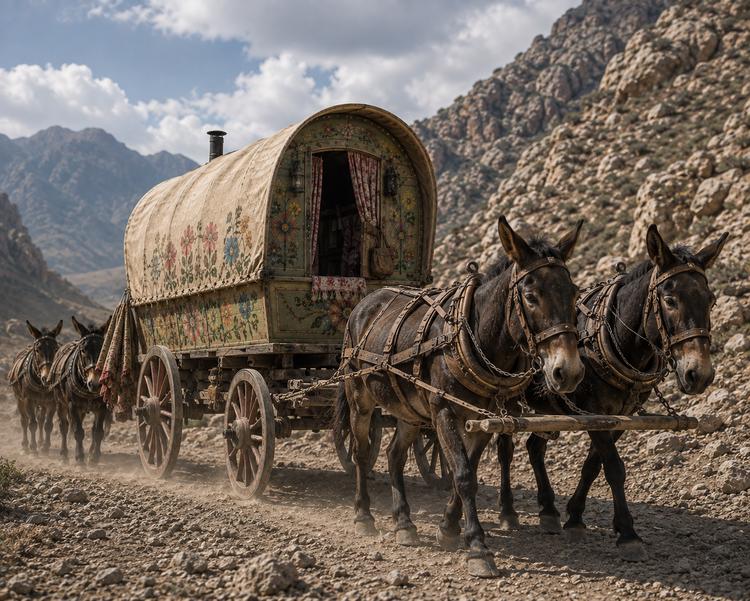
I woke with a gasp, my hands going to my chest for the horn, and finding nothing but a blanket covering my own bare skin. There was something on my face, and I touched it: a bandage. Breathing hard, I lifted my head and looked around. Above me, bunches of drying herbs swayed from the ceiling, casting strange shadows against the canvas walls. I lay on a bedroll on the floor of a moving covered wagon.
The small space reeked of sweat, blood, urine, vinegar, and something rotten. Men lay squeezed in shoulder to shoulder around me beneath wool blankets, their faces pale and shining with fever. Someone coughed wetly in the darkness. Someone else muttered in a language I couldn’t understand.
For a few moments, I had no idea where I was.
Then I heard Ahmed’s voice outside, reciting the Quran loudly as he rode, his voice waxing and waning with the wind, and everything came back to me at once: the mountain pass. The raid. Corporal Jian’s horn, the blue-eyed Afghan, Gulnur lying in Kuangren’s arms, the Afghans escaping with a wagon.
The pain hit me, and I groaned out loud. My leg was on fire. I struggled to sit up, to get a look at the leg, and regretted it. My head spun. Across from me, Memdooh was staring at the roof of the wagon with glassy eyes, his lips moving silently. He looked terrible. His cheeks were flushed, and sweat plastered his hair to his forehead.
“Memdooh?”
He turned his head toward me. For a moment, his expression brightened. “Darius.” His voice was barely a whisper. “Listen to this one:
This is an ode to the dead.
You’re in our hearts, you’re in our heads.
We leave you in the care of the One,
for still you run,
but in a better place,
beneath a better sun.”
I swallowed, my pain forgotten for a moment. “It’s lovely. How many did we lose?”
But Memdooh had fallen asleep, and did not reply.
Critical Condition
I studied the faces around me. What I noticed was who was missing: Gulnur. I knew she had been badly wounded. For an instant, panic seized me. We could not lose her. She and Kuangren, and their at times happy, at times quarrelsome marriage, was one of the bright spots of this entire journey. We all lived vicariously through them.
I forced myself to think. Of course she wouldn’t be here. Hakim Yusuf wasn’t going to pack a wounded woman into a wagon full of half-naked, feverish men.
Ya Allah, I prayed silently, please let Gulnur live. Kuangren loves her.
A shadow fell over me. Hakim Yusuf knelt beside me, pressing the back of his hand against my forehead.
“Ah,” he said, “the hero awakens.”
“How many did we lose? And what about Gulnur?”
“Eight dead. Four in the battle, four by toxin. Gulnur is alive but critical.”
“My leg is killing me. It feels like a burning tree trunk.”
He nodded seriously. “That’s what I’m saying. The Afghans’ arrowheads were poisoned. Some kind of plant toxin. And some appear to have been simply tainted with animal fat or dung, to make the wounds fester. Nasty stuff.”
Dizziness washed over me, and my head fell back to the floor. “Where’s Belly?”
“Who?”
“My horse.”
“Ah.” He chuckled. “I’m sure he’s fine.”
I moaned in pain. “Will I live?”
“Probably.”
I opened my mouth to protest – probably was not reassuring – but weariness and sleep fell upon me like a moonless night.
An Imaginary Fish
With the advent of spring rains, water was running in the gully behind Zihan Ma’s farm. The scent of safflower filled the air. Haaris and I sat on the bank of the stream, skipping stones across the shallow water. Far Away and Bao-Bao crouched beside us, studying the stream as if it were a slithering snake. One of my stones failed to skip and instead splashed. A drop of water hit Far Away and he flicked his tail in annoyance.
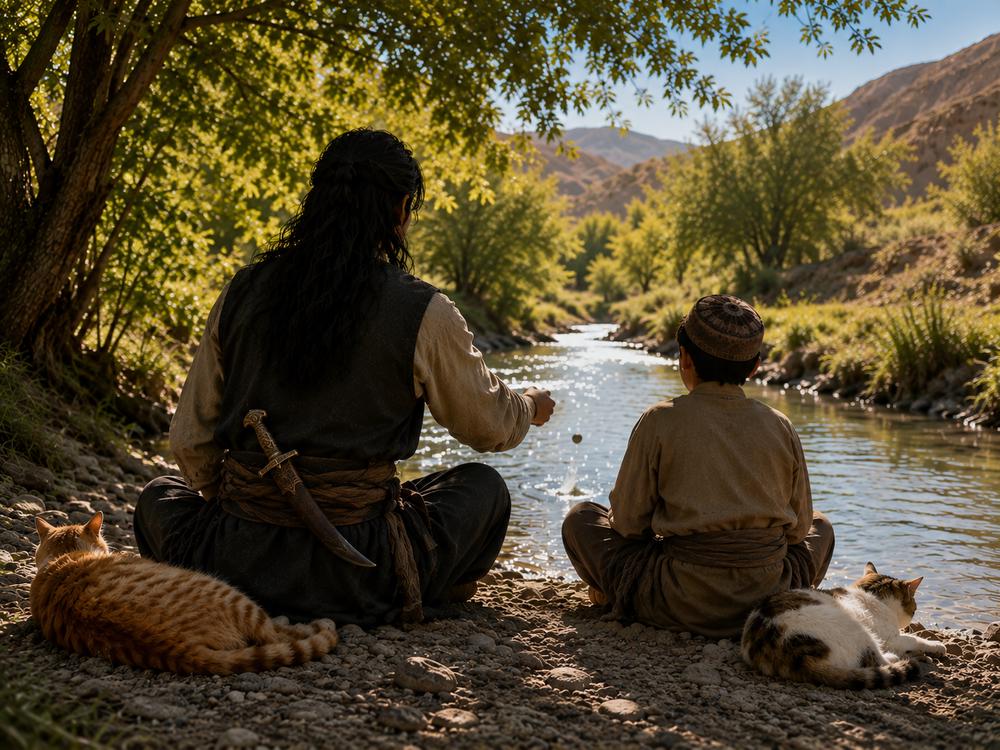
“Your throw is terrible,” Haaris declared.
“It’s not terrible. I’m practicing hitting targets.”
“What’s your target, an imaginary fish?”
Bao-Bao stood, stretched lazily, and walked straight into the stream.
“Haaris!” I shouted. “Your cat will drown!”
Haaris looked at me as if I were an idiot. “Cats can swim, Darius.”
Don’t Tell
The wagon hit a rut, and I woke with a gasp. I noticed immediately that while my leg hurt, it was not nearly as bad as before. But I still felt hot, dizzy and weak.
Then I realized that Weili was sitting beside me, and for a moment I forgot my physical pain. She wasn’t looking at me, and sat with her shoulders slightly rounded, and a shawl pulled around her shoulders. I studied the curves of her face. Her strong jaw line. The sadness that had always hidden behind her eyes now seemed deeper. I detected the faint, sweet smell of opium smoke on her clothing, and it revolted me. Others might think it was a perfume, but I knew better.
She noticed I was awake and smiled. “Hey. Half the caravan is talking about you.”
I tried to speak, but my throat was too dry. Weili went to the front of the wagon and came back with a tin cup filled with cold water. I drank deeply, then said, “What are they saying?”
“Depends. Shah says you killed ten men by yourself. Memdooh says Corporal Jian gave you his horn with his dying breath. Longwei says you’re an upstart. Meilin says you’re a tactical genius. Sarge says you may have saved the entire rear third of the caravan.”
“None of that is true.”
“No?”
“And you? What do you say?”
I saw the muscles in her jaw tense, then relax, then tense again, but she said nothing. The wagon creaked around us. There were only four patients in the wagon now. The others had either died or recovered, I did not know which. Memdooh too was gone. Hakim Yusuf bent over a wounded merchant, changing the bandage on a shoulder wound.
“There’s something I need from you,” Weili said at last.
“What?”
She glanced toward Hakim Yusuf, then bent low over me and whispered in my ear. “Please don’t tell anyone what you saw. About me and Arslan. I’ll be so grateful to you.”
For a moment, I simply stared at her. Then my face flushed red. She hadn’t come here to check on my wellbeing at all. She was here to ask me to protect her secret. I remembered the Afghans fleeing toward the cave with our wagon, and Weili and Arslan trying to shoot the driver and failing, again and again. How much of the loss of the wagon was my fault? I had known that our two best archers were addicted to opium, and I’d said nothing. And people called me a hero. What a joke.
“Get out,” I said.
“Okay, but -”
“Get out, Deng Weili!” I sat up and tried to push her, but the world spun. I heaved as if I might throw up, but managed to keep it down. I fell back onto the bed roll, curled up with my knees to my elbows, and closed my eyes against the hard, cold world.
Too Weak to Walk
Sunlight streamed in through a gap in the canvas flaps. The wagon was not moving. From outside came the sounds of men talking, making repairs, and eating. Yet the sounds were subdued, as if the entire caravan was covered with a gigantic blanket.
Shah and Ahmed were sitting cross-legged, watching me. Ahmed had my travel pack and dao.
Shah’s enormous body seemed to fill the wagon. “There he is!” he boomed. “The commander awakens!”
I groaned. “Don’t call me that.”
He grinned. “Too late. Half the caravan already does.”
“You have to get up,” Ahmed said. “Sergeant Karim has called a caravan-wide meeting. All must attend.”
“He is not ready.” This was Hakim Yusuf, who sat on a stool beside his prep table. “And he needs to stay warm.”
“We’ll carry him,” Ahmed said. “Why do you think I brought the giant?”
Hakim Yusuf fetched a towel and a pail of cold water, and grumbled as he toweled me down, removing layers of sweat and grime. “Hold still, boy. You fought fifty Afghans, but a wet rag is too much?”
“I didn’t fight fifty Afghans.”
“We did, actually,” Shah said. “I still can’t believe it.”
When he was done, Ahmed helped me dress in a clean tunic, trousers and boots, then strapped my dao onto my back. My leg ached, but the real problem was that I was as weak as a baby goose. By the time I was dressed I was breathing as though I had run a mile.
They wouldn’t let me walk. Shah wrapped a blanket around my shoulders, slid one enormous arm beneath my knees and the other behind my back, and lifted me as if I weighed no more than a sack of rice.
“Put me down.”
“No.”
Ahmed laughed, and I covered my face as Shah hauled me out into the sunlight. I squinted against the brightness and peered through my fingers to take in the surroundings.
Beautiful Fool
The narrow mountain pass was gone. Instead we stood in a broad mountain meadow surrounded by towering peaks, their upper slopes white with snow. Wildflowers dotted the grass in splashes of yellow and blue, bending in the wind like worshipers making ruku’. The caravan wagons had been drawn into a great circle, forty-nine wooden giants standing wheel to wheel. Smoke rose from cookfires. Teamsters repaired broken axles and harnesses, and tended to the animals. Merchants sat beneath blankets, drinking tea in the sunlight.
Outside the circle of wagons, the horses and mules, all on long tethers, grazed contentedly on the long grass, guarded by a dozen teamsters, surprisingly. Where were the guards?
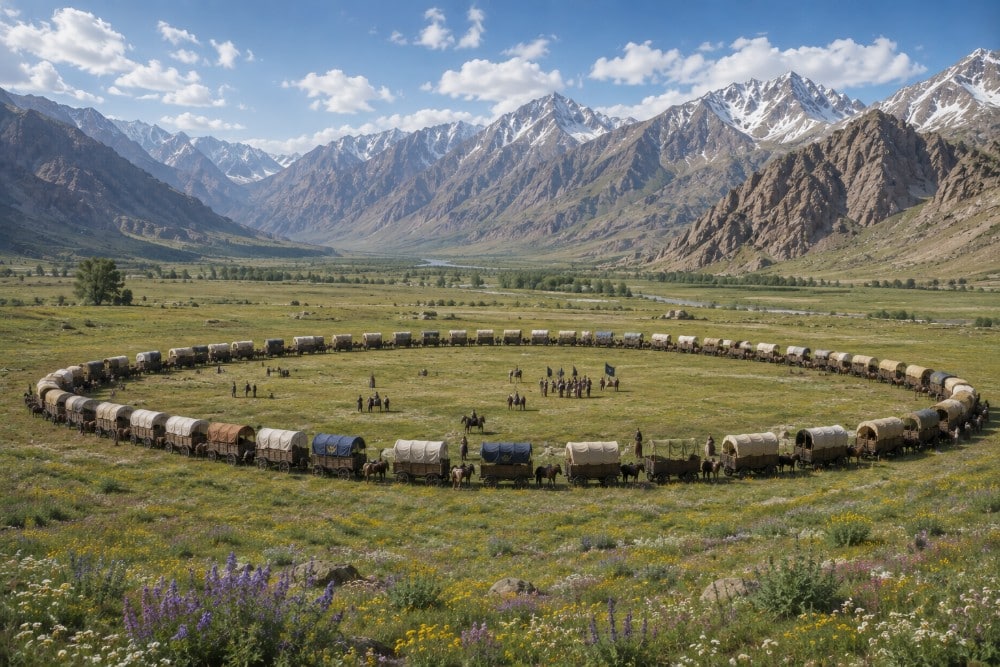
For a moment, the scene was so peaceful and lovely that I forgot everything. At that very instant, somewhere beyond the wagons, a horse let out a loud, excited neigh, then another. I recognized that voice instantly.
Ahmed shaded his eyes and looked toward the remount line. “Let him go!” he shouted to one of the teamsters. “It’s Darius’s horse!”
A moment later, Belly burst around the side of a wagon at a gallop, sending two cooks leaping out of his way. Laughter rippled through the camp as my horse raced straight toward us, black mane flying in the mountain wind.
“Slow down, you beautiful fool,” I whispered.
Belly skidded to a halt beside Shah, snorting and stamping his feet, then shoved his enormous head against my shoulder so hard that I nearly tumbled from Shah’s arms. I stroked his neck, and laughed when he nuzzled my pockets.
“I don’t have any apples.”
“I have a carrot I snagged from the cooks,” Ahmed said, and he handed it to me. “I thought Belly might make an appearance.”
I could have sworn that Belly grinned as he devoured the carrot, chewing happily. He trotted at Shah’s side as we moved farther into the camp, occasionally nudging my blanket with his nose as if to reassure himself that I was truly there.
Then I saw the graves. Ten mounds of fresh earth stood outside the circled wagons, near the western edge of the meadow. A large stone marked each one. The dirt was dark and wet, and a small flock of white birds hunted for insects in the upturned earth.
“We buried them this morning,” Shah said.
I stared. Somewhere beneath them lay Corporal Jian, and other men whose faces I had known for months, and whose voices I had heard every night around the campfires.
Ahead of us, every guard in the caravan stood assembled in the center of the field, talking quietly among themselves. As Shah carried me forward, heads turned. I saw Longwei and Meilin standing together. Her arm was in a sling, but they both seemed fine. Weili, standing next to Arslan as usual, shot me a worried look.
I felt ridiculous, being carried into this group.
“This is embarrassing,” I muttered. “You guys are killing me here.”
“Choose your words wisely,” Ahmed said.
My eyes shot to the fresh graves, and my face paled. “Sorry.”
I saw Kuangren, and called him over. He was thin and pale, and his eyes were puffy and red.
“How is she?”
“Alive but struggling.” His lower lip trembled. “This is the first time I’ve been away from her since it happened.”
I reached out to him, and, to my surprise, he took my hand and kissed it.
The conversation faded as Sergeant Karim stepped into the center of the meadow. He had removed his helmet and tucked it beneath one arm. The wind tugged at his gray hair and beard.
“Five Star guards!” he called.
Men straightened instinctively.
“Fall in!”
The familiar command echoed across the meadow. Conversations ceased. Men hurried into their places. Swords were adjusted, belts tightened, helmets straightened. Within moments, four neat rows stretched across the center of the field.
Timur
Shah lowered me onto a thick section of fallen log someone had dragged into place at the front. I nearly cried out as my left leg brushed the wood. The muscles had stiffened during my time in the wagon, and I could not bend the leg at all, so I sat with it stretched awkwardly in front of me beneath the blanket. Belly, who had not left my side, lowered his head onto my shoulder.
For a few moments, the only sounds were the wind moving through the meadow and the distant clatter of wagon repairs. Karim looked slowly across the ranks, then raised his voice.
“Brother Ahmed. Front and center.”
Ahmed stepped out of formation and walked to Karim’s side. He folded his hands on his chest, and began to speak.
“Bismillahir-Rahmanir-Rahim,” he began. “All praise belongs to Allah, Lord of the worlds. We praise Him, we seek His forgiveness, and we repent to Him.”
He paused, looking past us toward the graves.
“Three days ago, ten men stood among us. Today they stand before Allah.”
The wind carried his words across the meadow. No one turned to look at the graves. We all knew they were there.
“In an authentic hadith,” Ahmed went on, “the Messenger of Allah ﷺ said:
‘Whoever is killed defending his wealth is a shaheed. Whoever is killed defending his family is a shaheed. Whoever is killed defending his life is a shaheed. Whoever is killed defending his religion is a shaheed.’
“The men who died protecting the caravan and their fellow men are shuhadaa. We ask Allah, the Most Generous, to admit them into gardens beneath which rivers flow.”
A chorus of “Ameen,” rose from the assembly.
“There is something else,” Ahmed said. “Many of you are Muslims. Yet the men who attacked us were also Muslim. Some carried the name of Allah on their lips. That is disturbing.”
A murmur of assent passed through the ranks.
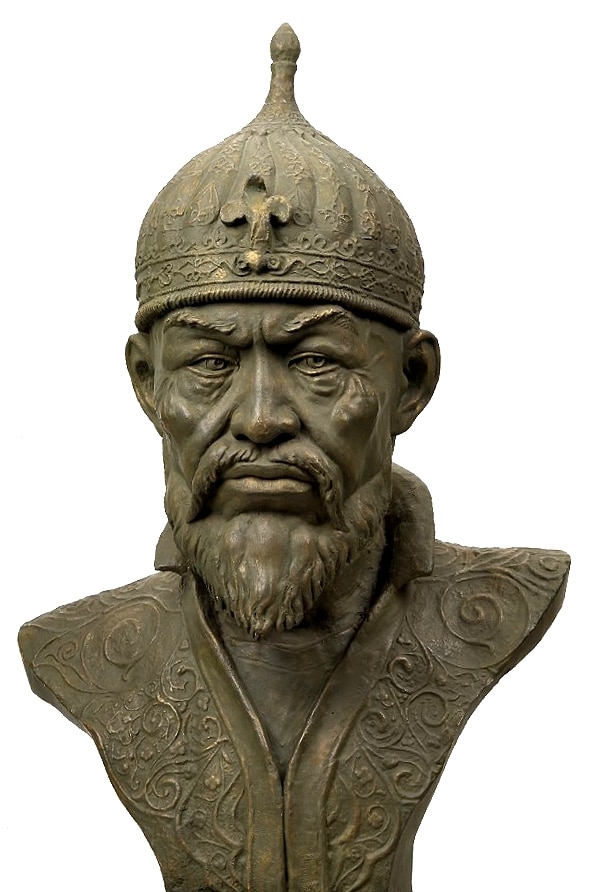
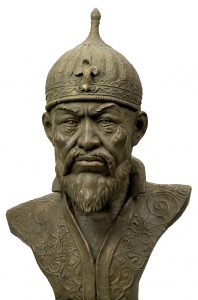 “Centuries ago, there arose a Muslim conqueror named Timur. Driven by ego, he dreamed of possessing the largest Mongol empire in history. He was famous for building masjids and employing scholars. Again, he was Muslim. Yet he marched against Muslim lands from India to Anatolia and Persia, leaving burned cities and mountains of skulls in his wake. Millions perished.
“Were the people of those lands wrong to defend themselves? No. They did what any honorable people must do. They fought because tyranny must be opposed, even when it comes dressed in turbans and robes.”
As he spoke these words, his gaze drifted across the assembled men and settled, for a long moment, on me.
“Allah Himself tells us in the Quran:
‘And if Allah had not checked one people by means of another, the earth would surely have been corrupted; but Allah is full of bounty to the worlds.’”
He swept his unwavering gaze across the assembled group.
“We stood against corruption, though it came wearing turbans and speaking the name of Allah. I would do it again.”
* * *
The meadow was silent save for the distant creaking of wagon wheels and the soft rustle of grass in the wind.
Ahmed raised his hands and began an eloquent dua for the dead. We raised our hands with his, murmuring Ameen. When the supplication ended, Ahmed returned to his place in the ranks.
Belly spotted a patch of long grass and wandered away to graze. I stared at the mountains, nodding slowly. Ahmed’s words had struck home. I thought I understood now.
Captain of Guards
Karim tucked his helmet beneath one arm and surveyed the assembled guards. The lines around his eyes seemed deeper than they had only a week before.
“Before we continue,” he said, “I want to thank every man and woman who stood and fought in that mountain pass. Many of you have ridden beside me for years, since the days when I was Sergeant Karim. Many of you still call me sergeant, and I do not mind. I take it as a term of affection. But for the benefit of our younger recruits, let me remind you that I am, in fact, a Captain of Guards in the service of Five Star. As such, I possess the authority to promote, demote, enforce discipline, and grant rewards.”
I had not known this, and was embarrassed that I’d been calling him Sarge this whole time, even if he didn’t mind it.
Shah was called forward. He blinked in surprise, then stepped forward. His gait was surprisingly graceful for such a large man.
“With only Darius Lee at your side,” Karim said, “you plunged directly into an advancing group of at least fifty raiders and shattered the spine of their attack. For bravery and loyalty, I hereby promote you to Senior Guard.”
The meadow erupted in applause. Shah bowed awkwardly and returned to his place.
I was surprised that Shah was not already more highly ranked. He must have been new to the company. The lowest rank, I knew, was Guard, which was me. Above that was Senior Guard – Shah’s new rank – then Veteran Guard – like Longwei – then Corporal, Sergeant, Master Sergeant, Lieutenant, Captain, and other more senior ranks held by company officers and members of my mother’s family back home.
Karim promoted several others whose names I scarcely heard. The fever had returned, and it settled behind my eyes like smoldering coals. The mountains beyond the meadow shimmered strangely in the sunlight, and the yellow flowers seemed brighter than before, almost painfully so. I thought they might be made of fresh butter. I licked my lips.
Meilin, her arm in a sling, was promoted to Veteran Guard.
Longwei stood very straight, his hands clasped behind his back. There was a hopeful look in his eyes that I had never seen before. A promotion would make him a Corporal – the first true command rank. For a moment, I was certain Karim would call his name.
He did not. The captain fell silent.
Longwei’s smile faltered. Watching his aging face, I saw disappointment. Not anger. Just the weary disappointment of a man who had expected something and received nothing. I felt bad for him.
Weili’s name was not called either, I noted. Nor mine. Which was fine.
Front and Center
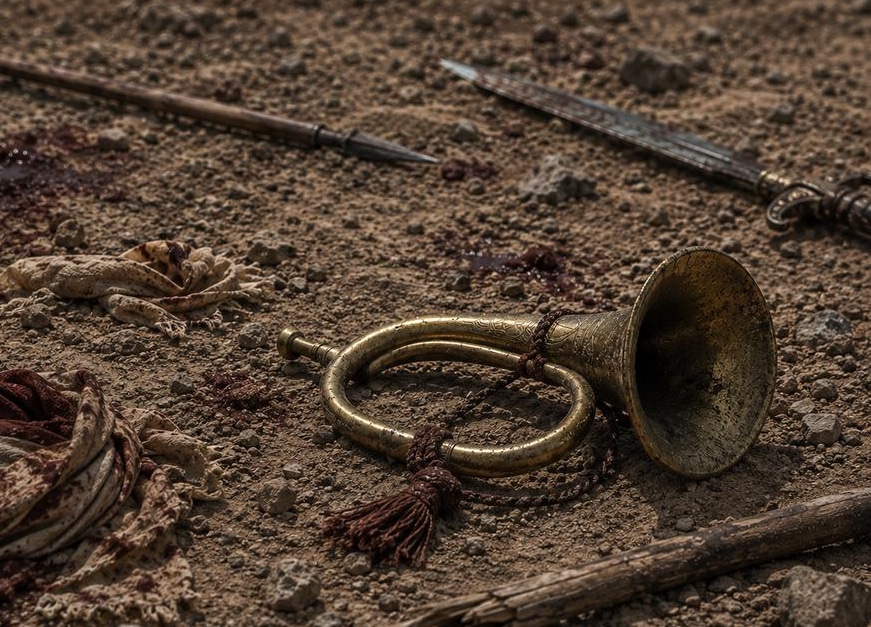
The log I sat on seemed to roll beneath me and I shot my hands out for balance. I blinked hard and found myself staring at Corporal Jian. He stood at the edge of the field behind Karim, horn around his neck and an arrow still in his chest. He studied me intently, as if trying to discern the true grit of the boy who had taken his horn.
Sergeant Karim’s – no, Captain Karim’s – voice boomed across the meadow.
“Darius Lee. Front and center.”
Lost in my fever dream, I did not move. Shah seized my arm and tugged. I tried to stand and collapsed. He caught me before I could fall. “Easy, commander.”
“Stop calling me that.”
No one laughed as Shah supported me with one arm as he helped me to stand beside Karim. My injured leg hung uselessly. Every face in the caravan seemed to be watching.
Karim stepped toward me holding Corporal Jian’s horn. “On the battlefield, age is irrelevant. Only performance matters. When Corporal Jian fell, many distinguished themselves. But one person rallied the men, and brought order to chaos.”
He paused, looking directly into my eyes.
“Darius Lee, you killed nine of the enemy that day. That is astonishing. But it is not for that reason that I promote you. Rather, your courage and judgment saved lives. Never forget that.”
He lifted the leather cord and slipped the horn over my head. It settled against my chest, surprisingly heavy.
“I promote you to Veteran Guard.”
The applause washed over me like a wave. Somewhere nearby, Belly raised his head from the grass and said, “Make sure the job comes with free apples, Boss.”
I swayed where I stood. The meadow was losing its shape. The mountains looked soft around the edges, like giant sesame buns. I wondered how they tasted. My skin felt cold, yet sweat trickled down my back beneath the blanket. Far Away slept in a mini sling that hung around my neck. How nice that he was here.
“Veteran Guard Darius Lee, would you care to say a few words?”
I looked out at the rows of guards, at the graves beyond them, and at the endless mountains beyond. The graves were open. The dead had walked away. I wished them safe travels.
My throat was dry. I swallowed, petted Far Away, and began to speak.
“Memdooh made up a poem. It goes like this:
This is an ode to the dead.
You’re in our hearts, you’re in our heads.
We leave you in the care of the One,
for still you run,
but in a better place,
beneath a better sun.
I think he should be promoted to veteran poet.”
I was serious about this, and was surprised when men laughed. Once again I saw Corporal Jian standing off to the side. He nodded his head at me, pleased, and I felt relieved.
“Corporal Jian was dead when I found him,” I said. “I closed his eyes. His hand was reaching for the horn, trying to do…” I shivered. “His duty… Even with an arrow in his chest.” My eyes drifted to Jian’s ghost. “He’s here with us. His eyes are bright. I think… He’s proud of everyone.”
Men nodded solemnly at this, not realizing that I could literally see him.
“There was a blue-eyed young Afghan. I didn’t want to kill him, but he would not stop. He was no Timur, but… I had no choice. We had no choice.”
I lifted a trembling arm and pointed. “Memdooh is a hero. He was wounded, but he stood and fired, even though he was scared. What a lion.”
I looked for Longwei, found him. “Longwei didn’t like my orders but he did well. He and Meilin killed the commander…”
My eyes searched out Weili and found her. She clasped her hands together and silently mouthed the word, “Please.” I almost said out loud, “Don’t worry, I won’t tell,” but instead I merely winked.
“A man tried to pull me down,” I continued, “And Belly gave him a Belly bite…” I laughed at that, remembering, and men laughed with me. “What a good horse,” I mumbled. “The best horse.” Then dizziness and exhaustion overtook me, and I fell into Shah’s powerful arms.
Holding Back
A few hours later, in the medical wagon, Captain Karim came to see me. I lay on my bedroll on the floor. Hakim Yusuf had fed and watered me, cooled my forehead and given me foul tasting medicine, and I was somewhat recovered.
“It was meant for you to blow Corporal Jian’s horn,” Karim said, sitting cross-legged beside me. “Some things are destined. I would have promoted you to corporal, but I have to consider the morale of the men.”
“What about Longwei?”
He nodded. “He’s a good fighter and an experienced guard. He knows the terrain, languages and local customs. A valuable man to have. But command is not right for him.” He produced a small leather purse, put it in my hand, and curled my fingers around it. “A bonus for you. We give out bonuses privately. No need to invite envy, or tempt otherwise honest men.”
I loosened the drawstring and looked in the purse. It was filled with gold coins. “SubhanAllah! This is a fortune.”
“Not really. You saved me far more.” He tapped my chest with one finger. “I’ll tell you something though. It sounds strange to say this, but you’re holding back. Your feet are in two different worlds.”
I remembered Meilin telling me something similar after our duel.
“Is that a bad thing?”
Karim looked up at the roof of the wagon, thinking. “I don’t know.”
With a pat on my shoulder, he departed.
A Night Like Deep River
That night, I woke with a desperate need to urinate.
For a moment I lay still, staring up at the canvas roof of Hakim Yusuf’s wagon, listening to the sounds of sleeping men. Someone nearby snored softly. One of the patients coughed in his sleep and turned over. Hakim Yusuf himself lay on his cot in the corner, wrapped in blankets and breathing heavily.
The bucket sat beside my bedroll.
I glared at it. I was sick of buckets. I tested my leg: it was stiff, and still sore, but far improved. I’d go do my business outside.
Very carefully, trying not to wake anyone, I pushed aside my blanket and sat up. My head still swam, though not as badly as before. My leg ached fiercely, but the fire had diminished to a dull, throbbing pain. I reached for my trousers and boots, wincing as I dressed. Then, by force of habit, I strapped my dao to my back, and finally took a little tin cup of water to wash up afterward.
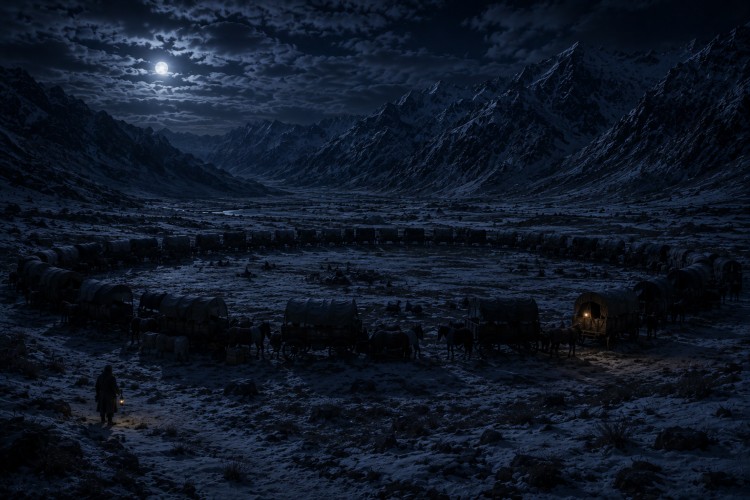
Outside, the night air struck me like a slap. The mountain meadow was gone. So were the towering white peaks. The caravan had moved on while I drifted in and out of fever dreams. We now camped among rolling, windswept hills. Snow covered the ground in patches, shining silver beneath a half moon. The wind hissed through the grass and carried with it the smell of horses and manure.
The camp was silent.
Somehow this place, and this night, reminded me of Deep River. Not in appearance, but in its impersonal frigidity. Deep River, for all its business, had felt barren at times. And the wind here was like the water of the river itself, freezing and unceasing.
The wagons stood in a circle, black shapes against the snow. Here and there, small tents had been pitched between them. The horses and mules slept standing, their backs covered with heavy wool blankets. Only the night guards remained awake, pacing the perimeter with spears and lanterns.
I raised a hand to one of them. He nodded in return, then resumed his patrol.
A stand of dark trees stood perhaps fifty paces from the camp. Relieved to be outside at last, I limped in that direction.
A Flicker of Light
I had not gone ten steps when something caught my eye.
A flicker of orange light, so faint that for a moment I thought it was just a patch of snow reflecting the moonlight. I stopped and searched. There it was again. The light came from one of the wagons.
That was impossible. Open flame inside a wagon was absolutely forbidden. Fire was one of the caravan’s greatest fears. One spark in the wrong place could destroy fifty wagons, hundreds of animals, and everyone sleeping beside them.
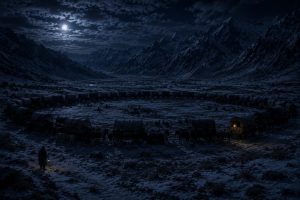 My stomach tightened.
I knew that wagon: it was the Silk Store, as we called it. Bolts of cloth filled its interior from floor to ceiling: silk, hemp, linen, rolls of compressed cotton, and embroidered carpets wrapped in oilcloth. I recognized it by the wheels. The Silk Store had shattered a wheel in Samarkand, and the smiths had fashioned two new matching wheels from walnut wood. They were darker and smoother than any of the other wheels. I heard they provided excellent stability and shock resistance as well.
I approached quietly, limping and gritting my teeth from the pain. The merchants responsible for the Silk Store had pitched two small tents nearby, and from inside came the unmistakable sounds of snoring.
I lifted the canvas flap at the wagon’s entrance.
My jaw dropped.
Permission to Burn
What in the name of Allah… Weili and Arslan were squeezed into a tiny space between carpets, bolts of fabric and tight rolls of compressed cotton. She sat slumped against one wall, her eyes half closed, an opium pipe dangling from her fingers. Beside her, Arslan crouched over a tiny oil lamp whose flame was turned almost completely down, no larger than a candle wick. Above the flame, he held a small metal spoon blackened with soot. A dark lump of opium hissed and bubbled inside it. Smoke curled lazily toward the roof.
For several seconds, I simply stared.
“Are you insane?” I hissed, climbing into the wagon. “Put out the flame. You can’t be in here.”
Weili blinked up at me, confused. “Darius?”
Arslan grinned stupidly. “We’re being careful.”
I looked around at the mountain of cloth surrounding us.
“Careful?” I whispered fiercely. “You’re cooking opium in a wagon full of flammable fabrics.”
Weili rubbed her eyes. “The flame is tiny. Nobody will notice.”
“That’s not the point. And I noticed.”
Arslan shrugged. “That’s because you sniffed out Weili like a fox after a rabbit.”
Resolution coalesced in my chest like a block of ice. I’d let this corruption continue for far too long. I was a Veteran Guard now. Enough was enough.
“No more of this, Weili. I can’t cover for you anymore, I can’t allow this.” I stepped past them and reached for the lamp to extinguish it.
Arslan lurched to his feet, intending to block my way, but in his drugged stupor he stumbled. His foot caught on a rolled carpet and he fell. His outflung arm struck the lamp, and it overturned and shattered, spilling burning oil across a bundle of compressed cotton.
The cotton ignited instantly, flaring up and burning brightly. For one frozen heartbeat, all three of us stared at the flames. Then the wagon exploded into chaos.
Fire leaped from one bolt of fabric to the next. It raced up the walls, and ignited the canvas cover of the wagon. It was as if the entire wagon had only been waiting for permission to burn. Flames surrounded us. My jacket was on fire, and smoke filled my lungs. Arslan cursed, while Weili screamed.
Around us, the wagon turned into a whirlwind of flame.
* * *
Come back next week for Part 24 – The Whipping
Reader comments and constructive criticism are important to me, so please comment!
See the Story Index for Wael Abdelgawad’s other stories on this website.

Wael Abdelgawad’s novels – including Pieces of a Dream, The Repeaters and Zaid Karim Private Investigator – are available in ebook and print form on his author page at Amazon.com.
Related:
Pieces of a Dream | Part 1: The Cabbie and the Muslim Woman
Trust Fund And A Yellow Lamborghini: A Short Story
The post Far Away [Part 23] – Delirium appeared first on MuslimMatters.org.

 A man directs a racist crowd to the home of ‘invaders’ in Thetford.
 A wildfire at Arthur’s Seat, Edinburgh