
Sanctioning "violent settlers," EU gives $3 million to firm hiring Israel's spies
Brussels officials pave way for future crimes against humanity.
Brussels officials pave way for future crimes against humanity.

Last week local elections were held in the UK, mainly for district and unitary authority councils in England but also for the Welsh and Scottish parliaments. For the second time, Reform UK gained majorities on a number of county councils as well as several large metropolitan boroughs in Yorkshire and the West Midlands. Last year, they gained majorities on a number of county and large unitary authorities in the Midlands: Lincolnshire, Nottinghamshire, Derbyshire and both halves of Northamptonshire as well as Kent, Lancashire and the metropolitan borough of Doncaster in South Yorkshire. This time they gained Suffolk and Essex counties (both formerly Tory), two met boroughs in the West Midlands and, crucially for Labour, three more met boroughs in South and West Yorkshire: Kirklees (Huddersfield), Calderdale (Halifax) and Wakefield. The map on the right shows the county and metropolitan boroughs according to current dominant party, and the turquoise areas show Reform UK held councils. Labour have been scoring poorly in opinion polls ever since 2024, when they won with a lot of help from a right-wing vote divided between the Tories and the rapidly growing Reform UK, formerly the Brexit Party led by Nigel Farage who was formerly the leader of UKIP. As a result, there have been a lot of calls for the prime minister and Labour leader, Keir Starmer, to resign. Starmer’s supporters are variously calling it idiocy or madness, comparing it to “changing pilots in mid flight”, and pointing to everything Starmer’s government has done for us.
It’s true that on previous occasions when a governing party has suffered local election losses, they have neither changed leaders nor called a general election: John Major in 1995 and Tony Blair in the first term of his government have been mentioned. However, both of these had won majorities on the basis of more than 40% of the vote; Starmer won 2024 on the basis of less than 34%, a smaller share than Blair won in his last election, in 2005, or Jeremy Corbyn’s share in 2017. (John Major’s government, which was losing safe seat after safe seat in parliamentary by-elections, went down to defeat two years after those council elections.) Starmer won seats that Labour had never won before, including in their 1997 landslide; as with some of those seats, these are unlikely to be won again and the winning candidate won less than 30% of the popular vote and benefited from a split Tory vote. For much of the time since, Labour has been polling around 20%. While opinion polls have their flaws, it’s unheard of for a governing party to show this poorly, or anything like it, consistently over months or more than a year. Mid-term blues are a thing, but they are never this bad for a newly elected government which should be riding high. Council elections are not referendums or votes of confidence on the government, but voters often treat them as such.
As the resignations mounted earlier today, someone on BlueSky mentioned by way of a historical parallel a challenge to Gordon Brown’s leadership in June 2009, supported by three ministers (James Purnell, Hazel Blears and Jacqui Smith). In fact, the two women had resigned for reasons connected with their expenses. None of the three, they point out, are still in Parliament: one is in the Lords, one has retired and one is now a CEO of a company. Yet Gordon Brown lost the election the following year, so it does not really strengthen their case for Starmer remaining leader.
These results, in other words, are dire. Labour’s leaders should be painfully aware of the ephemeral nature of the 2024 result and some of the particular constituency results, that Labour won by the skin of its teeth, but it seems they are not. They should be worried about the flipping of former safe Tory county councils to Reform, because it points to the end of the split Tory vote that Starmer benefited from; they should worry about the fact that people are undeterred by the Council Tax rises and other broken promises, poor attendance, recurrent resignations and defections at Reform councils since last year; can we really assume that the immediate resignations this year, or the revelation that one of their winning candidates was a made-up name and an AI-generated picture, will put people off in future? I see his supporters flattering him on social media, appearing blind to his faults as Corbyn’s fans back in the 2010s were to his. They also keep sharing lists of Labour’s achievements since returning to power. These are mostly good things, but in politics “if you’re explaining, you’re losing”. People should not need to have the benefits of a Labour government explained to them; they should be able to feel it, otherwise it will be like the benefits of the EU: we will miss them when they are gone and it is too late. So, stop praising Starmer’s “steady hand” and “boring” or “unflashy” policies. This is not the time for that. People have to know about what they are doing, and feel the benefits.
The country is in dire danger. A party of incompetents and racists is growing rapidly, gaining control of councils from both Labour and the Tories that were considered safe ten years ago, exploiting the failures of both of those parties. Labour have neglected its working-class base for decades, treating them by turns as an embarrassment and as having nowhere else to go. It treats other people’s lives as just bargaining chips, things to calculate over, though these are millions of people and millions of votes. Disabled people, immigrants and their British families, the white working class, the Asian working class. They have just alienated too many major groups for their current strategies to stand a chance of winning another election. I once read a description of the last native prince of Wales, Llywelyn ap Gruffudd (Griffith), that he “simply fumbled his way to disaster” and this, as Jess Phillips’s letter shows, describes aspects of Starmer’s leadership. I am not convinced a new leader will change much; whoever wins will probably be much like Starmer in terms of policy, maintaining the attacks on disabled people’s welfare supports and harsh, unfair changes to immigration law, the attachment to Israel while it wages war on its neighbours and continues the genocide of Palestinian natives, but they might just be able to connect with people in a way Starmer cannot (experience in the US shows the danger of that); what the party needs is not just new leadership but new ideas, fast, to prevent a defeat in 2029 that will make 1983 and 2019 look mild (not least because the winning party was nowhere near as extreme) and allow the wretched Farage to drag this country into the abyss.
Image source: Open Council Data.
At his grandmother’s opulent riverside estate, Darius finds himself judged not for who he is, but for whose son he is.
Read Part 1 | Part 2 | Part 3 | Part 4 | Part 5 | Part 6 | Part 7 | Part 8 | Part 9 | Part 10 | Part 11
* * *
Self-ControlledThe colorfully dressed doorman opened the gates before we even reached them.
The Chen residence did not resemble any home I had ever seen. Calling it a house seemed absurd. It was a walled compound of white stone and dark wood, with curved roofs layered one behind another like overlapping wings. Red lanterns hung beneath the eaves despite the daylight, and narrow streams of water crossed the inner courtyards beneath little carved bridges. Bamboo rustled softly in the winter breeze.
I slowed, taking it all in. It was like something I might have conjured in a dream.
Haaris, walking beside me, whispered proudly, “Big, right?”
Indeed. “What does Master Chen do for a living?”I whispered.
“He owns a foundry that makes weapons.” replied softly.
Servants moved everywhere, silent and efficient. One swept fallen leaves from the stone paths with a long reed broom. Another carried folded linens across the courtyard. Two men unloaded crates from a wagon near a side gate while a woman directed them sharply.
Something unsettled me immediately. After a few moments, I realized that no one here was comfortable. No one laughed or joked as Haaris and I did when we worked. Everyone was carefully self-controlled, as if they thought they were being watched at every moment.

I felt the absence of my dao acutely. Not that I thought I would need it here. But ever since I’d left it wrapped in cloth beneath the wagon seat in the stable yard, I’d been worried about it. What if someone stole it? It was a gift from my father – the only thing I had from him.
Before we entered the inner residence, an elderly servant approached and bowed stiffly, saying, “I will take your coats and travel packs, honored guests.”
We all handed over our bundles, including my travel pack containing the gifts I had bought in the marketplace. The old servant stacked everything carefully into a lacquered cart beside the entrance, then wheeled the cart away through a side doorway.
A servant girl in pale green robes then led us through a covered walkway into the main receiving hall.
The room was enormous. Dark beams crossed the high ceiling overhead. Silk wall hangings embroidered with Quranic calligraphy hung between painted landscape screens. One scroll depicted mountains rising above misty forests, with tiny travelers crossing a bridge far below. Another showed a river crowded with merchant barges beneath wheeling birds.
Tall porcelain vases stood in carved wooden alcoves, painted in deep blue with scenes of scholars, horses and flowering trees. A bronze incense burner shaped like a crane released thin trails of scented smoke into the air, giving the place a sweet and musky scent. Low tables of carved rosewood stood beside cushioned chairs lacquered black and gold.
Strangely, while I admired the beauty of this place, I was not intimidated. My clothes were new and clean. I had nothing to be ashamed of. And I had seen my father put wealthy merchants on their knees in the highway at the point of a sword before robbing them. They wore fine clothes, but they wept and begged like anyone else. A few wet themselves. I think my father had enjoyed humiliating them. As for me, I had merely felt embarrassed for them.
Furthermore, Zihan Ma had taught me that one of the meanings of laa ilaha il-Allah was that all men were equal before Allah, regardless of caste, color or clothing. Only their – what was the word? Taqwa. Only their taqwa differentiated them.
As a result, I never thought that the wealthy were better than me. Nor was I better than them. People were people. They were either honest or dishonest, kind or cruel. They were street thugs like the men who had tried to rob me – or indeed like my father, who I had no illusions about – or honorable men like Zihan Ma. I had never met the emperor of our land, nor would I, but I knew he was either a good man or a bad one, no matter what trappings of wealth surrounded him, and I knew he could not be a better man than my uncle.
Come CloserAt the far end of the hall sat an elderly woman in layered robes of soft blue silk. A pale gray scarf covered her hair. Beside her sat a thin older man with narrow shoulders and sharp features. His beard was trimmed short and precise. He wore a white robe of fine linen with silver embroidery, and jade rings gleamed on his fingers as he sipped from a porcelain tea cup.
Zihan Ma bowed respectfully toward the older man. “Master Chen.”
“Ma.” The man inclined his head slightly.
His eyes shifted toward me.
“This,” Lee Ayi said carefully, “is Darius Lee.”
I bowed deeply. “As-salamu alaykum Nai Nai and Master Chen.”
His eyes narrowed. “Were you taught to greet the women first?”
Before I could answer, Nai Nai smiled gently and said, “Come closer so I may see you.”
Haaris and I both went to her. Haaris hugged her, then I did. Her hands were warm and soft as she touched my face lightly, studying me with moist eyes. “You have your father’s eyes,” she murmured.
Master Chen snorted quietly into his tea. “An unfortunate inheritance.”
The room fell silent.
Lee Ayi crossed the room quickly and knelt beside her mother, taking both her hands. The warmth between them was immediate and genuine.
“We brought gifts for your birthday,” Lee Ayi said. She opened her bundle and carefully removed a folded silk shawl embroidered with tiny silver flowers. I had seen her making it over the last few weeks, but had not known it was for her mother.
Nai Nai touched the fabric reverently. “It’s beautiful,” she whispered.
Haaris eagerly produced a folded note written in his uneven handwriting. “Mine too!”
Nai Nai laughed softly and accepted it at once. “A letter?”
“A birthday note,” Haaris said proudly. “Baba helped me shape some characters.”
She opened it immediately, smiling as she read.
Then everyone looked at me.
I suddenly felt awkward. My own letter, though heartfelt, seemed childish now compared to the grandeur of this house. Still, I handed it to her. Nai Nai unfolded it slowly and read it in silence. I had written:
I am very happy to meet you, Nai Nai. My father had good qualities and bad, but I am sure that whatever good he possessed came from you. Whatever has befallen me in life, it brought me here to meet you. That is a barakah. I wish you a happy birthday and many to come.
When she finished, she pressed the paper briefly against her chest. “Thank you, Darius,” she said softly. “I will treasure it.” Her sincerity was real, and it moved me.
“Could you not even buy a gift for your grandmother?” Chen sneered. “A paltry letter? That’s fine for Haaris, but you are a young man.”
Nai Nai lowered her hands slowly. “Husband…”
“I merely speak the truth.” His gaze remained fixed on me. “Yong Lee was a troublesome boy long before drink rotted what remained of his judgment. No doubt this child is the same.”
I lifted my chin and met his gaze. I spoke calmly. “My father was more than that.”
Chen set down his tea cup abruptly, the tea spilling onto the porcelain dish beneath it.
Lee Ayi spoke softly. “Master Chen, Darius has traveled far. Let us welcome him peacefully.”
“Peacefully?” Master Chen replied. “Was Yong peaceful? I seem to recall gambling, fighting, drinking and theft following him from one province to the next like stray dogs.”
Haaris shifted uncomfortably beside me.
Zihan Ma’s expression remained calm, but I noticed his jaw tighten slightly.
Lee Ayi had told me to remain silent, but I would not keep my mouth shut while my father was reviled. I would never forget him coming home from prison, finding me half-starved, and weeping as he embraced me. That moment was engraved on my heart.
“My father,” I said, perhaps a little too loudly, “joined the army to fight the invaders. He died in defense of his country. What could be more honorable?”
Servants entered carrying tea for the rest of us, along with trays of candied fruits and little sesame pastries arranged in perfect rows.
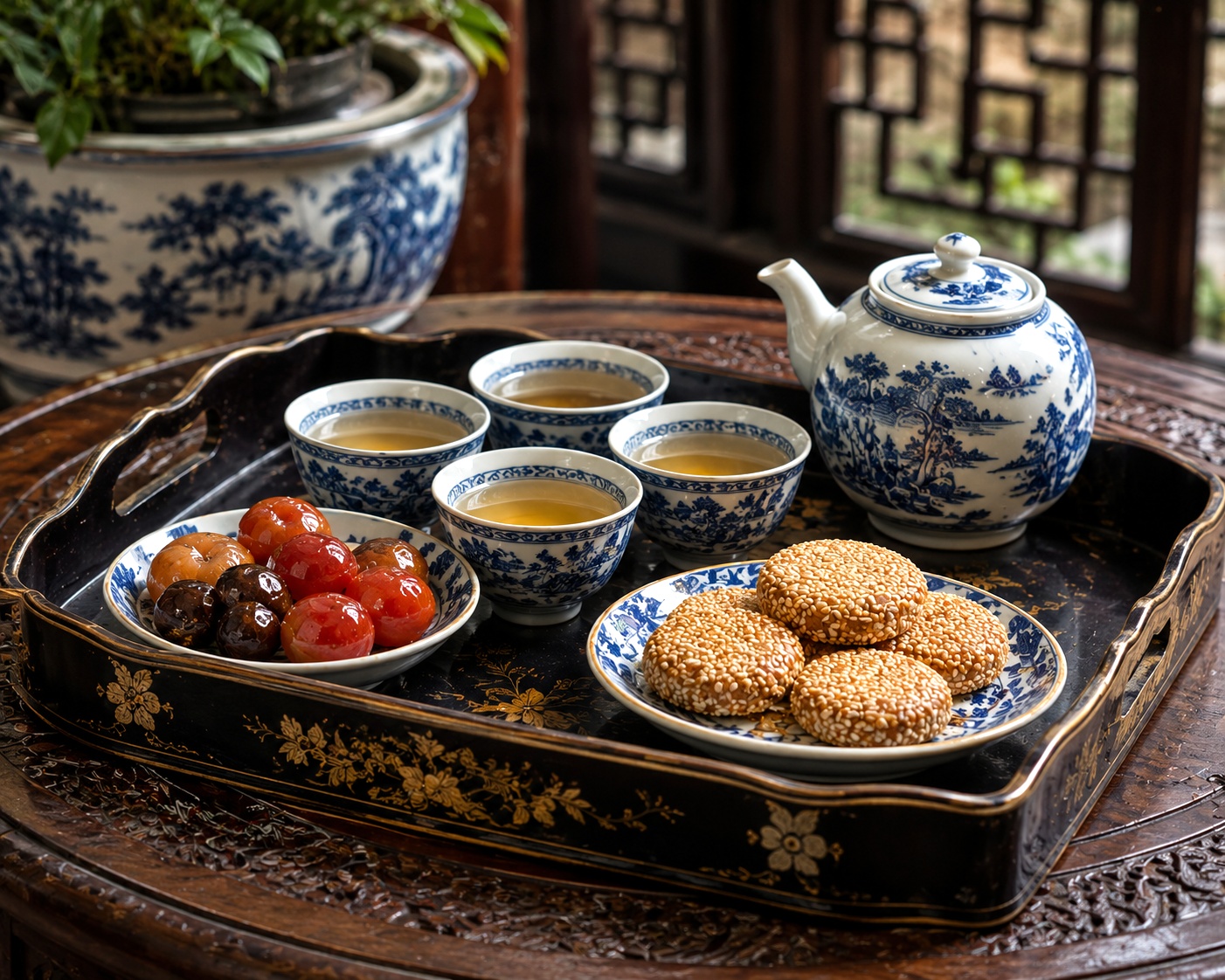
Master Chen took a pastry, and Haaris followed suit. I thought Chen might insult or berate me, but instead he spoke softly: “There is a saying. When the roots are crooked, the branches grow twisted.”
Nai Nai touched her husband’s hand with one finger. “I beg you. Let us have no more of this.” It was the voice of someone pleading for a small mercy she was not certain would be granted.
Master Chen finally looked away from me and sipped his tea.
The Accusation“We must pray Asr,” Zihan Ma said. “It is getting late.”
One by one we performed wudu’ in a large bathing room with a skylight and a live bamboo tree in a pot. Master Chen then led us to a dedicated prayer room. There he led us in salat. He could not kneel, so he sat in a chair as he prayed. When lifting his head from ruku’, he said, “Sami Allah lamaw zhamidu.” The salam at the end was similarly garbled. No one corrected him, of course.
After prayer we returned to the sitting room. Now Haaris and I did indeed remain silent as the adults spoke of the war, refugees, the farm, and other things. Master Chen’s armaments business was booming. There was no warmth in these conversations. In the time that it took to drink a single cup of tea, Zihan Ma rose.
“It was wonderful to see you both,” he said. “We must leave. We have a long trip ahead and we do not want to be on the road late at night. It’s not safe.”
“You must stay,” Nai Nai protested. “We have plenty of room. Please, for my sake.”
“We cannot,” Zihan Ma replied firmly. “The cows must be milked in the morning, and the gate opened for the farm hands.”
I knew this was not strictly true. The foreman had the key to the gate, and the men could milk the cows, feed the chickens and let the donkeys out. But I too wanted to be away from this oppressive place, and I was worried about Far Away. I wanted to hear his protesting meow when I picked him up and nuzzled him. I even missed Bao Bao, for her kindness toward Far Away had warmed me to her.
Master Chen gave a derisive laugh. “Cows.”
I wanted to say, “Didn’t you put milk in your tea?” But I held my tongue. I did not like this man at all.
The elderly servant wheeled the cart back in, and we picked up our packs and bags. Good byes were said, and final embraces given. Nai Nai hugged me with her thin arms, and I gave her a half-hearted embrace in return. She was my grandmother, and I would like to say that I loved her, but I did not know her.
A female servant opened the door for us and bowed. As we were about to leave, the elderly male servant leaned in toward Master Chen and whispered something in his ear.
“Wait,” Master Chen said. “I am told that certain items have gone missing. A pair of gold bracelets.”
Zihan Ma frowned. “That’s unfortunate. May Allah return them to you. As I said, we must be going.”
“You misunderstand,” Master Chen said sharply. He pointed at me with one rigid arm. “The boy has stolen them. He was seen taking them.”
For a moment I thought I had misheard him.
Zihan Ma said, “That is impossible. He was with us the entire time.”
“He was gone a long time when he went to make wudu. Let him open his pack.”
Zihan Ma’s jaw tightened. “This is unacceptable. Darius is my apprentice, and works hard on the farm. He’s a good boy. You have no cause to suspect him.”
“His father was a thief,” Chen said flatly. He turned to me. “Isn’t that true?” His eyes held a cunning gleam, and I felt the first stirrings of unease in my stomach. Something strange was going on here.
“Yes,” I said honestly. “Though he changed in the last year of his life.”
“And you?” Chen asked, a thin smile on his lips. “Did you steal?”
I considered. I would not dishonor Zihan Ma by lying. My reply was truthful: “When my father was in prison, and I was alone on the farm, I stole food from neighboring farms to survive. A few potatoes here, a cabbage there. Only that.”
At that, Zihan Ma shot me a troubled glance. He had not known that about me.
“You see?” Chen declared triumphantly. “Once a thief, always a thief.”
Zihan Ma began to protest, but I waved him off. “It’s okay, Uncle,” I said. “I have no objection to opening my pack.”
I set the pack down on the floor, untied the strings, and opened the top flap. Inside were the few items I had brought from home: a towel, a spare shirt, and the sabha Zihan Ma had given me. On top sat the three cloth-wrapped gifts I had bought in the marketplace.
Chen’s eyes narrowed. “Take everything out.”
The room had gone utterly silent.
I frowned slightly but obeyed. First I removed the wrapped gifts and set them carefully beside the pack. Then the towel. Then the shirt and the sabha.
Something metallic glimmered at the very bottom of the pack.
For a moment my mind refused to understand what I was seeing.
Then I reached down slowly and picked them up.
Two gold bracelets rested in my palm.
* * *
Come back next week for Part 13 – The Long, Dark Road
Reader comments and constructive criticism are important to me, so please comment!
See the Story Index for Wael Abdelgawad’s other stories on this website.

Wael Abdelgawad’s novels – including Pieces of a Dream, The Repeaters and Zaid Karim Private Investigator – are available in ebook and print form on his author page at Amazon.com.
Related:
As Light As Birdsong: A Ramadan Story
Kill The Courier – Hiding In Plain Sight
The post Far Away [Part 12] – Accused appeared first on MuslimMatters.org.
Muhammad Shehada discussed how the Iran war is frustrating the US-Israeli push to disarm Gaza resistance.
Exclusive: Push to register unaffiliated party with identical name to grassroots group follows Avi Yemini’s plan to use ‘Free Palestine party’ to funnel votes to One Nation
Get our breaking news email, free app or daily news podcast
Muslim Votes Matter (MVM) has complained to the Victorian Electoral Commission over an anonymous bid to register a political party under the same name ahead of the state election, accusing it of deliberately misleading voters.
MVM was established before the 2025 federal election as a grassroots advocacy and lobbying movement, responding to concerns about the lack of political representation for Muslim and minority groups in Australia.
Continue reading...Muhammad Shehada tells EI how a stormy meeting in Cairo exposed the real agenda behind the latest Gaza “peace” proposals.
Auntie Aisha Answers
“Auntie Aisha Answers: The Tween Muslim’s Ultimate Guide to Growing Up” by Shaykha Aisha Hussain Rasheed is an absolutely fantastic resource unlike any other books out there on the Muslim market.
This book is for tweens and teens, written in a genuinely age-appropriate way, and covers a wide range of topics that are so necessary for young Muslims to be exposed to (that they often aren’t). From information about puberty (the physical and emotional bits), to understanding diversity and disabilities, to a spiritual understanding of healthy boundaries and what that looks like both religiously and in friendships/ relationships, to big emotions like anxiety and grief… Auntie Aisha really does give amazing answers!
This book is also not just for girls; the content applies equally to both genders, and also covers male issues with regards to puberty and more.
Shaykha Aisha’s expertise as both a scholar and someone who understands the right way to bring up sensitive issues with kids really shines through this book.
Buy your copy here: https://bookshop.rabata.org/products/auntie-aisha-answers-the-muslim-tween-s-ultimate-guide-to-growing-up
Muslimah Mukallaf: A Muslimah’s Guide to Puberty, Faith, & Personal Care by Jenna bint Hakeem
I’m always on the lookout for solid resources for kids that discuss puberty and related matters from an Islamic perspective, in an age-appropriate way. When the author Jenna bint Hakeem offered me a copy of her book “Muslimah Mukallaf: A Muslimah’s Guide to Puberty, Faith, & Personal Care,” I was intrigued… but also skeptical at first (I feel a type of way about most self-published books!).
I’m happy to say that this book far exceeded my expectations. The author does a fantastic job doing everything from discussing the biological and Islamic aspects of puberty, how to properly take care of one’s hygiene (down to a detailed shower routine!), understanding emotional changes and managing them, and even tackling heavy topics like sexual abuse, porn, mental health, and more. There’s even an entire section on skincare and haircare!
I really appreciated that she also spent time talking about spirituality in an age-appropriate way, connecting it to the journey of growing up as a young Muslimah. I was impressed that she mentioned the fiqhi opinion of touching the mus’haf while menstruating (albeit this is a minority opinion) and also reminds readers to be respectful of elders who have the other opinion.
A couple of caveats: I wish she’d clarified in an intro about what fiqhi approach she is using. There were also a couple tiny things that could have been included or elaborated on. I would like to see a proper publisher reprint this with necessary improvements around typesetting and an editor.
As always, parents should read before giving to their kids, and be open to discussing differences of opinion and sensitive topics.
Buy yours here: https://bookshop.org/p/books/muslimah-mukallaf-jenna-bint-hakeem
“The Muslim Girl’s Pocket Guide to Growing Up” by Yasmin El-Husari
This book is exactly what it says it is: a pocket-sized booklet that reassures Muslim girls that everything they’re going through is totally normal! From acne to greasy hair (and hijabs!), periods and vaginal discharge, a brief primer on how and when to do ghusl, and even how to do a bra fitting, this little book packs in a lot of information.
It is quite concise, so there’s not tons of detail in terms of fiqh, and unfortunately no sourcing provided or mention of which madhab/ fiqh opinions the author is sharing regarding maximum/ minimum days of menses.
However, this book really is fantastic and laid out in a simple, easy-to-understand, age-appropriate way for girls 9 and up.
Buy yours here: https://www.amazon.ca/Muslim-Girls-Pocket-Guide-Growing
My First Period by Nur Khairunnisa Iskandar
My mom and I teach a girls puberty workshop, but we’re always on the lookout for good books on the subject – and we finally stumbled on one of the best ones so far!
This book does make it clear that it’s based on the Shafi’i madh’hab, so fiqh details are oriented accordingly. There are also random bits that are more culturally contextual e.g. a page on how common abandoning babies is in Malaysia (which I did NOT expect).
I’m very impressed with how much content this book covers, from the process of puberty to self-care to how babies are made to the (basic) fiqh of haydh. I’d say this book covers about 85-90% of what we cover in our workshop. I did have a couple mild quibbles (like calling female ejaculation ‘semen’) but by and large this is really well written, age appropriate, and visually great to navigate for younger readers.
I have no idea where international readers can purchase this from, but it is available for sale in Malaysia! Buy here: https://mphonline.com/products/my-first-period
What books do you recommend on this topic? And more importantly, what books on puberty are there for Muslim boys?
Related:
Muslimah’s Guide to Puberty: How to talk to your daughter about Adolescence
The post From the MuslimMatters Bookshelf: Puberty Books for Girls appeared first on MuslimMatters.org.
According to the Australian National Imams Council, a man entered Masjid Taqwa mosque claiming to have an AK-47 firearm in his vehicle
Get our breaking news email, free app or daily news podcast
Australia’s peak Islamic body has condemned growing “anti-Muslim sentiment”, after a man allegedly threatened worshippers at a Brisbane mosque on Sunday, falsely claiming to have a gun.
The man is alleged to have attended the Masjid Taqwa in Bald Hills, Brisbane at about 10.46am on Sunday and threatened worshippers who were praying in the mosque.
Continue reading...Israeli soldiers shoot man in head in Nablus while his wife gives birth to their son.
Among the greatest accomplishments of the Prophet ﷺ was not merely that he conveyed revelation faithfully, but that he nurtured a generation whose hearts were anchored to revelation. He did not simply deliver verses; he cultivated a civilization shaped by the Quran. The Prophet ﷺ nurtured, trained, and educated an amazing generation of individuals – both men and women – the likes of whom history had never seen before and will never see again. It is said that if the Prophet ﷺ had no other miracle besides his Companions, they would be enough proof for his Prophethood.
He transformed a people whose lives revolved around lineage, tribal honor, and material competition into a community whose identity revolved around the speech of Allah ﷻ. The Quran was not an accessory in Madinah or peripheral to their lives. The Quran played a central and pivotal role in every single aspect of their existence. It shaped and informed their beliefs, how they prayed, how they gave, how they forgave, how they thought, how they governed, how they dealt with hardship, and how they defined success. Divine revelation shaped their worldview, character, conduct, and behavior.
The Many Dimensions of a Quran Centered LifeThis transformation was not incidental—it was intentional. The Prophet ﷺ, through his teachings and his lived example, established a culture of learning, reciting, memorizing, teaching, and reflecting upon the Quran. He continuously highlighted its virtues, its blessings, its rewards, and its unparalleled value.
He ﷺ said: “The best among you are those who learn the Qur’an and teach it.” This statement redefines status and greatness. In a world that measures superiority through wealth, influence, and visibility, the Prophet ﷺ anchored excellence to engagement with revelation. The most noble person in this ummah is not the most affluent, nor the most eloquent, nor the most influential—but the one most deeply connected to the Book of Allah  ; learning it and transmitting it.
In another narration, he ﷺ said: “Whoever recites a letter from the Book of Allah will have a good deed, and a good deed is multiplied by ten. I’m not saying that alif-lām-mīm is one letter. Rather alif is a letter, lām is a letter, and mīm is a letter.” This reveals something profound about the generosity of Allah ﷻ. Even at the most foundational level—the articulation of individual letters—the believer is rewarded abundantly. Every sound uttered from the Quran carries eternal weight. This is divine speech, and engaging with it is never insignificant.
The Prophet ﷺ did not limit our understanding of the Quran to reward alone. He connected it to ultimate salvation. He ﷺ said: “Recite the Quran, for it will come as an intercessor for its companion on the Day of Judgment.” The Quran will not remain silent on that Day. It will advocate for the one who kept it close—who lived with it, struggled with it, and returned to it consistently. It will testify on behalf of its companion.
He ﷺ also emphasized the communal dimension of Quranic engagement: “No people gather in one of the houses of Allah, reciting the Book of Allah and teaching it to one another, except that tranquility descends upon them, mercy envelops them, the angels surround them, and Allah mentions them to those who are with Him.” This narration describes layers of divine response to a simple gathering centered on the Quran. Sakīnah descends, raḥmah envelops, Angels surround, and Allah ﷻ mentions that gathering in the highest assembly. The masjid, when animated by the Quran, becomes a space where heaven touches earth.
Through these teachings, the Prophet ﷺ created a living culture in Madinah. Some narrations mention that during the time of tahajjud, the streets of Madinah would resonate with the recitation of the Quran. Homes were illuminated not merely with lamps, but with revelation. The city itself pulsed with divine speech.
This culture was not born from obligation alone—it was born from love. The Companions understood that love for the Quran was a reflection of love for Allah ﷻ and His Messenger ﷺ. ʿAbdullāh ibn Masʿūd  said: “Whoever wishes to know whether they truly love Allah and His Messenger, let them reflect: if they love the Quran, then they truly love Allah and His Messenger.” This is a deeply theological reality. The Quran is the speech of Allah ﷻ. Love for speech reflects love for the Speaker. If the heart inclines naturally toward the Quran—longing to recite it, understand it, and live by it—then that is a sign of a heart inclined toward Allah ﷻ.
For the companions, the Quran was more valuable than material wealth. When ʿUmar ibn al-Khaṭṭāb saw camels loaded with gold, silver, and other material goods from Iraq, he was reminded of Allah’s Words: “Say: In the grace of Allah and in His mercy—let them rejoice. That is better than what they amass.” He explained that the true grace and mercy of Allah is the Quran—not accumulated wealth. Wealth is what people amass, while revelation is what transforms. This reframing is essential for us today. We live in a culture obsessed with accumulation—wealth, credentials, followers, achievements. Yet the Quran calls us to rejoice in something higher: divine guidance.
The Companions’ lives reflected this prioritization. Al-Awzāʿī رحمه الله mentioned that they excelled in five matters: adhering to the community, following the Sunnah, populating the masājid, reciting the Quran, and striving in the path of Allah . These were not isolated acts—they were interconnected dimensions of a Quran-centered life.
ʿUthmān ibn ʿAffān said: “If our hearts were pure, they would never be satiated from the speech of our Lord.” It is reported that his muṣḥaf was worn from frequent recitation—its pages bearing witness to his devotion.
One of the most powerful demonstrations of the Quran’s transformative force is seen in the incident of al-Ifk. When Abū Bakr , wounded by betrayal, resolved to cut off support from Miṣṭaḥ, Allah ﷻ revealed: “Let them pardon and forgive. Do you not love that Allah should forgive you?” His response was immediate: “Yes, by Allah, I love that Allah should forgive me.” And he resumed his support.
This is tadabbur embodied. The Quran did not remain abstract—it entered his wounded heart and elevated it. It redirected his deeply personal pain into forgiveness.
Asmāʾ  described the companions as people whose eyes shed tears and whose skin trembled when reciting the Quran. The Quran shaped both their inner and outer states—producing awe, humility, softness, and tears. When Allah ﷻ revealed: “Who will lend to Allah a goodly loan…” Abū al-Daḥdāḥ responded not with admiration, but with action—giving away his garden in pursuit of Allah’s Promise. They understood that when Allah ﷻ speaks, He is to be responded to—not merely admired.
The Prophet ﷺ did not simply leave behind a text. He left behind a living model of how to build a Quran-centered life and society—hearts that trembled at its warnings, softened at its mercy, sacrificed at its call, forgave at its instruction, and rejoiced in its guidance. Our responsibility is to revive that culture—within ourselves, within our homes, and within our communities.
And for many of our young Muslims today, one of the most critical arenas for this revival is the university campus.
Building a Culture of Quran on Campus: Practical StepsReviving a Quran-centered culture does not begin with grand programs—it begins with consistent, intentional acts that shape hearts and environments. For students seeking to cultivate this culture on campus, consider the following:
Even if small, begin with a weekly circle dedicated to recitation and reflection. Consistency is more transformative than scale. The goal is not attendance—it is anchoring hearts.
Create space to discuss meanings, themes, and personal takeaways. Ask: What is Allah ﷻ saying to us through these āyāt? Move from reading the Quran to being read by it.
Let the Quran be visible and audible—before meetings, after prayers, in moments of pause. Culture is built through repetition.
Address stress, identity, purpose, relationships, and struggles through the lens of the Quran. Show that the Quran is not distant—it is deeply relevant.
Encourage student leaders to frame decisions, priorities, and conflicts through Quranic guidance. A Quran-centered leadership produces a Quran-centered community.
Every gathering should lead to something practical—an act of charity, forgiveness, service, or personal change. The Quran was revealed to be lived.
Remind one another of the virtues, rewards, and beauty of the Quran. A culture sustained by love endures far longer than one driven by obligation alone.
The most powerful daʿwah is personal transformation. Let your own relationship with the Quran be sincere, visible, and consistent. Hearts are moved by authenticity.
Reviving a Quran-centered culture is not beyond us. It begins the same way it began in Madinah—with individuals who choose to return to the Book of Allah ﷻ, consistently, sincerely, and collectively.
May Allah ﷻ make us from the people of the Quran—those who are His special people and His chosen ones. May He make the Qur’an the spring of our hearts, the light of our chests, the remover of our anxieties, and the guide of our decisions.
Related:
– The Art of Tadabbur: Enriching Our Relationship With The Quran
– From The Chaplain’s Desk: The Power Of Dua
The post From The Chaplain’s Desk: From Madinah To Our Campuses, Reviving A Quran-Centered Culture appeared first on MuslimMatters.org.
EU Watch director is a highly selective champion of free speech.
Politicians and pundits in the UK are fuelling a moral panic around “the Muslim vote." Once seen as a reliable base for the Labour Party, the Muslim community’s growing support for independent candidates and the Green Party is now being framed as a threat to democracy. As the country heads towards the local elections, Taj Ali investigates whether a singular “Muslim vote” exists, and examines how these divisive narratives around sectarian politics are shaping public debate and impacting communities across Britain.
Continue reading...Jon Elmer breaks down how resistance operations in southern Lebanon are reshaping the battlefield, while Ali Abunimah interviews Maha Hussaini on Israel’s systematic sexual torture of Palestinian prisoners.