Aggregator

Deadly Attack at San Diego Mosque Sends Shockwaves

Muslim Matters - 21 May, 2026 - 19:21

The Islamic Society of San Diego


Tragedy struck the Muslim community of San Diego in a murderous attack by a pair of armed teenagers who killed three people, including a security guard, before shooting themselves at a mosque on 18 May 2026 in what the city police are investigating as a hate crime. At least one suspect who attacked the Islamic Center of San Diego is reported to have been suicidal, but the attackers also left a racist, anti-Islamic screed that strongly suggests an anti-Islamic motive.

Casualties and Tributes
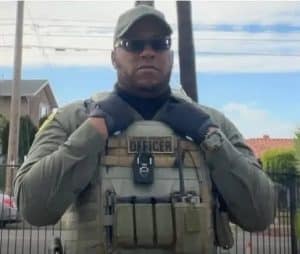
Amin Abdullah

Hours before the shooting, the suspects, Cain Clark and Caleb Vasquez, were already on the police radar after a woman reported that her suicidal son had run away from home with weapons. He and his collaborator made for and attacked the Islamic Center, which includes a school in a part of the city with a strong Muslim presence. The police arrived four minutes after the shooting began, but by then five people had been killed.

Among them was a security guard, Amin Abdullah, who lost his life as he tried to intercept the assailants. After this father of eight was killed on the first day of Dhul-Hijjah 1447, Muslims widely shared his fitting last post on the social media outlet Facebook, which is worth reproducing:

“What is success? To many people success is financial stability, good reputation, beauty, etc. As for ME! Wallahi, thumma Wallahi. It is returning back to Allah OUR creator with the same pure soul he loaned me at birth. Having the Mala’ikah of Allahu Ta’ala saying “don’t fear and don’t grieve, but receive the glad tidings of Jannah which you were promised by the Most forgiving and the most merciful”. May Allahu ta’ala grant us Husnal Khatimah, AAAMEEEN”
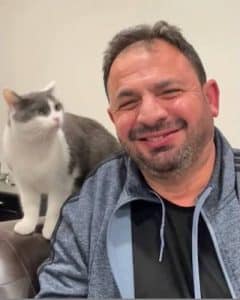
Nadir Awad

“It is fair to say his actions were heroic,” said San Diego police chief Scott Wahl of Abdullah’s last moments. “Undoubtedly he saved lives today.”

Preacher Uthman Farooq, who knows the family, said that Abdullah “wanted to defend the innocent so he decided to become a security guard.”

The Islamic Center hailed Abdullah as “a courageous man who put himself on the line of the safety of others, who even in his last moments did not stop protecting our community.”

The other casualties, Nadir Awad and Mansoor Kaziha, were also saluted for their courage by members of the community. Asim Billoo described Kaziha, also known as Abul-Ez, as “the caretaker of our community” in a public salute: “When danger arrived at our school, he did not hesitate. He shielded our children from the shooters, placing his life between them and harm. He lived his life serving us, and he left this world protecting our future.”
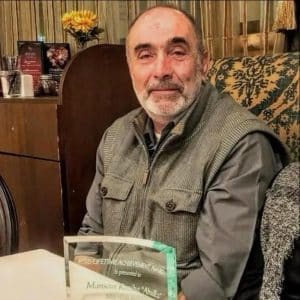
Mansour Kaziha (Abu’l Izz)

Of Awad, Billoo added, “Uncle Nadir lived his life as a devoted neighbor to the house of Allah, and today, he proved the depth of that devotion. Hearing the danger, he ran from the safety of his own home toward the masjid, rushing to apprehend the murderers and save the children. We pray Allah grants him the highest rank as a neighbor of Allah ﷻ in Jannah.”

The efforts of these martyrs saved the lives of other worshippers, many of whom were children. Witnesses testified to the terror of the encounter, where Awad’s wife and the husband of the kindergarten teacher also rushed to protect the children. Teacher Iman Khatib-Villarreal paid tribute to the “real men” who sacrificed their lives to protect others, and saluted “the best start to every morning…Brother Amin Abdullah, the truthful servant of Allah as his name translates.”

Costs of Islamophobia

“We are considering this a hate crime until it’s not,” said Wahl. This was based at least in part on the incendiary rhetoric found in the killers’ car, which mentioned “racial pride”, dealt in anti-Islamic rhetoric, and glorified Brendan Tarrant, the Australian mass murderer who massacred 51 Muslims at a New Zealand mosque in 2019: a particularly savage reminder of the consequences of Islamophobic rhetoric that has only spiralled in the mid-2010s.

Mosque director and imam Taha Hassane said, “It is extremely outrageous to target a place of worship. Our Islamic centre is a place of worship.”

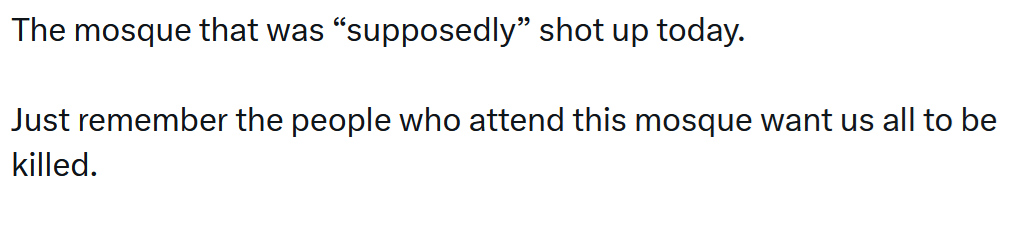
There has been a surge in anti-Muslim rhetoric in recent years, much of it driven by pro-Israel agitators such as Laura Loomer, a far-right propagandist who has the ear of Donald Trump. In the aftermath of the attack, Loomer shared a 2023 social media post by Hassane’s wife, which condemned Israel’s genocide of Palestinians, casting doubt on both the very real murders at San Diego and vilifying the congregation with what came dangerously close to incitement:
For his part Trump, who has not hesitated to join in anti-Muslim rhetoric when it suits him, particularly against such communities as Somali-Americans, feebly described the attack as “a terrible situation”.

While San Diego mayor Todd Gloria condemned the attack and expressed sympathy with the city’s Muslim community, an unnamed protester was unconvinced. “Our Muslim brothers and sisters have been talking to you for how long?” she demanded, accusing him of emboldening “Zionist propaganda” and would “keep doing it as long as it lines your ****ing pockets, won’t it. Do something!” It is worth noting that much of the anti-Muslim rhetoric in the United States, as in Europe, has been systematically pushed by pro-Israel networks as well as by organs of the Israeli state.

Tazheen Nizam, the San Diego head for advocacy group Council of American-Islamic Relations, sent condolences to the community, saying, “No one should ever fear for their safety while attending prayers or studying at an elementary school.”

Politicians and elected officials condemned the attack. San Diego congresswoman Sara Jacobs wrote, “I’m devastated for those students, worshippers, and the Clairemont community. Everyone should be able to pray, worship, and learn in peace.”

California governor Gavin Newsom also sent condolences: “California sends our deepest condolences to the families and communities impacted by today’s shooting. Worshippers anywhere should not have to fear for their lives…To the San Diego Muslim community: California stands with you.”

Reactions have come from beyond California: Maryland governor Wes Moore wrote, “Islamophobia has no home in Maryland and we stand with our communities in their time of uncertainty and concern.”

New York City mayor Zohran Mamdani, perhaps the most visible Muslim American politician of recent years, promised to beef up reinforce security for mosques in his city, adding, “Islamophobia endangers Muslim communities across this country. We must confront it directly and stand together against the politics of fear and division.” Mamdani’s successful election campaign in 2025 had withstood a barrage of particularly pointed, vitriolic anti-Muslim rhetoric that has yet to entirely ebb.

Like other episodes of anti-Muslim violence that have spiralled in recent years, the attack in San Diego demonstrated the extreme endpoint of such rhetoric.

The post Deadly Attack at San Diego Mosque Sends Shockwaves appeared first on MuslimMatters.org.

The APA Gave Him A Human Rights Award. Then They Cut His Microphone For Talking About Gaza.

Muslim Matters - 21 May, 2026 - 18:06

Dr. Mansoor Malik is a professor of psychiatry at John Hopkins. For most of his career, his work has been what you’d expect from a clinician-educator at a major academic medical center: healthcare worker wellbeing, peer support programs, minority physician mentorship, geriatric psychiatry. He helped build the RISE program at Hopkins, a peer support model for clinicians in distress. He trained residents. He published on burnout and resilience. He served as president of the Washington Psychiatric Society.

Then Gaza happened, and Dr. Malik turned his scholarly attention to a question the profession was not ready for: what happens to the people who watch? The clinicians, the observers, the professionals in institutions that issue statements about human rights, while looking away from the largest assault on a healthcare system in modern memory. He started writing about moral injury, the guilt and shame that come from witnessing atrocities your institution refuses to name, and about what he describes as moral invalidation: the mechanism by which institutions deny suffering not by disputing its existence but by deciding that naming it is more dangerous than the suffering itself.

He did not keep this work quiet. In December 2024, he co-authored a piece in Mondoweiss with two other psychiatrists, Dr. Ravi Chandra and Dr. Gary Belkin, arguing that major U.S. medical organizations had failed their ethical obligations on Gaza. That despite overwhelming documentation of medical war crimes and findings of plausible genocide from the ICJ and Amnesty International, the profession had chosen silence. In a 2025 follow-up, he went further and named the institution directly: “The silence of the APA over the Gaza genocide is unacceptable.”

The APA, the American Psychiatric Association, read all of this. A body that publishes the DSM and sets the professional standard for every psychiatrist in America. They read all of it, and it did not come as a surprise.

They had expended considerable effort in blocking his work. He and his co-authors described it themselves in the December 2024 Mondoweiss piece: their efforts to establish a peace caucus within the APA were shut down by leadership. Proposals to include seminars about Islamophobia, the Gaza genocide, or even interfaith peace promotion at the APA Annual Meeting were rejected. Any attempt to highlight civilian suffering in Gaza, they wrote, was labeled “pro-Hamas” or “supporting terror.” The door was closed, repeatedly.

And then, a door seemed to open. About a year and a half after the publication of that article, the APA awarded him their Chester Pierce Human Rights Award.

The Chester Pierce Award is an endowed lectureship named after the Black Harvard psychiatrist who coined the term microaggressions, the idea that small, repeated acts of psychological hostility accumulate into measurable harm. The award was established in 1990 to honor individuals who bring attention to human rights abuses affecting populations with mental health needs. It was renamed for Pierce in 2017 and endowed in 2021. It comes with a lectureship at the APA Annual Meeting, a travel stipend, and a plaque. It is not a casual recognition.

The APA gave this award to a man who had publicly called their silence on Gaza unacceptable. Whatever internal calculus led to the decision, the result was that an organization that had blocked Dr. Malik’s Gaza advocacy for years chose to honor him with an award named after the psychiatrist who built his career confronting institutional racism.

Dr. Malik titled his lecture “From Microaggression to Mass Violence: Psychological Autopsy of the Gaza Genocide.” The word genocide was in the title from the beginning. When the APA approved the lecture, when they scheduled it, when they published the abstract, when they listed it on the conference app, the word was right there, in the title they signed off on.

He planned to take Chester Pierce’s original insight and extend it to the institutional scale. Not just individual microaggressions, the macro version. The institutional denial of suffering. The systems-level refusal to name what is happening. The question his lecture asked was: what happens when a profession built to recognize psychological damage learns to look away from the largest concentration of psychological damage on earth?

Incoming APA President-Elect Rahn Bailey endorsed Dr. Malik’s nomination in writing, stating that his work “perfectly embodies the spirit of Dr. Chester Pierce’s legacy.”

The APA knew what Dr. Malik was going to say. They knew because he had been saying it publicly for over a year. They gave him the award anyway. And then they published his words on their own website. In December, his column. In April, their profile of him.

In December 2025, Psychiatric News, the APA’s online publication, ran a full Viewpoints column by Dr. Malik titled “Should Moral Injury Become a New Psychiatric Diagnosis?” It was not a cautious piece. He wrote about Gaza in terms no reader could misunderstand:

“Physicians amputating without anesthesia, aid workers blocked from delivering food, and soldiers confessing feelings of guilt of being complicit in the murder of children.”

The APA published the phrase “murder of children” on its own website, under Dr. Malik’s byline, with editorial review, and distributed it to 38,000 members.

He went further. He argued that psychiatry has a moral obligation not just to treat the wounded but to confront the structures that wound them. “Silence in the face of atrocities and injustice compounds the injury,” he wrote, “for both victims and clinicians.”

The APA published that sentence on their own website, under their own masthead.

Then, in April 2026, one month before the conference, Psychiatric News ran a second piece, a feature interview announcing Dr. Malik as the Chester Pierce Award recipient. He told the reporter exactly what he planned to say in his lecture, naming Palestinians explicitly.

Two published pieces on the APA’s own website. Six months apart. Both explicitly about Gaza, moral injury, and the psychiatric profession’s obligation to name suffering rather than look away. Both editorially reviewed, approved, and distributed to the entire membership.

And then.

***

Fifteen minutes before the session. Fifteen. APA staff started deleting. The abstract: gone. The co-presenters, Austina Cho and Ravi Chandra: erased from the program, their names removed without notification. The slide deck: access stripped. The session title: changed. Where the conference app had read “Chester Pierce Human Rights Award: From Microaggression to Mass Violence: Psychological Autopsy of the Gaza Genocide,” it now read only “Chester Pierce Human Rights Award.” The content scooped out. The shell left standing.

Fifteen minutes. That’s how long it took the largest psychiatric organization in America to gut its own award lecture. Fifteen minutes to undo months of vetting, approval, publication, and promotion.

An APA board member walked into Room 314 at the Moscone Convention Center in San Francisco and told the audience the lecture was being “postponed” for “safety concerns.”

The room was packed. Standing room only. Psychiatrists who had flown in from across the country and around the world to be there. They did not leave.

Dr. Malik did not leave.

The APA said he would still receive the award. But that he could not deliver the lecture the award was supposed to honor.

He refused to step down. The audience refused to disperse. So the APA cut the microphones.

The American Psychiatric Association, at its own annual conference, cut the microphone of its own human rights award recipient, in a room full of its own members, because he was going to talk about Gaza. The same Gaza that appeared in his column on their website in December. The same Gaza that they quoted him discussing in their own profile of him in April.

What happened next was not the lecture (it couldn’t be, without amplification or slides) but an open mic session where audience members stood up, one after another, and spoke. A former APA president described the backlash she faced when she invited Desmond Tutu to address the organization in 2011. Dr. Malik’s own supervisor from Johns Hopkins described being threatened with the loss of his research funding in the early 2000s for using the phrase “occupied territory.” Multiple psychiatrists, of all religions and backgrounds, stood up and called for APA board resignations. One attendee wrote in the conference app’s comment section: “This was by far the best session I’ve been to all week and the speaker didn’t even get to speak.”

***

Psychiatrists who wrote to APA leadership about what happened in Room 314 discovered the censorship had a second layer.

Their emails were blocked.

Not bounced. Not sent to spam. Blocked at the server level. The APA’s email system rejected the messages before they reached anyone.

Psychiatrists tried from multiple email addresses. Blocked. They compared notes. The pattern became clear: any email containing Dr. Malik’s name or the lecture title was being filtered out. The APA had configured its own email infrastructure to reject communications about its own award recipient.

The APA censored a lecture about Gaza. Then, when psychiatrists tried to write to the APA about the censorship, the APA censored the complaints about the censorship. Two layers of silencing. The lecture, and then the response to the lecture.

Some resorted to character substitutions. M@ns00r Mal1k. Ch3ster Pi3rce. Palest1nians. Board-certified psychiatrists deliberately misspelling a colleague’s name like teenagers dodging a content filter on a gaming platform, because the largest professional organization in their field had decided that his name was a keyword to be blocked.

When the character substitutions proved unreliable, at least one psychiatrist faxed the letter. In 2026. Faxed it. Because the American Psychiatric Association had made it impossible to email them about their own human rights award.

This is not an isolated incident. Springer published a chapter by Palestinian psychiatrist Samah Jabr in an Islamophobia textbook, a chapter the editors called “a rare but needed Palestinian perspective,” then retracted it.

The pattern is the same every time. The content clears the institution’s own review process. It gets approved. And then the pressure arrives. Not before the review, when it might be mistaken for legitimate peer critique, but after, when the only purpose it can serve is suppression. The content is never engaged on its merits. The goal is to make the institutional cost of keeping it higher than the cost of pulling it.

The APA decided, fifteen minutes before Dr. Malik’s lecture, that the cost of pulling it was lower. That calculation only works if no one responds. If the suppression is quiet, the institution pays nothing. If it is loud, the equation changes.

Dr. Malik’s work, the recent work, the work that earned him this award, centers on a single observation: that institutions do not deny suffering by saying suffering does not exist. They deny it by deciding that naming it is more dangerous than the suffering itself. They do not say “we disagree with your findings.” They say, “your findings cannot be spoken here.” The suffering becomes unspeakable not because it is contested but because it is inconvenient.

Dr. Malik didn’t need the microphone. The APA made his argument for him.

***

Dr. Malik is delivering the lecture that the APA suppressed. On Sunday, May 25, he will present “From Microaggression to Mass Violence: Psychological Autopsy of the Gaza Genocide” at a webinar hosted by Doctors Against Genocide. No APA approval required. No microphone to cut. No email filter to hide behind.

If you are a psychiatrist, a physician, a mental health professional, a Muslim who has ever watched an institution smile at you while it erased you: attend. Share the link. Send it to every colleague who still believes that following the rules protects you.

Dr. Malik followed every rule. He earned the endorsement of the APA’s own incoming president. He published his plans on the APA’s own website, not once, but twice. He told the APA directly, in public, that their silence on Gaza was unacceptable. They gave him an award for it. And fifteen minutes before he could speak, they deleted his words from their website, removed his colleagues from the program, and cut his microphone.

The rules were never meant to protect him. They were meant to make the silencing look procedural.

Register here: https://doctorsagainstgenocide.org/events


The post The APA Gave Him A Human Rights Award. Then They Cut His Microphone For Talking About Gaza. appeared first on MuslimMatters.org.

Pages